How Mood Impacts Spending Habits
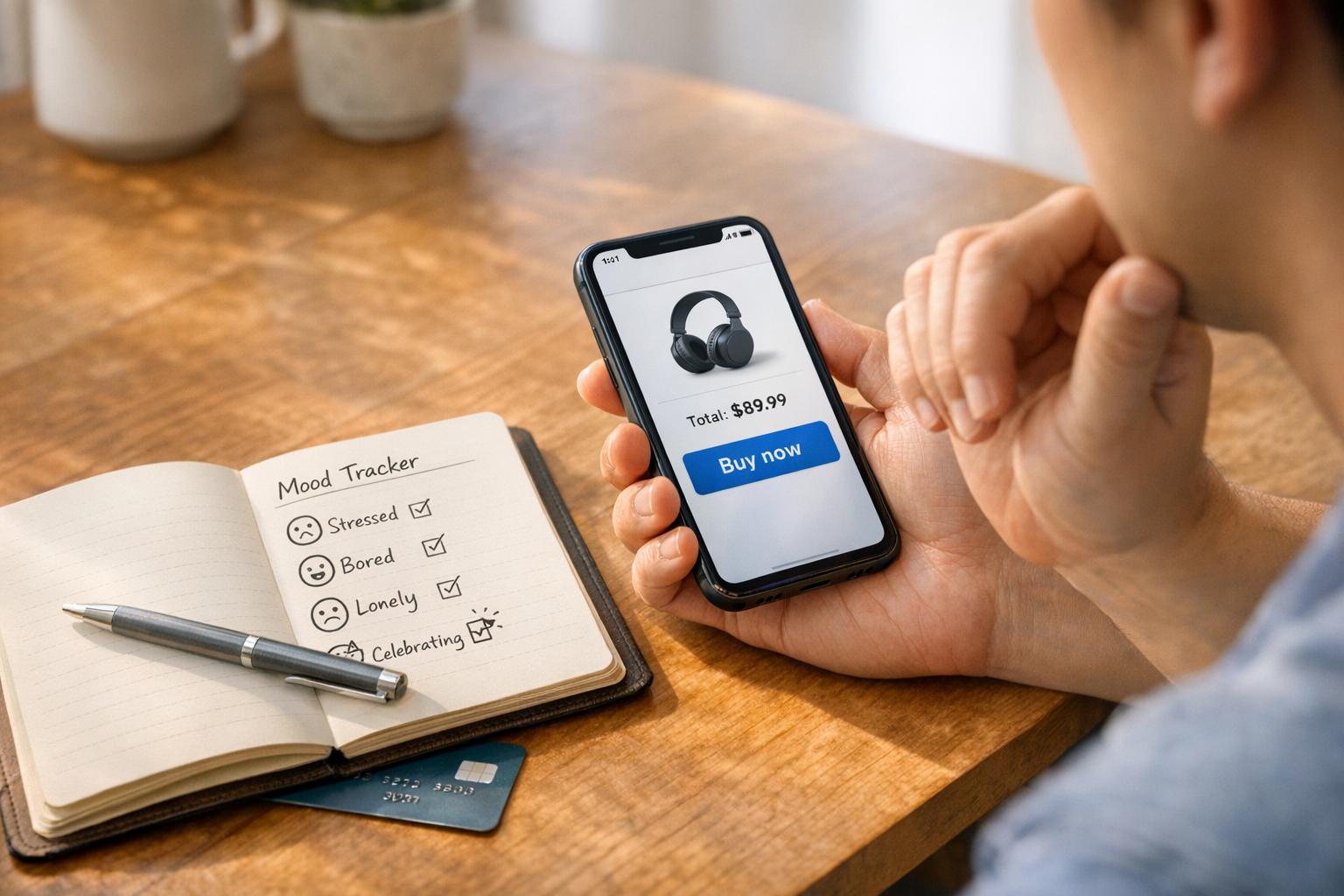
When you’re stressed, bored, or even celebrating, your emotions can drive spending decisions. Emotional spending often leads to impulse buys, with Americans averaging $5,400 annually on unplanned purchases. This behavior is fueled by dopamine, the brain’s “feel-good” chemical, offering temporary relief but often resulting in financial regret.
Key Takeaways:
- Emotional Triggers: Stress, boredom, sadness, and even happiness can lead to unnecessary spending.
- Impulse Spending Stats: 84% of consumers admit to impulse purchases, with 49% spending more when stressed.
- Tracking Helps: Identifying emotional triggers and using an impulse spending calculator can break the cycle.
- Practical Tips: Wait 24 hours before purchases, set spending limits, and use tools like ImpulseLog to manage habits.
Understanding how emotions influence financial choices can help you take control of your spending and improve your overall financial well-being.
ADHD and Emotional Spending ≠ Self-Control Issue
sbb-itb-1fa9254
How Mood Affects Your Spending Decisions
How Different Emotions Trigger Specific Spending Behaviors
Your mood plays a big role in how and why you spend money. When you're feeling down, stressed, or even bored, your brain often turns to spending as a quick fix. Why? Because making a purchase triggers a release of dopamine, a chemical that makes you feel good temporarily. This "feel-good" moment can help ease negative emotions in the short term, but it often leads to overspending. That initial rush can quickly turn into buyer's remorse and even financial strain [7][4][12].
This cycle becomes a habit. Your brain starts associating spending with feeling better, so the next time you're feeling low, it craves that same dopamine hit [6][8]. One way to break this pattern? Try tracking your spending or waiting 48 hours before making a purchase. This gives your logical side time to take over, reducing impulse buys by nearly 60% [12]. But here's the kicker: retailers know how to exploit this dopamine-driven behavior, especially online.
Dopamine and the Reward Response
Online stores are experts at triggering your brain's reward system. Features like bright "buy now" buttons, limited-time offers, and free-shipping alerts are designed to make it harder to resist [12].
Your emotional state also impacts how much you're willing to spend. For example, feeling anxious or stressed can make you value an item 10% to 30% more than you normally would [12]. That’s why a $50 splurge might seem reasonable after a tough day, even though you'd hesitate to buy the same thing when you're calm. On average, Americans spend $5,400 a year on impulse purchases, much of it driven by this dopamine-seeking behavior [6]. And different emotions lead to different types of spending.
How Feelings Drive Impulse Purchases
Your emotions don’t just influence when you spend - they also shape what you buy. For instance, stress often leads to "relief spending." This might mean ordering takeout instead of cooking or treating yourself to a small "reward" after a hard day [10][9]. Sadness, on the other hand, drives "retail therapy", where buying something comforting - like a cozy sweater or skincare - helps lift your mood [11][4].
Boredom is another big trigger. When you're bored, your brain craves excitement, and shopping provides that thrill. This is why 70% of impulse purchases happen on phones, often late at night when boredom strikes [11]. Even positive emotions can lead to spending. Celebratory purchases - like splurging on a fancy dinner or a new outfit - are part of the same dopamine loop, just starting from a happier place [9][10].
"We often spend when we're happy, to celebrate a recent win or to reward ourselves, but we also spend when we're sad to get a boost of dopamine to help us feel better in the moment." - Marsha Barnes, Certified Financial Social Worker and Founder, The Finance Bar [11]
Common Mood Triggers and What They Make You Buy
Your mood doesn’t just drive the decision to shop - it also influences what ends up in your cart. Stress pushes you toward comfort buys, like takeout or small indulgences that promise relaxation [9][4]. Boredom often leads to late-night scrolling and purchases of gadgets or novelty items for quick entertainment [11][2]. Sadness inspires "self-care" shopping, with items like cozy clothes or skincare products [11][4].
Celebrations, on the other hand, encourage splurging on luxury goods or social spending, like buying drinks for friends [9][2]. Feeling lonely? Online shopping offers the anticipation of a delivery, which can feel like a connection [2]. Social comparison, fueled by seeing others' curated lives on social media, often drives purchases of trendy clothing or status symbols to "keep up" [1][2]. In fact, up to 84% of consumers admit to making impulse purchases, most of which are tied to emotional states rather than actual needs [2].
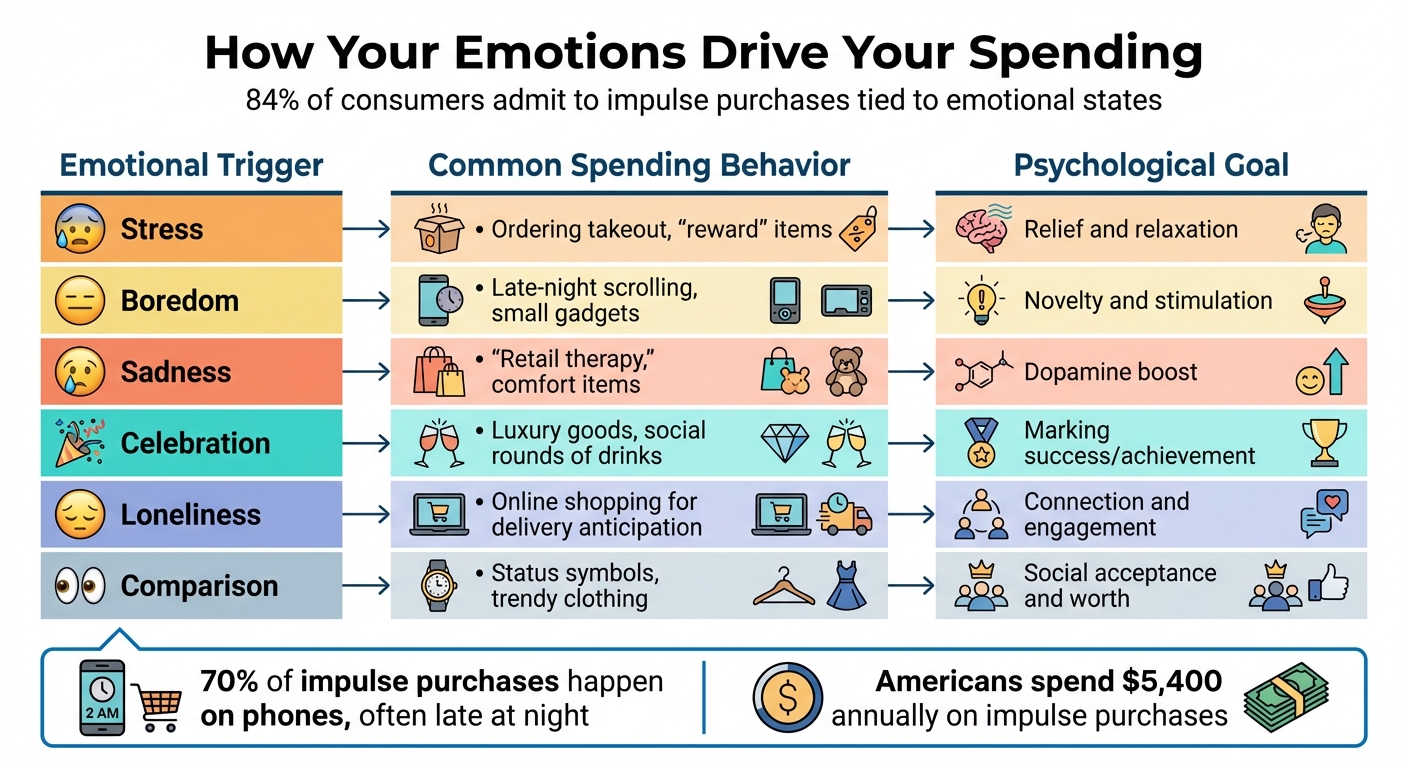
Here's a quick breakdown of how your emotions influence your spending habits:
| Emotional Trigger | Common Spending Behavior | Psychological Goal |
|---|---|---|
| Stress | Ordering takeout, "reward" items | Relief and relaxation [9][4] |
| Boredom | Late-night scrolling, small gadgets | Novelty and stimulation [11][2] |
| Sadness | "Retail therapy", comfort items | Dopamine boost [11][4] |
| Celebration | Luxury goods, social rounds of drinks | Marking success/achievement [9][2] |
| Loneliness | Online shopping for delivery anticipation | Connection and engagement [2] |
| Comparison | Status symbols, trendy clothing | Social acceptance and worth [1][2] |
How to Identify and Track Emotional Spending
Spotting Your Emotional Spending Triggers
Managing emotional spending starts with figuring out what sets it off. These triggers - whether internal emotions or external cues - often lead to shopping as a way to cope or feel better [2]. Start by reviewing your spending history. Go through your bank statements from the last 3–6 months and compare unplanned purchases with your calendar. For instance, did that $75 online shopping spree happen right after a stressful meeting? Or maybe you splurged on takeout after a lonely weekend [13]?
As you dig into your habits, patterns will start to emerge. Stress might lead to treating yourself after a tough day, while boredom often results in late-night scrolling that ends with a checkout. Loneliness could push you to shop as a way to feel connected, and scrolling through Instagram might stir up social comparison, tempting you to buy trendy items you don’t need [2][3][14]. Even happy moments, like celebrating a success, can trigger overspending [2]. Research shows that 39% of Americans identify as emotional spenders, with the numbers rising to 52% for Millennials and 58% for Gen Z [13].
"Emotional spending rarely starts with a number. It starts with a feeling." - My Financially Flexible Life [2]
Once you’ve identified these triggers, you can start turning insights into actionable steps.
Using Charts and Graphs to Track Spending Patterns
After spotting your triggers, visual tools can help you better understand your spending habits. Charts and graphs make it easier to see patterns in your behavior. A simple way to start is by adding a mood emoji to the memo line of every transaction in your budgeting app. Over time, this creates a visual record that ties specific emotions to your spending [5].
For a more detailed approach, consider mood-transaction logging. Rate your mood on a scale from 1 to 10 and note what triggered the purchase - like an ad, a notification, or a particular feeling - within an hour of the transaction [12]. Set aside 20 minutes each Sunday to review your spending categories and mark transactions influenced by emotions. This weekly habit helps you identify recurring patterns and make adjustments [12]. Using these visual tools, you can clearly see how emotions influence your financial decisions.
How ImpulseLog Tracks Emotional Spending
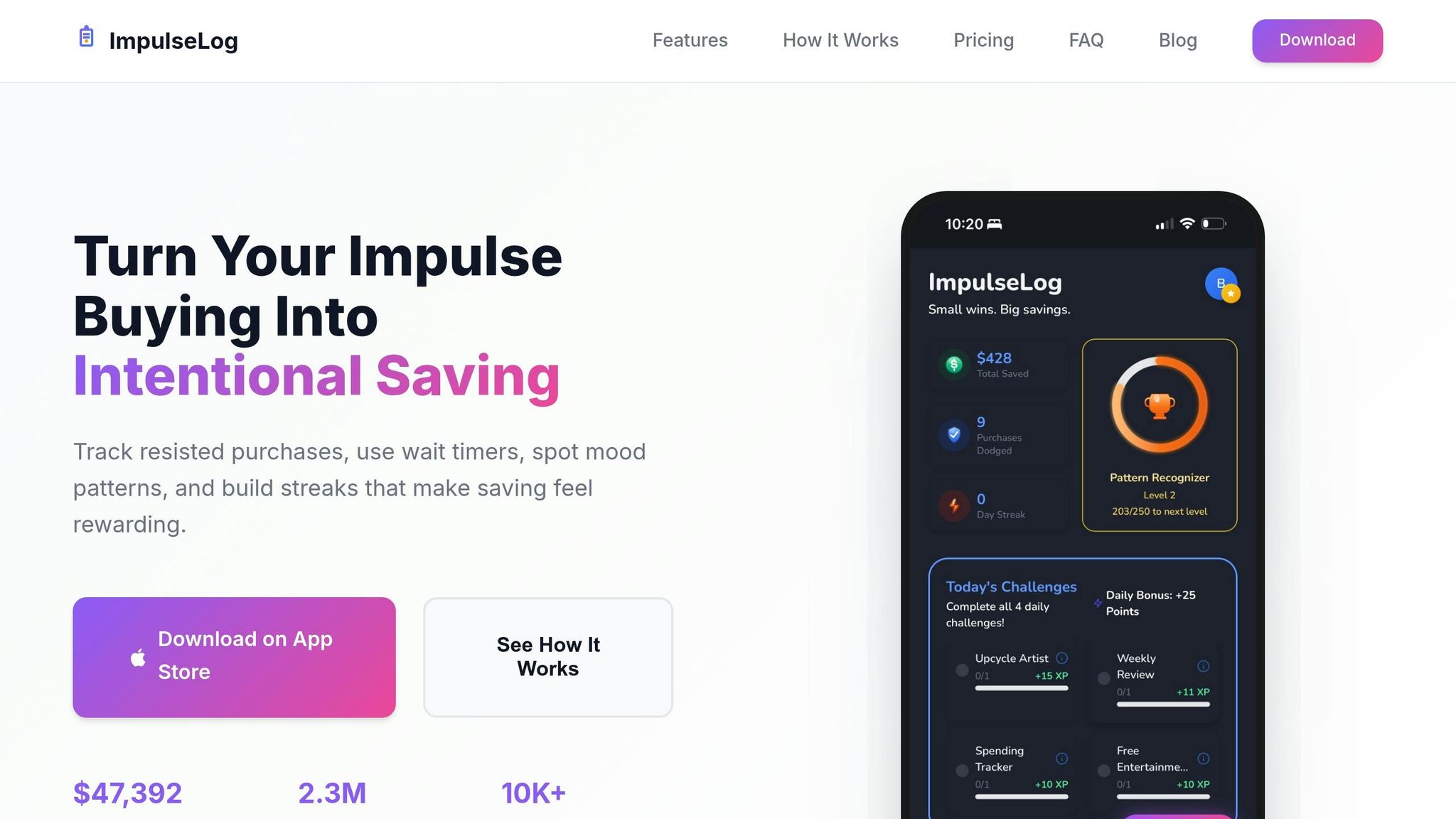
ImpulseLog takes tracking a step further by combining real-time logging with AI-driven insights. The app is particularly useful for neurodivergent individuals, such as those with ADHD, who may struggle with impulse control. It encourages users to log their spending urges within 60 minutes, capturing their emotional state while it’s still fresh [15][12]. Its AI engine (upgraded to gpt-5-mini as of February 2026) analyzes the relationship between your mood, sub-mood, and spending or saving habits, uncovering patterns that might otherwise go unnoticed [15][16].
The app’s Impulse Ledger uses color-coding to make tracking easy: green represents resisted impulses (money saved), while orange marks completed purchases (money spent) [16]. A "Spending vs. Resistance" chart gives you a visual snapshot of your progress, showing how often you’ve successfully resisted the urge to spend [16]. To help curb impulsive decisions, the app includes built-in wait timers, such as a 24-hour delay, creating a pause between the urge to buy and the actual purchase [16]. With a quick 20-second daily check-in, you can log your mood and review pending decisions, building a habit of self-awareness [16]. The gamified features - like earning XP, unlocking achievements, and maintaining streaks - make tracking emotional spending feel more engaging and less like a chore [15][16].
How to Manage Emotional Spending
Wait 24 Hours Before Buying
One of the easiest ways to keep emotional spending in check is to pause before making a purchase. Waiting just 24 hours gives your emotions time to settle, allowing you to think more clearly and separate impulsive wants from genuine needs. Studies suggest this simple tactic can cut down impulse buys by 60% to 70% [20].
Set a spending threshold - say $25, $30, or $50 - for purchases that require this waiting period [18]. Another helpful trick is to add items to a wishlist or "maybe later" list, which satisfies the urge to shop without actually spending money [17]. Interestingly, most online impulse buys happen between 8 p.m. and midnight when your willpower is at its weakest [20].
After taking that pause, the next step is to establish clear spending limits to keep your finances on track.
Create Spending Limits and Stick to Them
Set up a monthly budget specifically for impulse buys, often called a "Joy Fund." This lets you spend guilt-free within a set amount, such as 2% to 5% of your monthly income [20][12]. Once you’ve used up this fund, it’s a clear signal to hold off on any more impulsive purchases for the month [13].
To help you decide whether to make a purchase, try using the TAPER checklist:
- Timing: Have you wanted this for a while?
- Affordability: Can you afford it without using credit?
- Purpose: Is it something you truly need?
- Emotional state: Are you bored, stressed, or upset?
- Regret potential: Will you regret this later? [19]
This framework helps you weigh an impulse buy against your overall financial priorities [13].
In addition to budgeting, reducing external temptations can make it easier to stick to your plan.
Remove Common Spending Triggers
Retailers use clever marketing tactics to nudge you into spending. For instance, push notifications can boost immediate clicks by 30% to 45% [12]. To resist these temptations, make shopping less convenient: remove saved credit card details, delete shopping apps, and unsubscribe from promotional emails and notifications [12][19].
Switching to cash for discretionary spending, like dining out or entertainment, can also help. Physically handing over cash makes the expense feel more real compared to digital payments [18][19]. Another idea is to limit non-essential purchases to specific days of the week, like Tuesdays and Saturdays, which can curb the habit of daily browsing [5]. By minimizing distractions, you’ll find it easier to stick to both your waiting period and budget.
Use Your Tracking Data to Improve Habits
Tracking your spending can reveal emotional triggers and help you develop better habits. Reviewing your transactions weekly - spending about 20 minutes on Sundays - can highlight purchases driven by emotion and uncover patterns you might not notice otherwise [12]. This awareness alone can reduce impulse spending by 20% to 30% [20].
Tools like ImpulseLog take this a step further, using AI to analyze how your mood affects your spending. It also provides visual feedback to celebrate moments when you resisted the urge to shop. Following a cooling-off rule has been shown to reduce discretionary spending by 12% to 20% [12]. And when the shopping urge strikes, try replacing it with no-cost activities like a 20-minute walk or calling a friend - these alternatives can cut shopping cravings by 25% to 40% [12].
Conclusion: Understanding Your Emotions Improves Your Finances
As highlighted earlier, understanding your emotions plays a major role in making better financial choices. In fact, emotions influence 90% of your financial decisions [21]. When stress, boredom, or loneliness drives your purchases, it’s often a sign of deeper needs that require attention - not just another quick fix through spending.
Learning to pause before acting on these emotions can make a big difference. Financial therapist Nathan Astle puts it well:
"Sustainable change happens one small step at a time. Taking time to pause, reflect, and choose differently is the first step on the journey to a more positive and holistic relationship with money." [21]
Tools like ImpulseLog can help bridge the gap between emotions and spending. Instead of looking back at your transactions weeks later and wondering why you spent money, this app helps you log impulses in the moment. By tracking your emotions and spotting patterns, you gain real-time insights. Plus, with gamified features, it replaces the instant gratification of hitting “Buy Now” with the rewarding feeling of earning XP for resisting an impulse. Visualizing these mood-spending connections can turn emotional triggers into actionable strategies.
Start small and build from there. This week, try focusing on one trigger - maybe unsubscribe from promotional emails or set a $30 limit before making any purchase. Even small efforts can make a difference; studies show that simply increasing awareness can cut impulse spending by 20% to 30% [20]. Progress takes time, but each step brings you closer to a healthier relationship with your money.
FAQs
How can I tell if a purchase was emotional or truly needed?
To figure out if your purchase was emotionally driven, reflect on the reason behind it. Did you buy it impulsively to manage feelings like stress, boredom, or sadness? Or was it a planned and necessary expense? Emotional spending often happens on a whim, influenced by how you feel at the moment, rather than an actual need.
What should I do instead of shopping when I’m stressed or bored?
When you feel stressed or bored, shopping might seem like a quick fix, but there are better ways to handle those emotions. Try connecting with friends or family, practicing mindfulness, or exploring relaxation techniques. You could also dive into hobbies that genuinely make you happy. These options not only help you manage your feelings but also save you from the financial stress that often comes with impulsive shopping.
How can ImpulseLog help me spot mood-based spending patterns?
ImpulseLog offers a way to uncover the connection between your emotions and spending habits. By letting you log your mood alongside impulse purchases, it helps you recognize patterns tied to feelings like stress or boredom. With visual progress tracking and AI-driven mood insights, you can gain a clearer understanding of these emotional triggers, making it easier to take control of your spending behavior.