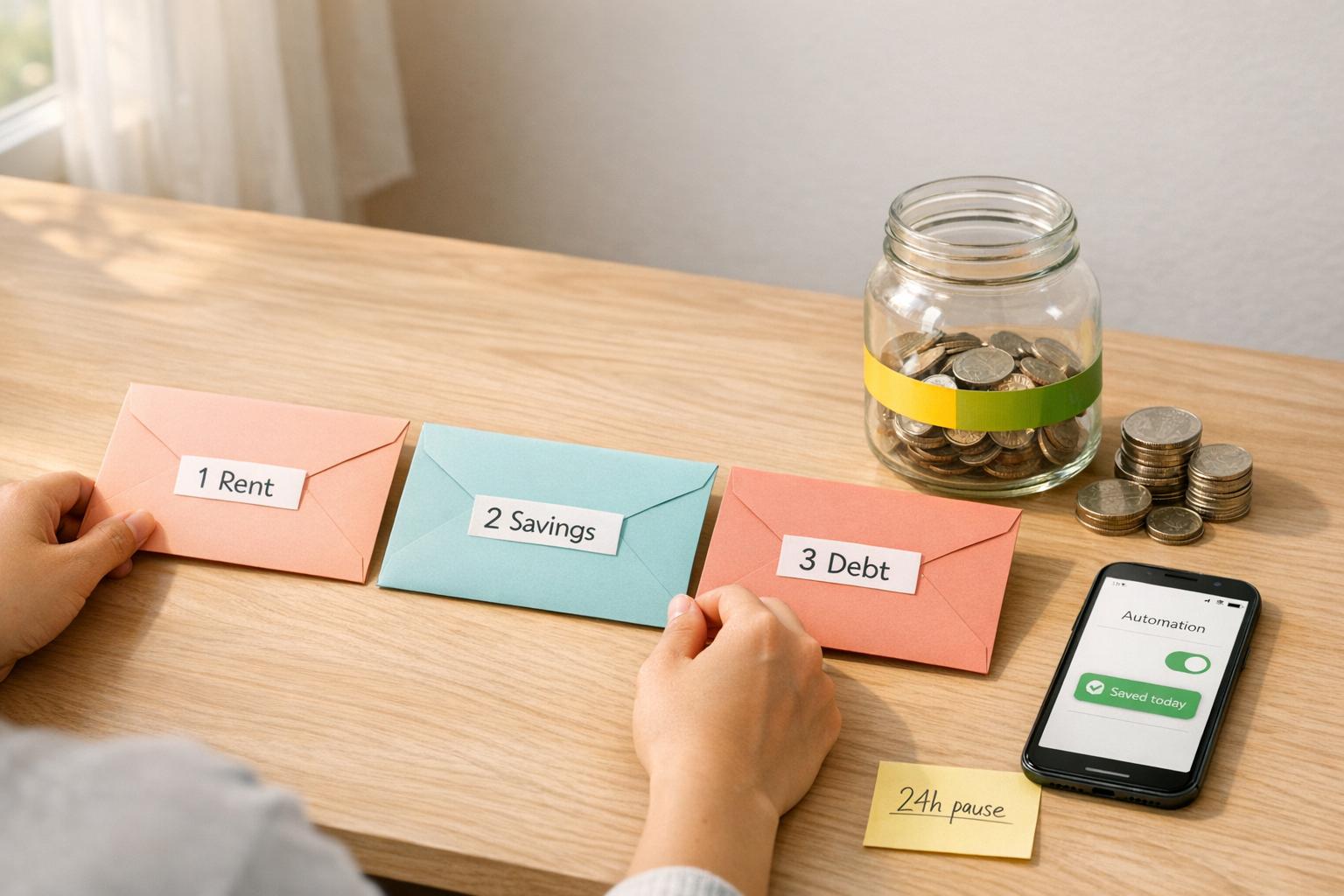
Ultimate Guide to ADHD Financial Prioritization
Managing money with ADHD is tough, but it’s possible with the right strategies. ADHD affects impulse control, time management, and decision-making, leading to challenges like the "ADHD tax" (e.g., late fees, impulse buys). The good news? Simple systems can help you stay on track and build financial stability. Here’s what works:
- ADHD-Friendly Budgets: Use methods like the 3-Bucket System, Envelope Method, or Multiple Bank Accounts to simplify budgeting.
- Curb Impulse Spending: Introduce waiting periods, use cash for purchases, and set up visual goals to make future rewards feel real.
- Gamify Saving: Tools like ImpulseLog reward you for resisting impulse buys, turning saving into a fun, dopamine-boosting challenge.
- Automate Finances: Automate bill payments and savings to avoid missed deadlines and reduce decision fatigue.
- Focus on Goals: Break long-term goals into smaller, actionable steps and track progress visually to stay motivated.
These approaches don’t require perfection - they’re designed to work with how your brain naturally operates. Start small, automate where you can, and celebrate progress along the way.
ADHD Money Management Tips That ACTUALLY Work
sbb-itb-1fa9254
Creating an ADHD-Friendly Budget
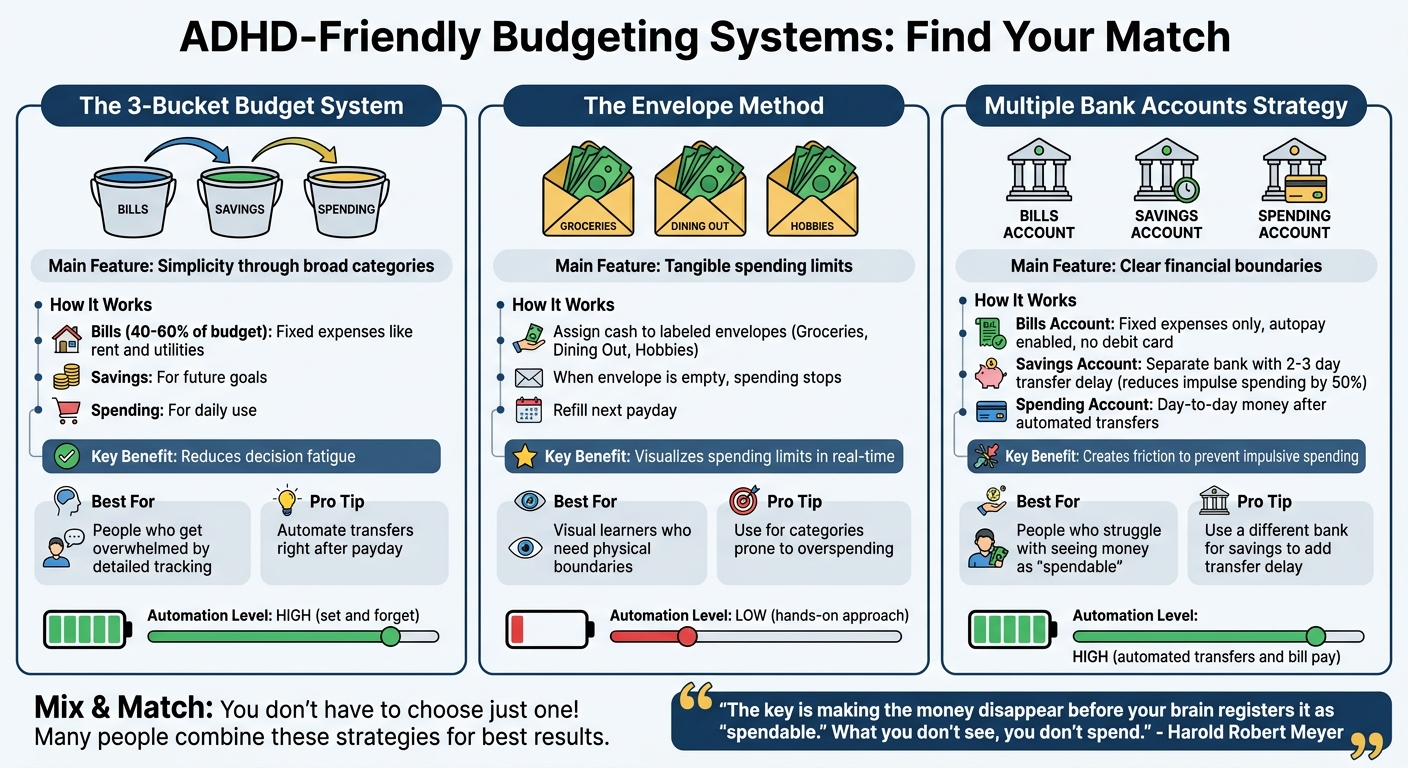
ADHD-Friendly Budgeting Systems Comparison Guide
Traditional budgeting often requires constant focus and meticulous tracking - two things that can feel nearly impossible for someone with ADHD. Instead of forcing yourself into systems that don't align with how your brain works, the key is to adopt a method that complements your natural tendencies.
"Traditional budgeting fails spectacularly for ADHD brains because it demands sustained attention, detailed tracking, and fights against how your brain naturally works." – Harold Robert Meyer, Founder, The A.D.D. Resource Center [6]
The solution lies in simplicity. ADHD-friendly budgets rely on broad categories, automation, and visual tools to reduce mental strain. By cutting down on decision fatigue, these systems make it easier to stick to your financial goals. Here are three straightforward approaches designed with ADHD in mind.
The 3-Bucket Budget System
This method is all about keeping things simple. Divide your income into three main categories: Bills (fixed expenses like rent and utilities), Savings (for future goals), and Spending (for daily use). Forget the need for detailed subcategories - this system thrives on clarity.
Set up automatic transfers the day after payday to allocate money into each bucket. Typically, fixed costs make up 40–60% of the budget [4], with the rest split between savings and spending based on your priorities. Once your spending bucket runs out, you're done until the next payday - no overthinking required.
Automation ensures you don't rely on memory or willpower. The system handles the heavy lifting, leaving you free to focus on other things.
The Envelope Method
Also known as the "jam jar" method, this approach uses physical cash to manage spending. Assign specific amounts of cash to envelopes labeled for categories like Groceries, Dining Out, or Hobbies. Once an envelope is empty, spending in that category stops until it's refilled.
The physical act of using cash makes spending more tangible. Watching the money in an envelope shrink creates a direct connection between your purchases and your financial limits. This method is particularly helpful for curbing impulsive spending and staying in control.
Multiple Bank Accounts Strategy
Using separate bank accounts for different purposes creates clear boundaries and prevents accidental overspending. Here's how it works:
- A Bills Account at your primary bank is used exclusively for fixed expenses. Set up autopay for all bills here, but don't carry a debit card for this account [6].
- A Savings Account at a separate bank adds a layer of friction. The 2–3 day transfer delay can reduce impulsive spending by up to 50% [6].
- A Spending Account holds what's left after automated transfers. This is your day-to-day money, and when it's gone, you wait until your next paycheck.
"The key is making the money disappear before your brain registers it as 'spendable.' What you don't see, you don't spend." – Harold Robert Meyer, Founder, The A.D.D. Resource Center [6]
By automating transfers and separating funds, this strategy minimizes temptation and simplifies decision-making.
| System | ADHD-Friendly Benefit | Quick Tip |
|---|---|---|
| 3-Bucket System | Reduces decision fatigue | Automate transfers right after payday |
| Envelope Method | Visualizes spending limits | Use for areas prone to overspending |
| Multiple Accounts | Creates clear boundaries | Use a separate bank for savings to add friction |
You don't have to commit to just one method. Many people find combining these strategies works best. The key is to experiment and figure out which approach feels natural and helps you stay on track.
Managing Impulse Spending
For individuals with ADHD, impulse spending isn't about lacking self-control or financial smarts. Instead, it’s a performance deficit - you know what you should do, but your brain struggles to follow through in the moment [7]. The numbers paint a clear picture: roughly 65% of adults with ADHD frequently max out their credit cards, and over 60% don’t have a savings account [7]. The stakes are high, but there’s hope. By tweaking your environment, you can create barriers between the impulse and the purchase. These strategies use simple delays and visual reminders to help bridge the gap.
"Financial struggles in ADHD are not typically caused by a lack of knowledge... it is a performance deficit. This means you know what to do, but your brain struggles to do it in the moment." – Dr. Russell Barkley, Clinical Psychologist [7]
These methods are especially effective because they address time blindness - a common ADHD trait where future consequences feel distant and abstract compared to the immediate thrill of an impulsive buy.
The Waiting Period Method
One of the simplest ways to curb impulsive spending is by introducing a cooling-off period. For small purchases, wait 24 hours. For bigger ones, extend it to 72 hours. Instead of clicking "Buy Now", add the item to a wish list. This pause gives your brain time to process the decision and lets the initial dopamine rush subside [8][9].
You can also create extra steps - or "digital friction" - to slow down your spending. For example:
- Delete shopping apps from your phone.
- Unsubscribe from retailer emails.
- Remove saved credit cards from browsers.
- Place a "NO" sticker on your physical credit cards as a visual reminder before swiping [7][8].
For larger purchases, set up an accountability system. Text a trusted friend to explain why you’re considering the purchase. Having to distinguish between a need and a want can provide a helpful checkpoint and prevent regret later [8][9].
Future-Focused Spending
ADHD brains often struggle to connect with long-term outcomes, but making future goals visually tangible can help. For example, set a picture of your financial goal - like a dream vacation, a new home, or a growing savings account - as your phone lock screen. This simple trick keeps “future you” front and center [8].
When faced with a spending decision, ask yourself: "Does this help me move closer to my financial goals or further away?" [7]. Writing a short “stability note” about how financial security feels - calm, stress-free, and in control - can also make the abstract future feel more concrete. Read it whenever you’re tempted to spend impulsively.
Tracking progress visually can be another game-changer. Use savings charts that you can physically fill in. Watching your balance grow can deliver a dopamine boost similar to the thrill of a checkout page [1].
"The goal is to give your brain rewards that are not arriving through checkout pages." – David DeWitt, CFP® [1]
Cash-Only and Shopping List Rules
To ground your spending decisions, consider using tangible cash and sticking to a focused shopping list. Physical cash makes spending real in a way that digital payments don’t. Handing over bills creates a psychological connection and a sense of loss that tapping a card simply doesn’t replicate [8]. For discretionary spending, try the envelope method - assign cash to categories like dining out or hobbies, and once the cash is gone, that’s it. For online shopping, use prepaid cards with a set balance to mimic the same cash limitations [8][9].
"The tangible act of handing over bills creates awareness that tapping a card doesn't." – Harold Robert Meyer, Founder, The A.D.D. Resource Center [8]
Shopping with a list can also help. It keeps your logical, planning brain engaged and reduces the urge to browse for dopamine hits. For groceries, set a timer to create urgency and stay focused. And here’s a pro tip: never shop on an empty stomach - your brain’s search for immediate stimulation can lead to impulsive choices.
When heading out for non-essential activities, leave your cards at home and carry only the cash you’ve budgeted. Finally, take time every quarter to review your subscriptions. Cancel any “zombie” subscriptions or forgotten free trials that quietly drain your resources. Redirecting those funds toward your priorities can make a big difference [9].
Using Gamification for Financial Management
Let’s face it - traditional money management can feel like a chore, especially for ADHD brains. Gamification flips the script by turning it into a fun, rewarding challenge. Instead of relying solely on willpower, gamified tools engage the brain’s dopamine-driven reward system, making saving money feel as satisfying as scoring points in a game.
"Your ADHD brain is literally wired differently when it comes to dopamine, reward processing, and impulse control." – David DeWitt, CFP® [1]
The stats back this up: nearly half of adults with ADHD (47%) are unhappy with their money management, and 46% struggle with impulse buys [13]. Gamification steps in where traditional methods fall short, offering immediate rewards that help bridge the gap [11][14].
Track Spending with ImpulseLog
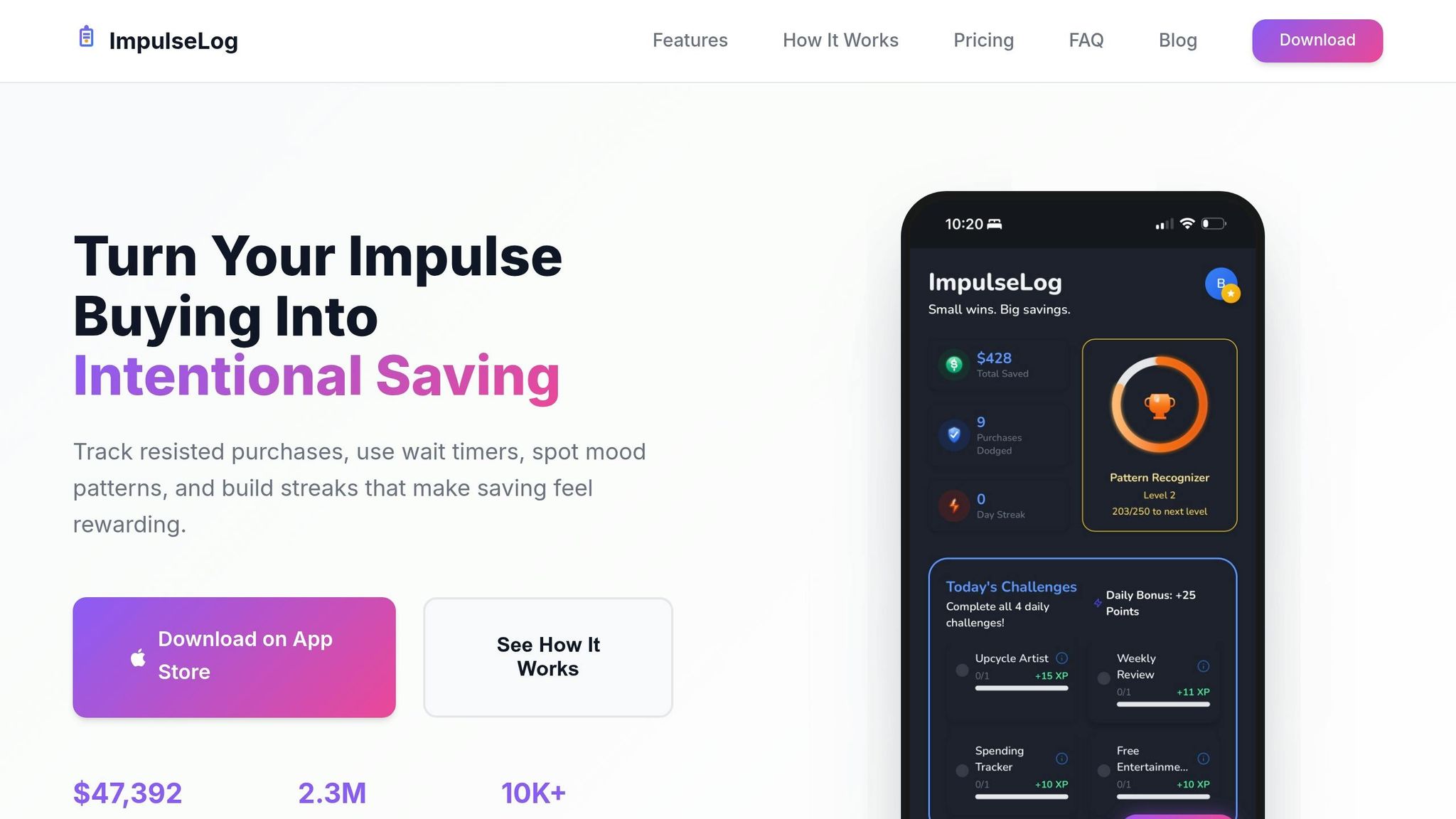
ImpulseLog is a tool designed specifically for neurodivergent minds. Unlike standard budgeting apps, it hones in on impulse control. Here’s how it works: whenever you resist an impulse buy, you log what you almost bought, how much you saved, and your mood - all in just a few seconds. This quick process makes it easier to follow through, which is critical for ADHD brains [10].
The app uses an XP (experience points) system to reward you for every resisted purchase. Instead of getting a dopamine hit from spending, you earn points and level up - turning saving into an achievement. For $8.99/month, the Premium plan adds AI insights that help uncover patterns between your mood and spending triggers [10].
"ImpulseLog is specifically designed for impulse control, not general budgeting. We focus on the psychology of impulse buying and use gamification to make saving fun and rewarding." – ImpulseLog [10]
Daily Challenges and Achievements
ImpulseLog takes gamification a step further with daily challenges. These challenges keep your financial goals front and center, countering the ADHD tendency to forget things that aren’t immediately visible. Challenges might include resisting one purchase, reviewing your savings goal, or completing a "no-spend day." Each completed task gives you a small win, offering a quick dopamine boost and making it easier to stay consistent [10].
The app also features 23 achievements you can unlock, like saving your first $100, maintaining a 7-day streak, or resisting 50 impulse buys. These milestones provide external rewards, which ADHD brains often need to stay motivated due to underactive internal reward systems [14].
Visual Progress and Streaks
Visual tools make the abstract concept of saving money feel tangible. ImpulseLog uses colorful charts and graphs to show your savings growth, helping combat time blindness. Watching your balance climb or seeing a streak of impulse-free days gives you the same kind of dopamine boost you’d get from spending - minus the financial hit [1][10].
Streaks add another layer of motivation by creating momentum and accountability. Even if you slip up, your progress is still visible, making it easier to bounce back without falling into a spiral of discouragement. This constant feedback loop reinforces good habits, aligning perfectly with ADHD-friendly financial strategies [10][12].
Here’s something to think about: the “ADHD Tax” - the money lost to impulsive spending, late fees, and forgotten subscriptions - can add up to thousands of dollars each year. Redirecting just $2,000 annually into an investment with a 7% return could grow to nearly $200,000 over 30 years [1]. Gamification makes it easier to capture that money by turning saving into a game you actually want to play.
Automating Your Finances
Managing finances can be a major challenge for individuals with ADHD, especially when it comes to remembering due dates and navigating payment systems. The good news? Automation can take the burden off your shoulders entirely. Harold Robert Meyer, Founder of The ADD Resource Center, explains it perfectly:
"When money moves automatically, it bypasses your executive function entirely. You're not deciding to save - it just happens. You're not remembering to pay bills - they pay themselves." [6]
By automating key financial tasks like bill payments and savings transfers, you can eliminate up to 90% of the tasks that often lead to missed deadlines, late fees, and other costly mistakes known as the "ADHD Tax" [6].
Automatic Bill Payments
A great first step is setting up a dedicated checking account just for recurring bills. Calculate the total of your fixed monthly expenses - rent, utilities, subscriptions, insurance - and schedule automatic transfers into this account every payday. This ensures that money for your bills is separated from your spending cash [6].
To make this system foolproof:
- Schedule all transfers and payments for the day after payday. This way, money is allocated to obligations before you’re tempted to spend it [6].
- Set up automatic minimum payments on all credit cards to safeguard your credit score [15].
- Use digital calendar alerts 1–2 days before a bill is due to catch any issues, like insufficient funds [15].
- Review automated payments annually to cancel unused subscriptions and avoid "subscription creep" [15].
- Opt for paperless billing and organize all statements in a single digital "Finances" folder to reduce clutter [6].
Automatic Savings Transfers
Automating your savings can help you save up to 3.6 times more than relying on manual transfers [16]. The secret is to "Pay Yourself First" by scheduling automatic transfers to savings accounts immediately after payday [16].
For added control:
- Use a different bank for savings to introduce a 2–3 day delay on withdrawals, curbing impulsive spending [6].
- Take advantage of banks with sub-accounts or "buckets" to label savings for specific goals like "Emergency Fund" or "Vacation", making progress more visible [16].
- Start small - even $10–$20 per paycheck can build a lasting habit.
- If your employer offers direct deposit splitting, direct a portion of your paycheck straight into a high-yield savings account [16].
- Combine these strategies with round-up features, where spare change from daily purchases is automatically saved, making it effortless to grow your savings [16].
Marine Lafitte, Lead Financial Commentator at Millions Pro, sums it up well:
"The biggest reason people fail to save is not a lack of income; it is a lack of systems." [16]
Scheduled Financial Reviews
While automation simplifies the day-to-day, regular check-ins ensure everything stays on track. For ADHD brains, shorter, more frequent reviews - like weekly check-ins - work better than monthly ones. They help reduce decision fatigue and keep time blindness at bay.
Here’s a simple schedule to follow:
| Review Frequency | Duration | Primary Goal |
|---|---|---|
| Payday | 5 Minutes | Confirm that automated transfers and payments occurred as planned. Move any leftover money to savings. |
| Weekly | 10–15 Minutes | Review recent transactions, check balances, and plan for the week ahead. |
| Quarterly | 30 Minutes | Audit subscriptions and memberships, canceling anything unused or unnecessary. |
Set aside the same time each week - like Sunday afternoons - for your weekly review. On payday, spend just five minutes verifying that transfers went through and allocating any extra funds to savings. A quarterly review can help you catch forgotten subscriptions or unexpected charges before they drain your resources.
Setting and Reaching Financial Goals
Managing money with ADHD can feel like trying to solve a puzzle with missing pieces. The key? Building a system that works with your brain, not against it. Financial educator Brynne Conroy explains it best:
"Managing money with ADHD isn't about fitting into rigid financial systems - it's about finding what works for your brain" [3].
One common misstep is trying to tackle everything at once. Instead, tie your financial goals to something that excites you - like planning a dream vacation, setting up a cozy new home, or finally moving out on your own. When your goals align with your passions, sticking to them becomes a lot easier [3].
Short-Term vs Long-Term Goals
ADHD brains often struggle with distant, abstract goals. The solution? Break them into smaller, actionable steps that fit into your daily habits. For example, instead of saying, “I’ll save for retirement,” create time-bound, specific targets like “Save $1,000 for emergencies in six months” [18]. This clarity makes it easier to stay on track.
Using SMART goals - Specific, Measurable, Achievable, Relevant, and Time-bound - is a great way to structure your plans. For instance, saving $1,000 in six months translates to about $42 per week. One person shared how this approach helped them maintain a positive balance of over $1,000 for the first time in their adult life [17].
For longer-term goals, especially if your income fluctuates (like with freelancing), plan based on your lowest expected income month. This keeps you from overcommitting and helps reduce financial stress. A good starting point is allocating 5–10% of your income to an emergency fund and 10% to long-term investments [4].
Here’s a simple breakdown to guide your weekly savings:
| Goal Type | Example | Timeframe | Weekly Action |
|---|---|---|---|
| Immediate | Build a $500 emergency fund | 3 months | Save $42 per week |
| Short-Term | Save $2,000 for a vacation | 12 months | Save $39 per week |
| Long-Term | Save $20,000 for a house down payment | 5 years | Save $77 per week |
Timed Focus Sessions
Long, drawn-out planning sessions often lead to burnout and decision fatigue. Instead, try short, focused bursts of activity. Set a timer for 10–15 minutes to tackle one task, like reviewing your spending, updating your budget tracker, or paying bills. When the timer goes off, stop [5][18].
To build consistency, schedule these sessions at the same time each week. Many people find Sunday afternoons ideal, especially if paired with a routine like sipping coffee. This technique, called habit stacking, helps you create a dependable system without relying solely on willpower [19].
Another strategy is body doubling - having a friend or partner join you (in person or virtually) while you handle financial tasks. This shared focus can ease the resistance that often accompanies money management [5][18].
If you find yourself in a moment of hyperfocus, use it to your advantage. Dive into tasks like researching savings accounts or exploring investment options. While hyperfocus can sometimes make you lose track of time, it’s also a powerful tool when directed toward productive goals [3].
These small, focused sessions pave the way for steady progress and make financial planning feel less overwhelming.
Tracking Progress with Analytics
Once your financial goals are clear, visual tracking can make progress feel tangible and motivating. Tools like ImpulseLog are particularly helpful, turning raw data into easy-to-read charts and unlocking achievements along the way.
This gamified approach isn’t just fun - it works. As Finny Blog puts it:
"ADHD money management is not about discipline. It is about design" [19].
Tracking your "ADHD Tax" (those sneaky costs like late fees or unused subscriptions) can also reveal where your system might need improvement. For example, eliminating a $30 monthly late fee saves you $360 annually - a win worth celebrating.
Another effective tactic is scheduling weekly “money dates” with an accountability buddy. Spend 10 minutes updating each other on your progress and celebrating even the small wins [3][18]. Research shows that 93% of ADHD individuals who sought support reported better financial outcomes, with financial planners receiving a 3.64 out of 5 rating for their help [13].
Linda Roggli sums it up perfectly:
"Money loves attention!" [2].
By checking in regularly - using simple tools like ImpulseLog - you’ll feel more in control. Even a budget followed 60% of the time is better than a perfect one you never use [19].
Start small. Save $10 a week, and you’ll build momentum while keeping your system flexible enough to handle life’s curveballs [18][19].
Conclusion: Financial Success with ADHD
Managing money when you have ADHD means working with your brain’s natural tendencies instead of against them. By using the strategies discussed earlier, you can create a system that not only fits your unique needs but also helps you thrive financially. As Harold Robert Meyer, Founder of The A.D.D. Resource Center, wisely states:
"The goal isn't perfection - it's protection from your future impulsive self while giving your current self permission to enjoy life" [6].
The key isn’t striving for perfection but designing systems that align with how your brain operates. Tools like automation, visual tracking, strategic friction, and gamification help simplify financial management and make it more engaging. These approaches work with your brain’s wiring, making tasks feel less like a battle and more like an achievable challenge.
It all begins with self-awareness. Understanding that financial difficulties often stem from executive function challenges - not personal failings - is a game-changer [9][5]. From there, you can build forgiving systems that adapt to your needs. For example, gamifying your progress with visual charts or rewards taps into your brain’s dopamine system, turning what might feel like a chore into something satisfying and motivating.
The beauty of these systems is that they combine your natural strengths - like hyperfocus, creativity, and passion - with practical habits. Start small: automate bills, track spending visually, and celebrate even minor victories. Over time, these steps can lead to big changes.
Financial management with ADHD doesn’t have to be overwhelming. With patience, thoughtful planning, and tools that fit the way your brain works, you can create a financial future that feels steady and fulfilling.
FAQs
Which budgeting system is easiest to start with if I have ADHD?
Managing finances with ADHD can feel overwhelming, but the right system can make a world of difference. The "no-budget" method is a great fit because it skips detailed tracking and strict rules, focusing instead on simplicity and automation.
This approach leans on tools that automate payments and savings, so you don’t need to micromanage every dollar. Using visual cues - like separate accounts for spending and bills - can also make it easier to stay on track. These strategies cater to the way ADHD brains work, creating routines that feel natural and less stressful. By keeping things flexible and straightforward, financial management becomes much more manageable.
How do I stop impulse spending online when I’m tempted in the moment?
To curb online impulse spending, try creating small hurdles that make impulsive purchases less convenient. For instance, you could use website blockers to restrict access to shopping platforms or implement a 24-hour waiting rule before making a purchase. Another helpful tactic is tracking your spending habits with tools like ImpulseLog, which can increase awareness of your patterns. Recognizing that impulsive buying often satisfies your brain’s craving for stimulation can also guide you toward building healthier habits and smarter financial routines.
What should I automate first so I don’t miss bills or savings goals?
Automating your finances can be a game-changer when it comes to staying on top of bills and savings goals. By setting up automatic transfers - especially on payday - you can ensure that your bills are paid promptly and your savings grow without any extra effort. This method takes the pressure off your memory and willpower, making it easier to stick to your financial plans consistently.