
How Predictive Analytics Improves ADHD Finances
Managing finances with ADHD is challenging due to impulsive spending, time perception issues, and executive function struggles. Predictive analytics offers a solution by identifying spending patterns, forecasting impulses, and providing real-time interventions. These tools analyze factors like how mood affects shopping, time of day, and spending triggers to help you avoid costly decisions.
Key takeaways:
- Impulse control: Alerts predict spending urges with 84% accuracy, helping you pause before acting.
- Spending insights: Track triggers like late-night shopping or payday splurges to build awareness.
- Gamification: Earn rewards for good habits, replacing impulsive buys with positive reinforcement.
- Savings growth: Users report avoiding thousands in unnecessary purchases by using these tools.
ADHD Financial Challenges Explained
Impulsive Spending and Emotional Triggers
For individuals with ADHD, the brain’s constant craving for dopamine often makes spending feel like an easy fix for boredom, stress, or feeling underwhelmed [6][1]. This isn’t about being careless - it’s tied to how the ADHD brain functions. As David DeWitt, CFP®, puts it:
"Your ADHD brain is literally wired differently when it comes to dopamine, reward processing, and impulse control. This is not a metaphor" [6].
Here’s the challenge: even when someone with ADHD knows their financial goals, following through with an ADHD budget planner can be a struggle. That’s because ADHD affects executive function - the mental processes that help with planning and self-control [6]. So, while you might fully understand the importance of saving, that late-night "buy now" button can still feel irresistible.
Spending often becomes a way to cope. Whether it’s dealing with rejection, criticism, or just feeling overwhelmed, shopping can act as a quick emotional boost - a kind of "retail therapy" [4]. Unfortunately, this can lead to a cycle of shame. Financial mistakes trigger feelings of guilt, which can result in avoiding bank statements or financial tasks altogether. This "shame-avoidance spiral" allows debt to snowball, making the situation even harder to confront [2]. These emotional and impulsive triggers are a major driver of financial missteps, creating both short-term challenges and long-term consequences.
The Cost of Temporal Discounting
Another hurdle for people with ADHD is how they perceive time. Dr. Russell Barkley, a leading expert on ADHD, explains:
"People with ADHD tend to experience time like nearsightedness. They can only really deal with things that are near in time" [6].
This concept, known as temporal discounting or "present bias", means that the ADHD brain prioritizes immediate rewards over future ones [8][7][2]. For example, the satisfaction of buying something today feels far more real than the abstract concept of a credit card bill due in three weeks [2]. Research shows that hyperactive-impulsive symptoms, rather than inattention, are the key drivers of these financial struggles [7].
Consequences of Poor Financial Habits
The combination of impulsive decisions and a focus on the present often leads to serious financial setbacks. Over a lifetime, adults with ADHD experience an earnings gap ranging from $543,000 to $616,000 compared to their neurotypical peers [2]. The retirement outlook is even more concerning, with ADHD individuals having a projected net worth gap of 40% to 64%, amounting to roughly $431,000 less by retirement [9].
Chi Liao, a finance professor at the University of Manitoba, highlights the broader impact:
"those with more severe childhood ADHD symptoms are significantly more likely to experience difficulty paying bills, payment delinquency, lack of emergency savings, and delays in purchasing necessities" [9].
There’s also the so-called "ADHD Tax", which includes late fees, interest charges, forgotten subscriptions, and missed payments. In the UK, this adds up to about £1,600 ($2,000) annually [3]. On top of that, individuals with ADHD are more likely to rely on high-cost financial options like payday loans with APRs as high as 700% or pawn services [9][7]. These hidden costs often create a cycle of financial instability, making it even harder to break free. However, understanding these challenges is the first step toward addressing them, and tools like predictive analytics can help anticipate and reduce impulse-driven decisions.
sbb-itb-1fa9254
MANAGING MONEY WITH ADHD | how to create a budget, automate your finances & avoid impulse spending
How Predictive Analytics Identifies Spending Patterns
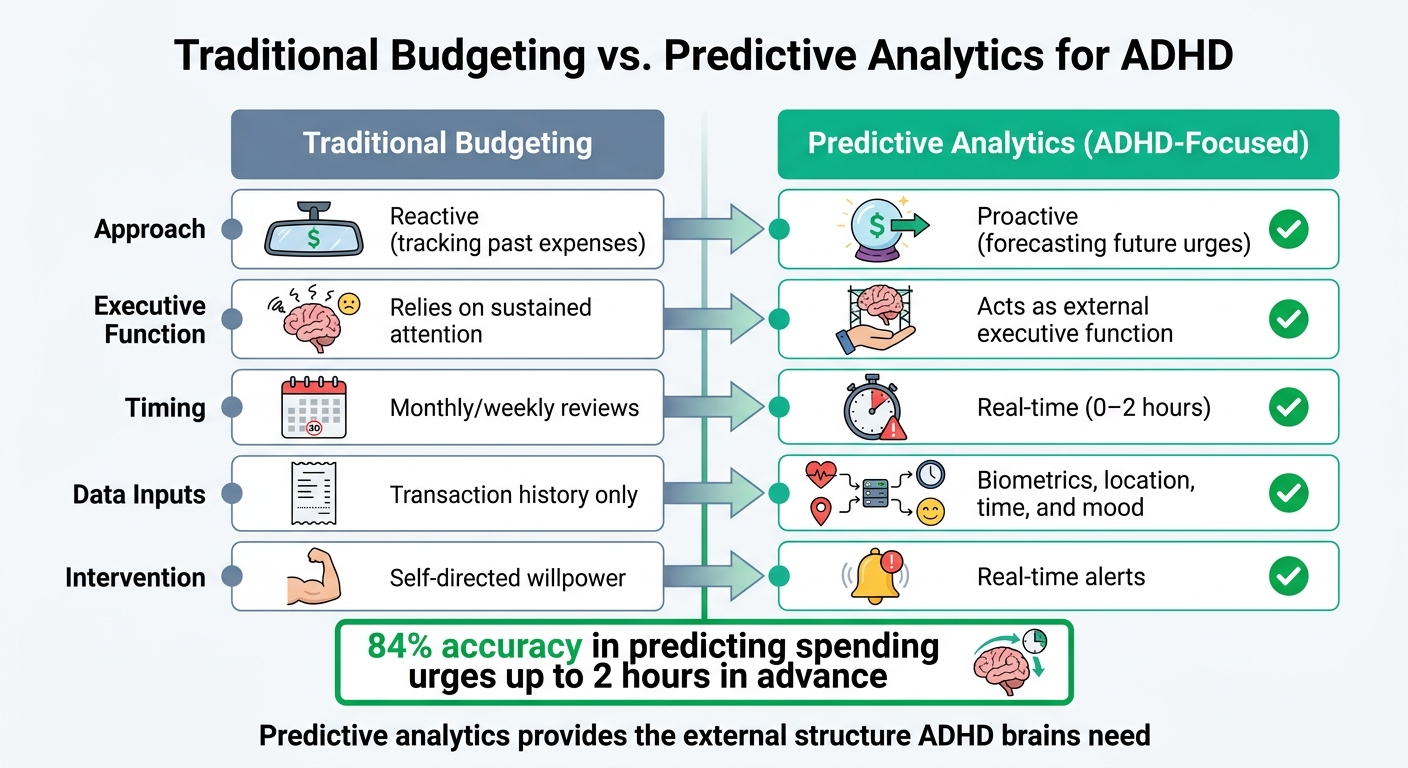
Traditional Budgeting vs Predictive Analytics for ADHD Financial Management
Predictive Analytics Basics
Predictive analytics uses past behaviors to predict future actions. For individuals with ADHD, this technology can identify your unique spending habits and send alerts before you make an impulsive purchase.
Modern systems analyze 56 data points across five categories: spending time, location, biometric signals, financial activity, and behavioral context [10]. Essentially, it creates a detailed map of what triggers your financial decisions. It’s not just about tracking transactions - it’s about understanding the conditions that lead to them.
For example, these systems have observed that impulse buying spikes during late-night hours (10 PM–2 AM) [10]. Additionally, poor sleep quality can impair the prefrontal cortex by up to 40%, leaving you more susceptible to impulsive spending the next day [10]. As the Whistl team puts it:
"The AI doesn't just track your money. It learns your patterns, understands your triggers, and protects your future self from present-moment vulnerability." [10]
By recognizing these patterns, the system can predict when you’re most at risk of making impulsive decisions, as outlined in the next section.
Forecasting Impulse Purchases
With 84% accuracy, predictive analytics can anticipate spending urges and send warnings up to two hours before they reach their peak [10]. This early notice gives you time to intervene and regain control before acting on the impulse.
The technology identifies what’s known as a "Trigger Genome" - a set of patterns that signal heightened risk for impulsive spending [4]. These triggers include dopamine-seeking behavior during boredom, the "3 PM slump" when energy drops, late-night inhibition loss, and high-risk periods like the first three days after payday [4][10]. It also tracks "spending velocity", which is a sudden increase in purchases that often signals you’re entering a phase of impulsivity [10].
Location plays a role too. For example, being within 500 meters of a high-risk location, like a casino, can raise gambling urges by 340% [10]. Advanced systems even consider ADHD medication schedules, offering extra support during evening "wear-off" periods when impulse control tends to weaken [5].
These predictive capabilities are designed to help you take action before financial habits spiral, paving the way for real-time financial management.
Proactive vs. Reactive Financial Management
For individuals with ADHD, moving from reactive to proactive financial management is a game-changer. This shift provides the external structure needed to address challenges with executive functioning.
Traditional budgeting apps focus on showing what you’ve already spent, while predictive analytics highlights what you’re likely to spend in the near future. This difference is key to transforming how financial decisions are managed.
| Feature | Traditional Budgeting | Predictive Analytics (ADHD-Focused) |
|---|---|---|
| Approach | Reactive (tracking past expenses) | Proactive (forecasting future urges) |
| Executive Function | Relies on sustained attention | Acts as external executive function |
| Timing | Monthly/weekly reviews | Real-time (0–2 hours) |
| Data Inputs | Transaction history only | Biometrics, location, time, and mood |
| Intervention | Self-directed willpower | Real-time alerts |
For ADHD brains, this proactive approach is essential. As Dr. Russell Barkley explains:
"ADHD brains need external structure to compensate for internal executive function deficits. Effective external structure is immediate, automatic, and non-judgmental." [4]
Instead of relying solely on willpower, predictive tools act as your external prefrontal cortex, catching potential issues in real-time and allowing you to address them before they become problems.
Breaking the Impulse Purchase Cycle
Early Warning Systems for Impulse Control
ImpulseLog goes beyond simple alerts - it actively helps you delay impulsive decisions. Take Emma, a 28-year-old user who managed to overcome $8,000 in credit card debt. She noticed that her impulse purchases spiked by 89% during late-night boredom[4]. Using this data, she set up blocks on shopping sites between 9 PM and 2 AM. Over the course of a year, this strategy helped her avoid $14,200 in potential purchases and significantly reduce her debt[4]. Emma described her experience:
"The 2-hour prediction is wild - it knows I'm about to impulse-buy before I know."[5]
This kind of proactive alert system doesn’t just warn you about risky moments - it also equips you with tools to counteract them effectively.
Behavioral Interventions and Decision Delays
When ImpulseLog detects a high-risk moment, it doesn’t just send a notification and hope for the best. Instead, it initiates a structured 8-step process designed to help you pause and regain control. This sequence includes acknowledging the urge, reviewing past spending patterns, completing a 2-minute breathing exercise, visualizing long-term goals, exploring alternatives, committing a small amount to savings, and enforcing a 30-minute cooldown. You can even choose to notify an accountability partner for added support[4].
Interestingly, the 2-minute breathing exercise alone reduces impulses by 72%[5]. Marcus, another 28-year-old user, found these interventions particularly helpful during his high-risk Thursday nights. By sticking to the program, he maintained a six-month streak of $0 gambled and saved $12,000 toward buying a car[5].
Building Awareness of Spending Triggers
Stopping impulsive spending is one thing, but understanding the triggers behind it is key to tracking spending with ADHD and creating lasting financial habits. ImpulseLog’s predictive analytics help you identify the emotions and situations that lead to impulsive decisions. For instance, poor sleep can impair your prefrontal cortex by up to 40%, and late nights can triple your likelihood of making impulse purchases[10]. The tool also highlights risky periods, such as the days following payday, giving you a clearer picture of when you’re most vulnerable[4].
ImpulseLog’s AI-powered mood tracking connects your emotions to your spending habits. By analyzing how you feel before making purchases, you can uncover patterns that might otherwise go unnoticed. As Marcus explained:
"Knowing it's watching my sleep and stress levels makes me more aware of how my body affects my spending. It's educational, not just protective."[10]
This kind of self-awareness doesn’t just help you avoid immediate spending - it also builds the foundation for long-term financial discipline. By turning unpredictable urges into recognizable patterns, you gain the power to make smarter, more intentional choices with your money.
Sustaining Financial Habits with Gamification
Predictive analytics might identify your spending triggers, but gamification keeps you on track by rewarding every smart financial choice. ImpulseLog’s gamification tools pair perfectly with its predictive alerts, helping you build lasting financial habits in a way that feels engaging and rewarding.
Dopamine-Friendly Motivation
For ADHD brains, immediate rewards are key - and gamification delivers just that. Instead of waiting months to see the payoff of saving, you can earn XP points, unlock achievements, and level up every time you stop impulse buying. Gamification essentially swaps the dopamine rush of impulse buying with instant gratification for making better choices. ImpulseLog includes 23 achievements tailored specifically for neurodivergent users, turning financial management into a game where you can actually win[11].
The impact is clear. ADHD users of gamified financial tools managed to block an average of $3,840 in impulse purchases over six months - far more than the $2,420 blocked by non-ADHD users[4]. These tools align with how your brain naturally works, offering animated celebrations, streak milestones, and visual badges that make hitting your financial goals rewarding right now instead of feeling like a distant dream.
Structured Accountability Through Challenges
Daily challenges help break overwhelming long-term goals into manageable steps that feel achievable. Instead of worrying about saving $5,000 over the next year, you focus on today’s task: “Log three impulses without acting on them.” This strategy avoids the executive function overload that often disrupts ADHD financial planning[11].
The "don't break the chain" system rewards consistency over perfection. If you miss a day, you don’t lose everything - you simply start a new streak. This approach counters the all-or-nothing mindset that can derail financial progress. The results speak for themselves: 72% of ADHD users actively engage with these accountability features, compared to 64% of non-ADHD users[4]. These tools naturally lead into visual progress tracking, reinforcing your commitment to building better financial habits.
Visual Progress Tracking for Engagement
Colorful charts and visual trackers turn financial data into something you’ll actually want to check. ImpulseLog’s tools make it exciting to watch a savings goal bar fill up or a graph climb higher. This kind of visual feedback helps your future self feel more tangible and relevant - a crucial factor for those dealing with time blindness[11].
These visuals aren’t just for show - they’re practical. They help you identify patterns you might otherwise overlook and give you concrete proof that your efforts are paying off. Whether you’re celebrating a seven-day streak on the free plan or diving into detailed analytics with Premium, seeing your progress laid out visually keeps you motivated and engaged[11].
Measuring Financial Progress and Success
Keeping track of financial progress is about identifying what works best for your ADHD brain, recognizing patterns, celebrating your wins, and adjusting plans before small missteps turn into larger setbacks.
Tracking Key Financial Metrics
Start by measuring your "ADHD tax" - those extra costs like late fees, duplicate purchases, or forgotten subscriptions. On average, these can add up to about $17 per month, or $204 annually, and impact 42% of consumers[12][13][14]. Interestingly, most of these costs are often tied to just a couple of expense categories, making them easier to spot and address.
Another useful step is tracking avoided impulse buys with an impulse spending calculator to see the value of items you decided not to purchase. Tools like ImpulseLog can help you record the value of these "almost-buys", turning them into visible savings. This approach not only reinforces positive habits but also helps you see which strategies work best for managing your spending triggers[15][11]. By monitoring your success rates, you gain a clearer picture of what aligns with your unique needs[5].
Once you’ve gathered this data, advanced dashboards can transform it into clear insights you can act on.
Using Analytics Dashboards for Insights
Analytics dashboards take raw data and turn it into meaningful, actionable insights. For example, ImpulseLog’s Premium plan ($8.99 per month) offers AI-powered tools that analyze how your mood influences your spending. It can even predict high-risk times, like late nights when poor sleep increases the risk of impulse spending by 73% for individuals with ADHD[4][11][16].
The best dashboards don’t just highlight challenges - they also showcase your victories. For instance, color-coded charts can display your resisted impulses alongside actual purchases, giving you a balanced view of your progress[16]. You can also set up alerts for unusual charges, which eliminates the need for manual checks - especially helpful on days when staying organized feels tough[12]. A quick 10-minute review each week, instead of waiting for monthly summaries, can help you stay on top of things without feeling overwhelmed[12].
But the benefits of tracking don’t stop at personal insights - sharing this data with professionals can take your strategy even further.
Sharing Progress with Advisors or Therapists
ImpulseLog Premium allows you to export detailed reports on your spending patterns, mood correlations, and intervention logs, making it easier to share this information with advisors or therapists[11][16]. Professionals can use this data to pinpoint hidden triggers and refine your strategies. For example, a therapist might identify connections between certain emotional states and spending habits, helping you prepare for vulnerable moments before they happen.
When choosing a platform, look for one that gives you control over what data is shared and with whom. This way, you can decide exactly how much information your advisor or therapist can access[4].
Combining personal tracking with professional insights creates a well-rounded approach to managing finances, especially when predictive tools are part of the mix.
Conclusion
Managing finances with ADHD isn’t about changing who you are - it’s about working with your brain by predicting and managing impulsive spending before it happens. This approach opens up a crucial moment for better decision-making.
Tools like ImpulseLog can act as a kind of external support system, helping with planning and impulse control. By analyzing patterns like your mood, time of day, or spending triggers, the tool predicts when you’re most likely to overspend. It then steps in with helpful interventions - like adding wait timers, suggesting calming exercises, or showing visual reminders of your savings goals. These small but timely actions create the foundation for another key element: making money management more rewarding.
This is where gamification comes in. Features like XP points, badges, and progress bars turn saving money into something engaging and even fun. Each time you resist an impulse buy and see your savings grow, you get that little burst of positive reinforcement that makes sticking to your goals easier and more satisfying - something many traditional budgeting apps just don’t offer.
Beyond these strategies, external accountability can also make a huge difference. Whether it’s tracking avoided impulse purchases, automating your savings, or sharing your progress with a trusted advisor, these systems help you stay on track. The goal isn’t perfect self-control; it’s creating tools and routines that align with how your brain works. By combining real-time insights with engaging, reward-based systems, this approach offers a practical way to tackle ADHD-related financial challenges.
Start small, celebrate your progress, and remember: your impulses are just information - not a measure of your value.
FAQs
What data does predictive analytics use to flag impulse spending?
Predictive analytics uses data such as spending habits, environmental cues, physical states, and financial behavior to spot patterns linked to impulse spending. By analyzing these factors, it becomes easier to anticipate and manage impulsive financial choices more effectively.
How can I set up alerts that actually stop me from buying things?
To help curb impulsive spending, try tools that offer real-time notifications and behavioral prompts. For instance, apps like ImpulseLog allow you to log purchases you resisted, identify spending patterns, and set delays - like a 24-hour cooling-off period - before making a purchase. These features encourage reflection and help you avoid snap decisions. Some tools even use predictive technology to analyze triggers such as your mood or the time of day, sending alerts before the urge to buy kicks in. This keeps you more mindful and in control of your spending habits.
How do I track whether these tools are saving me money over time?
Tracking your savings becomes easier with tools that offer visual progress reports and detailed analytics. These features break down your spending and savings patterns, giving you a clear picture of where your money goes. For example, platforms like ImpulseLog let you set and monitor savings goals - such as "Piggy Banks" - while also keeping tabs on achievements and streaks.
By regularly reviewing these insights, you can see how skipping impulsive purchases adds up. It’s a great way to stay motivated and measure your progress toward reaching your financial goals over time.