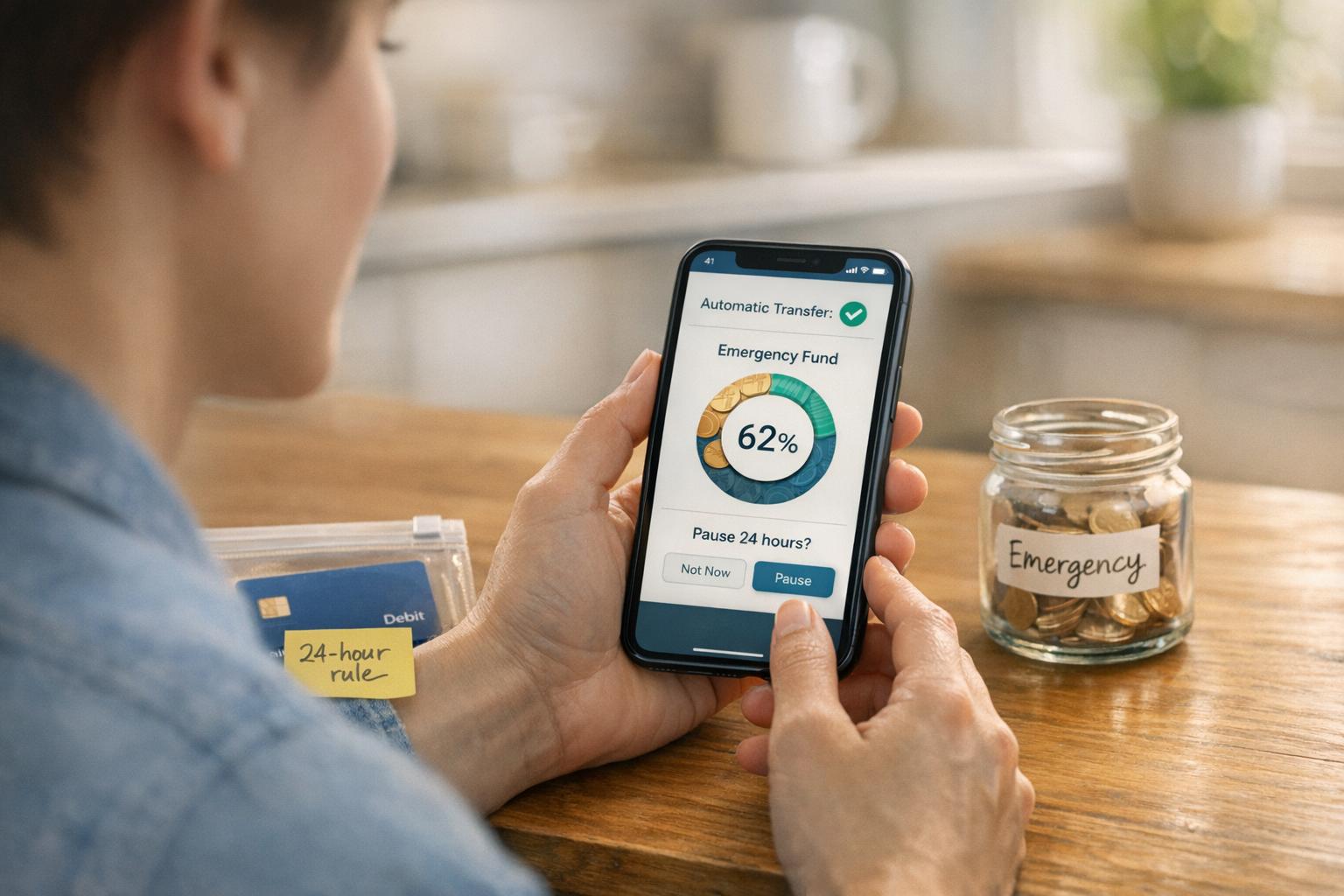
ADHD and Savings: Insights from Studies
Managing money is extra challenging for adults with ADHD. Struggles with impulse spending, delayed gratification, and emotional regulation can lead to financial instability. For example, adults with ADHD are twice as likely to skip saving for retirement and score higher on impulsive buying scales compared to non-ADHD individuals. These behaviors often stem from ADHD-related executive function deficits, such as difficulty planning, staying organized, and managing time.
Key takeaways:
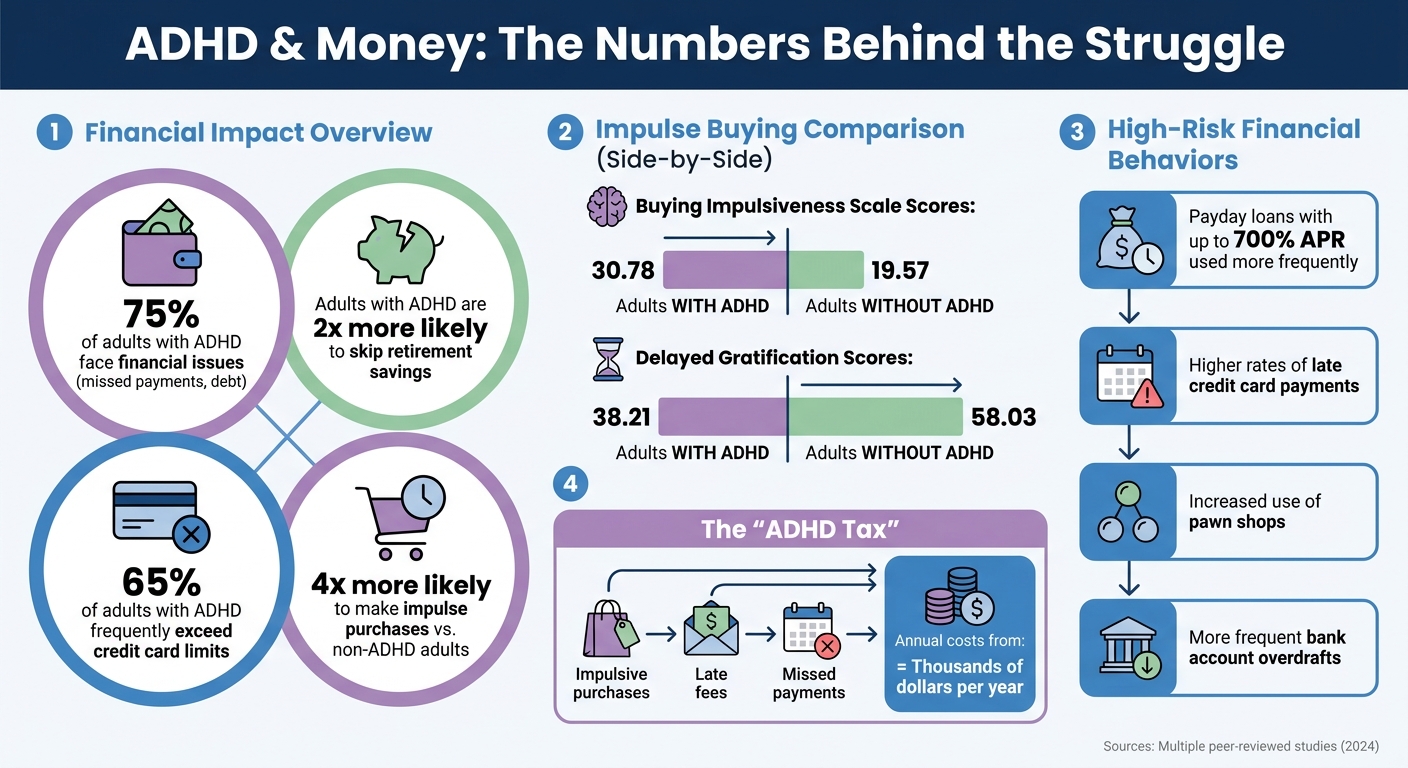
- 75% of adults with ADHD face financial issues like missed payments and debt.
- ADHD brains prioritize immediate rewards over long-term savings due to temporal discounting.
- Impulse spending is linked to lower dopamine levels, making it harder to resist quick purchases.
Practical solutions include:
- Automating savings to bypass decision-making.
- Using tools like ImpulseLog to track spending triggers and gamify saving.
- Creating "speed bumps" like removing saved payment methods or using the "2-Hour Rule" to delay purchases.
The article highlights strategies and tools tailored for ADHD brains, helping individuals turn impulsive tendencies into consistent savings habits.
ADHD and Financial Challenges: Key Statistics and Impact
What Research Shows About ADHD and Savings
Impulse Buying and Emotional Regulation Problems
Research highlights that adults with ADHD often face challenges with impulse buying. For instance, a 2024 study revealed that adults with ADHD scored an average of 30.78 on the Buying Impulsiveness Scale, while those without ADHD scored significantly lower at 19.57 [4]. This isn't simply about lacking self-control - it stems from difficulties in delaying gratification, which is the ability to prioritize future rewards over immediate ones [4].
Another critical factor is present bias, or hyperbolic discounting. This tendency leads individuals with ADHD to overvalue immediate rewards while undervaluing future benefits, contributing to lower savings and increased borrowing [6][3]. Dr. Itzhak Ben-David, a finance professor at The Ohio State University, explains the broader consequences:
For many people with ADHD, there is an outsized tendency to be impulsive and to place more emphasis on the present... we find that people with ADHD use payday loans more often, use pawn shops, pay late fees on credit card, have overdrafts on their bank accounts, and switch employers very often [6].
When emotional regulation issues combine with challenges in executive functioning, they often result in unplanned, impulsive purchases. These behaviors shed light on how impulsivity directly affects financial habits like saving.
Adults with ADHD Save Less Money
Studies consistently show that adults with ADHD save less and are less likely to open savings accounts [5][3]. Their ability to delay gratification - a key skill for saving - is noticeably lower, with ADHD participants scoring an average of 38.21 compared to 58.03 for non-ADHD individuals [4].
In a study of 544 adults, ADHD symptoms were linked to problematic financial behaviors, such as tracking spending difficulties, late credit card payments, higher balances, and increased use of high-interest services like pawn shops [3]. Payday loans, notorious for their interest rates of up to 700% APR, are also used more frequently by adults with ADHD due to their tendency to prioritize immediate needs over long-term costs [6][3].
Unstable employment adds another layer of difficulty, leading to unpredictable income that makes consistent saving nearly impossible [3]. These patterns highlight how ADHD-related behaviors can deeply influence financial stability.
How Childhood ADHD Affects Adult Financial Health
The financial struggles linked to ADHD often begin early in life. Long-term studies tracking individuals from childhood to adulthood show that childhood ADHD is associated with higher rates of school dropouts, underemployment, poor job performance, and unstable careers [3].
These early setbacks frequently translate into financial instability later in life. Lower educational attainment limits earning potential, while difficulties maintaining steady employment create inconsistent income streams [3]. Even after accounting for factors like income, education, and substance use, ADHD symptoms remain strongly tied to personal debt and poor employment histories [3].
What’s especially troubling is that financial challenges can persist into adulthood, even for individuals who received effective ADHD treatment as children [3]. Adults with ADHD also tend to perform worse on financial competence tests - such as interpreting bank statements or managing complex financial decisions - indicating that their struggles extend beyond impulsivity alone [7].
sbb-itb-1fa9254
Practical Ways to Improve Savings with ADHD
Identify Your Emotional Spending Patterns
For many individuals with ADHD, shopping can become a way to cope with boredom, stress, or feeling understimulated [8]. In fact, 65% of adults with ADHD frequently exceed their credit card limits, and they are about four times more likely to make impulse purchases compared to those without ADHD [8][9]. This behavior is tied to the executive function challenges that ADHD presents.
Dr. Russell Barkley, a clinical psychologist, sheds light on the issue:
"Impulsive spending has almost nothing to do with understanding math or money. Instead, it is a direct symptom of a brain that is starving for stimulation." [9]
To combat this, creating "speed bumps" can help disrupt impulsive spending habits. For example:
- Remove saved payment methods and disable one-click purchasing.
- Use physical reminders like "NO" or "PAUSE" stickers on credit cards.
- Try the "2-Hour Rule": Add an item to your cart and step away for two hours - or 24 hours for larger purchases - to let the urge subside [8][9].
Another helpful tool is a "Dopamine Menu", which is a list of free or low-cost activities that provide stimulation, like taking a short walk, playing a quick game, or diving into a creative hobby [8]. These alternatives can satisfy the need for excitement without harming your wallet.
Before making a purchase, ask yourself: "Does this align with my financial goals, or is it moving me further away?" [9]. Additionally, unsubscribe from marketing emails and newsletters that trigger impulsive buying.
Once you’ve pinpointed these spending patterns, automating savings can help you stay on track.
Set Up Automatic Savings Systems
Automation is a powerful tool for managing finances, especially when ADHD makes decision-making in the moment a challenge [1]. Since ADHD can make it harder to connect with future consequences, automation ensures money is saved before it can be spent impulsively [1].
David DeWitt, a Certified Financial Planner, explains it well:
"When you do not have to decide, you cannot mess up." [1]
Here are some ways to make automation work for you:
- Schedule automatic transfers to your savings account right after payday to ensure funds are set aside immediately [1].
- Use a digital cash envelope system by dividing your money into separate accounts: one for bills, one for everyday spending, and one for savings that’s harder to access [8].
- Consider keeping your savings in a different bank to create a delay (1–2 days) that makes impulsive spending more difficult [10].
Automating bill payments for fixed expenses can also reduce mental load and eliminate the risk of late fees [10]. Instead of managing a monthly budget, try setting up weekly automated transfers into your spending account. This approach gives you a fresh start every week and helps prevent overspending [2]. You can also use subscription-canceling tools to identify and stop paying for services you no longer use [8].
By reducing the number of decisions you need to make, automation simplifies money management and supports long-term financial stability.
Use Game-Like Features to Stay Motivated
Turning savings into a challenge can make the process more engaging and rewarding. Gamification taps into the ADHD brain’s craving for dopamine, making saving feel as exciting as spending [11]. Breaking down big financial goals into smaller, manageable steps provides immediate feedback, which can help counteract time blindness [11].
Here are some ways to gamify your savings:
- Track "no-spend days" on a calendar to build a streak, similar to achieving a high score in a video game [11].
- Set small challenges to avoid impulse purchases and reward yourself for each success [11].
- Use visual savings trackers - whether physical or digital - to see your progress in real time [1].
Renaming your savings accounts with creative titles like "Don’t Touch Fund" or "Guilt-Free Spending" can help you form a stronger emotional connection to your goals [12]. Placing visual reminders, such as sticky notes or a vision board near your wallet or phone, can also keep your savings goals front and center during moments of temptation [11].
Apps like ImpulseLog take these ideas further by offering daily challenges, progress tracking, and achievements. By turning the act of resisting impulsive spending into a game, these tools provide the stimulation your brain craves while helping you save.
ADHD Money Expert: How To Budget, Save and Manage Debt.
How ImpulseLog Helps People with ADHD Save Money
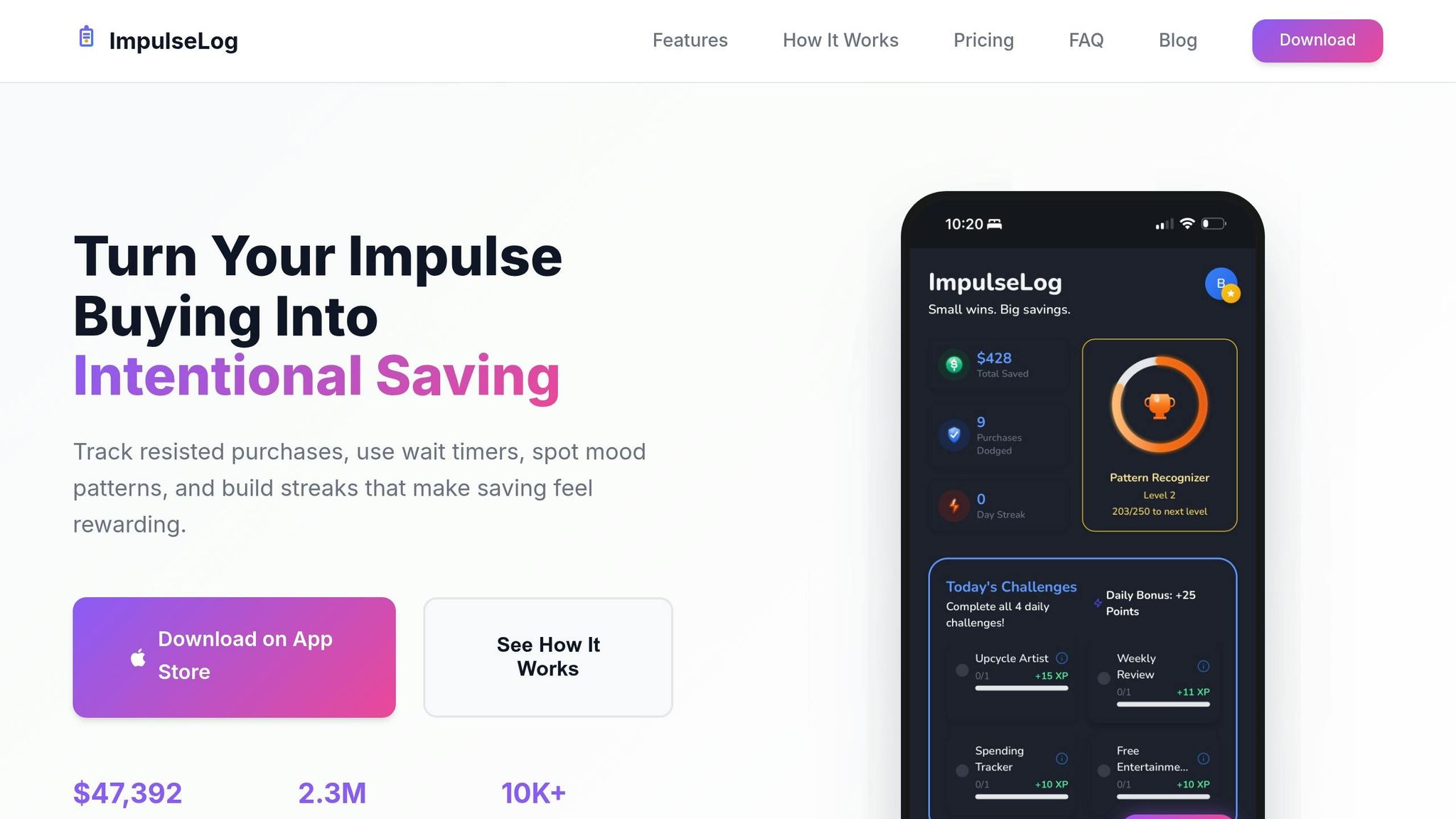
ImpulseLog builds on research about impulse spending and emotion-driven decisions, offering tools designed to help users with ADHD develop better financial habits.
Track Impulse Purchases and Emotional Patterns
ImpulseLog simplifies tracking impulse spending, a common challenge for those with ADHD. The app allows users to log "almost-buys" by recording the item, cost, and category whenever they resist a purchase. This creates an Impulse Ledger, where green entries represent money saved, and orange entries show actual purchases. This visual system helps users clearly see their progress and identify areas for improvement.
The app also uses AI-powered mood insights (via gpt-5-mini) to analyze the connection between emotional states and spending triggers. Users can log their mood and context with each entry, enabling the AI to detect patterns, such as increased spending during periods of stress or boredom. Premium users receive weekly summaries with actionable tips to address these emotional triggers. Additionally, the app includes wait timers that encourage thoughtful decision-making by adding a delay before purchases.
See Your Progress and Earn Rewards
ImpulseLog makes saving money engaging by turning progress into a visual and interactive experience. Users can set up to eight savings goals, each with its own tracker, making future objectives feel more immediate and achievable. To keep motivation high, the app incorporates an XP system and a 10-level growth structure, complete with visual milestones. There are also 23 achievements that reward both consistency and major savings milestones.
For those who struggle with time blindness, features like customizable "Piggy Banks" and streak trackers help maintain focus on long-term goals. The streak system even includes "Streak Shields", which protect progress on days when users may forget to log details but still engage in saving activities. These gamification elements align with ADHD-specific strategies to reduce impulsivity and encourage consistent habits.
Complete Daily Challenges and Set Savings Targets
ImpulseLog also integrates daily rituals to help users establish a savings routine. A quick, 20-second daily check-in prompts users to review their mood and any pending purchase decisions. This low-effort habit adds structure without overloading executive function, making it easy to stick with.
The app's daily challenges, like "Digital Detox Hour" or "Impulse Delay", offer quick, rewarding tasks. These challenges provide instant feedback, such as confetti animations, XP boosts, and streak updates, which act as small but effective "speed bumps" to curb impulsive spending.
Psychotherapist Roozbeh Khoshniyat explains:
"ADHD impulsive spending isn't about being careless or lazy. It's about how your brain is wired... you're not broken, and [need] to build a system that actually works with your ADHD instead of against it."
ImpulseLog offers a free version with essential features like logging, savings goals, streaks, and achievements. For $8.99 per month, the Premium plan unlocks advanced tools, including AI mood insights, predictive analytics, data export, and custom categories. With a perfect 5.0/5-star rating on the Apple App Store, users frequently commend how the app makes saving money enjoyable while helping them better understand their spending habits.
Conclusion: Better Financial Health for Adults with ADHD
Managing finances with ADHD is not a matter of willpower - it’s about understanding how the ADHD brain works. The challenges stem from differences in how rewards are processed, time is managed, and emotions are regulated. For instance, adults with ADHD are much less likely to have savings accounts and are more likely to carry debt compared to their neurotypical counterparts [13]. The so-called "ADHD Tax", which includes costs like impulsive purchases, late fees, and missed payments, can add up to thousands of dollars each year, representing a serious financial drain [1].
Acknowledging these neurological differences allows for more practical, ADHD-friendly solutions. For example, recognizing that impulse spending often acts as a self-regulation tool can help shift the focus from guilt to creating effective systems. Strategies like ADHD spending tricks and automating savings, removing stored payment information, and building a "dopamine menu" of enjoyable, no-cost activities align with how the ADHD brain operates. These approaches make saving money feel immediate and achievable.
Specialized tools designed for neurodivergent minds can bridge the gap between knowing what to do and actually doing it. As David DeWitt, CFP®, puts it, "The immediate wins almost every time. Not because you lack self-control, but because your ADHD brain struggles to make future consequences feel real and relevant to present decisions" [1]. ADHD-friendly tools use visual trackers, instant rewards, and simplified decision-making to bring long-term financial goals into the present.
Apps like ImpulseLog turn these strategies into daily habits. By combining impulse tracking, AI-based mood insights, and gamified progress features, the app provides the frequent feedback that ADHD brains thrive on. With tools like daily challenges and visual savings goals, abstract concepts like financial planning become more tangible and motivating.
Improving financial habits with ADHD isn’t about relying on willpower - it’s about building systems that account for the brain’s natural tendencies, even on tough days [2]. With tailored strategies and tools, impulsive decisions can be transformed into consistent, rewarding financial behaviors.
FAQs
Why does ADHD make saving so hard?
ADHD often presents unique challenges when it comes to saving money. Impulse control issues, struggles with emotional regulation, and a heightened focus on immediate rewards can make it tough to prioritize long-term financial goals. For many, the allure of instant gratification overshadows the importance of setting aside funds for the future.
Another hurdle is "time blindness" - a common experience for those with ADHD - where the concept of future planning feels abstract or disconnected. This, combined with difficulties in making financial decisions, can lead to impulsive spending that derails savings efforts.
Fortunately, tools like ImpulseLog are designed to help. By tracking spending habits and offering visual progress updates, these tools cater specifically to neurodivergent individuals, making it easier to build better financial habits over time.
What are the best “speed bumps” to stop impulse spending?
Managing impulse spending can be challenging, but there are practical strategies that can help. Tools like ImpulseLog allow you to track your purchases, giving you a clearer picture of your spending habits. Setting strict spending limits is another effective way to stay within budget.
Another tip? Delay your purchases. Giving yourself time to think before buying can help you regulate emotions and avoid impulsive decisions. Limiting easy access to payment methods - like removing saved credit card details from online stores - can also make it harder to spend impulsively.
Research has shown that delaying gratification and making small changes to your environment can be especially helpful in managing impulsivity, particularly for individuals with ADHD. These adjustments can create a more mindful approach to spending.
How can I automate savings so I don’t forget or overspend?
Automating your savings can be a game-changer if you’re managing ADHD-related challenges like impulsivity or time blindness. A simple way to start is by setting up automatic transfers from your checking account to a savings account as soon as your paycheck hits. This "out of sight, out of mind" approach can help you save without overthinking it.
Budgeting tools or apps can also take the stress out of managing finances by automating bill payments and savings contributions. For an extra boost, try gamified apps like ImpulseLog. These apps can track impulse purchases and reward you for staying on track, making saving money feel less like a chore and more like a fun challenge.