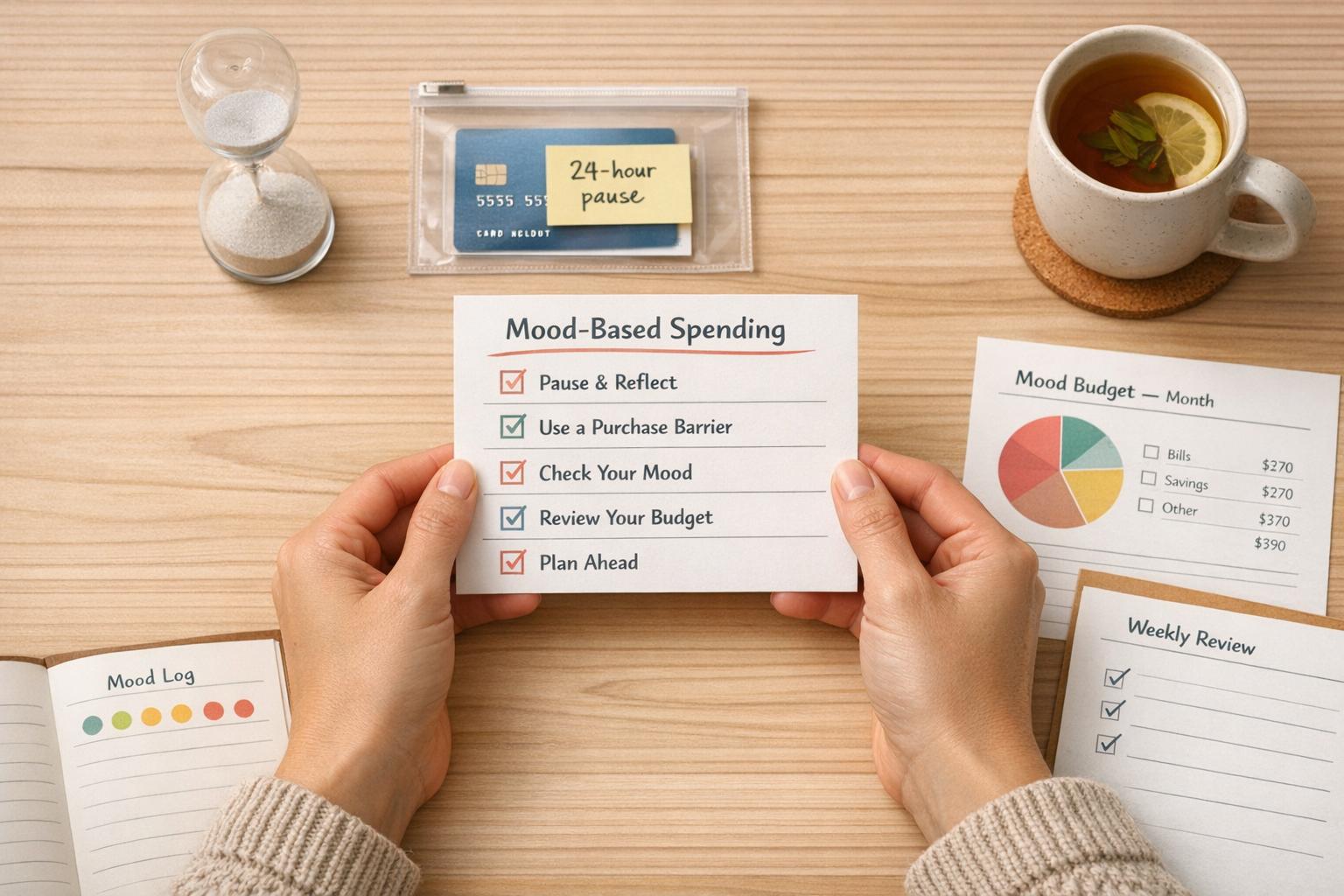
Checklist for Managing Mood-Based Spending
Managing mood-driven spending is a challenge, especially for individuals with ADHD, where emotions and impulsive purchases are tightly linked. Shopping often acts as a quick dopamine fix, making it harder to resist. This guide provides actionable steps to help you regain control over emotional spending without relying solely on willpower.
Key Takeaways:
- Emotional Triggers: Stress, boredom, and excitement often fuel impulsive spending.
- Pause Before Buying: Wait 24–48 hours for non-essential purchases to reduce impulse buys.
- Track Spending: Use tools like spending logs or apps (e.g., ImpulseLog) to identify patterns and triggers.
- Set Barriers: Remove saved payment methods, unsubscribe from promotional emails, and set shopping curfews.
- Budget for Treats: Use an ADHD budget planner to allocate a small monthly amount for non-essential purchases to avoid overspending.
- Gamify Saving: Use apps with streaks, achievements, and rewards to make saving money satisfying.
- Weekly Reviews: Spend 20 minutes each week analyzing spending habits to identify emotional triggers.
By creating structured systems that align with how your brain works, you can build better spending habits and reduce financial stress.
How to Avoid Impulse Spending When You Have ADHD
sbb-itb-1fa9254
Why Track Emotional Spending
Tracking your spending isn’t about guilt or self-punishment - it’s about taking back control. Instead of relying on your already overworked brain, you’re handing off the task to an external system that can do the heavy lifting for you [8][6]. By logging each purchase and noting the emotional triggers behind it, you start to see patterns. You gain insight into when, where, and why you spend.
This is especially important because financial challenges for people with ADHD aren’t usually about a lack of knowledge. As Dr. Russell Barkley, a clinical psychologist, puts it: "Financial struggles in ADHD are not typically caused by a lack of knowledge... it is a performance deficit. This means you know what to do, but your brain struggles to do it in the heat of the moment" [8]. Tracking creates a framework that helps your brain bridge that gap, making it easier to act on what you already know. It’s a simple but powerful tool for identifying and addressing emotional spending triggers.
Common Emotional Triggers
For neurodivergent individuals, certain emotional states can act like fuel on the fire of impulsive spending. For example:
- Stress spending: After a tough day, shopping might feel like a quick escape or relief.
- Boredom spending: When life feels dull, shopping can become a form of entertainment, offering a much-needed spark.
- Excitement spending: A new hobby or a shiny, interesting item can hijack your ability to pause and think clearly, leading to impulsive purchases [10][8][2].
These behaviors often tie back to the brain’s craving for stimulation. A quick purchase provides a dopamine hit, but it’s fleeting. Add decision fatigue to the mix - after a long day of managing emotions and executive function tasks, resisting impulses can feel impossible [3][6]. On top of that, time blindness makes it hard to connect today’s impulse buy with the consequences two weeks from now, like missing rent [1][3].
### How to Track Spending with Logs
This is where spending logs can make a real difference. They create a pause between the impulse to buy and the actual purchase. Even just writing down what you’re about to buy forces your brain’s decision-making center - the prefrontal cortex - to step in [3][8]. Over time, this habit builds self-awareness by showing you exactly what triggers your spending, whether it’s a specific place, time, or emotional state [6][4].
Tools like ImpulseLog take this concept to the next level. The app makes it quick and easy to log purchases and note your mood, taking just seconds to complete. Powered by GPT-5-mini, the app analyzes the connection between your emotional state and spending habits, offering tailored recommendations based on your past behavior [9]. It even includes features like visual progress tracking and gamified elements - XP, streaks, and achievements - that make the process feel rewarding rather than restrictive.
ImpulseLog offers a Free plan that includes basic logging, streak tracking, and analytics at no cost. For those looking for deeper insights, the Premium plan ($4.99/month or $29.99/year) unlocks advanced features like AI-driven trigger analysis and pattern detection [9]. These tools are a key part of building a system to manage mood-driven spending effectively.
Checklist for Managing Mood-Based Spending
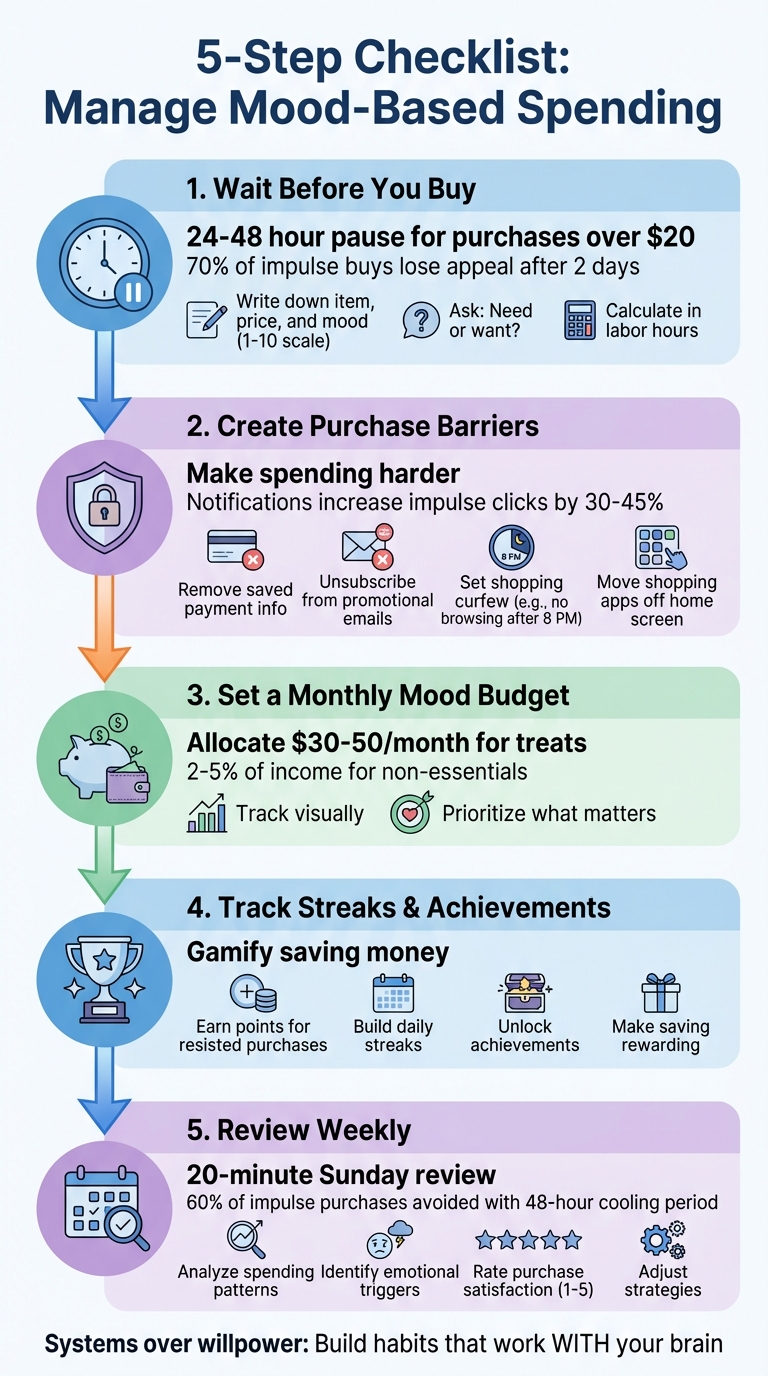
5-Step Checklist for Managing Mood-Based Spending with ADHD
Managing mood-based spending isn’t about getting things perfect - it’s about creating a system that works with your tendencies rather than fighting them. The steps below provide a framework to help you pause, reflect, and take control of those emotion-driven purchases. The goal? To put some space between the urge to buy and actually spending the money.
Step 1: Wait Before You Buy
Time is your best friend here. For any non-essential purchase over $20, give yourself 24 hours to think it over [7][12]. For bigger-ticket items, extend that to 48 hours [11]. Research shows that around 70% of impulse buys lose their appeal after two days [12][13].
When the urge hits, jot down the item, its price, and how you’re feeling at that moment. Writing it down can give you a small dopamine boost, similar to buying, but without spending a dime [9][13]. Rate your mood on a scale of 1–10 and note what triggered it - was it stress, boredom, or excitement about something new?
During the waiting period, ask yourself a few key questions: Is this something I need or just want? What problem am I solving by buying this? Am I paying for a product or just the idea of what it promises? [12][7][6]. You can even break down the cost into labor hours. For example, if your post-tax hourly rate is $15, a $90 gadget equals six hours of work [7].
Step 2: Create Purchase Barriers
Impulse buying thrives on convenience. To counteract this, make it harder to spend. Remove saved payment info, turn off one-click checkout, and log out after shopping sessions [7][8][13]. These small steps create a moment of pause before you can proceed.
Keep credit cards out of easy reach, or even label them with a reminder like “PAUSE” to stop yourself from swiping without thinking [8][11]. Unsubscribe from promotional emails and mute notifications from shopping apps - these can increase impulsive clicks by 30% to 45% [11]. If you’re tempted by apps, move them off your phone’s home screen so they’re less accessible.
Another helpful tactic is setting a “shopping curfew.” For example, no online browsing after 8:00 PM. If you find yourself in a shopping spiral, close the tab and take a 20-minute break before deciding whether to return.
Step 3: Set a Monthly Mood Budget
Instead of banning all non-essential purchases, set aside a small amount each month for treats or extras. A common guideline is $30 to $50 per month, or roughly 2% to 5% of your income [11][7]. This lets you enjoy occasional splurges without risking your financial stability.
Visual tracking can help you stay within this budget. By seeing your progress, you’re more likely to prioritize what you buy, making sure your money goes toward things that genuinely matter to you.
Step 4: Track Streaks and Achievements
Once you’ve set your budget, make saving money feel as rewarding as spending it. Apps like ImpulseLog use gamification - things like points, levels, and achievements - to turn resisting purchases into its own source of satisfaction [9]. Each time you log an impulse instead of buying, you earn points. Every day you stick to your mood budget adds to your streak.
This kind of system builds accountability and momentum, helping you stay consistent while making the process more enjoyable.
Step 5: Review Your Spending Weekly
Take about 20 minutes every Sunday to go over your spending logs and mood patterns [11]. This habit can reveal patterns, like overspending during specific times, and help you understand the emotions driving your purchases.
AI tools can even analyze your data, showing trends like peak purchase times or how much you’ve spent on impulse buys versus planned expenses [9]. Rate each emotional purchase on a scale of 1–5 to gauge how satisfying it actually was [11]. If you notice certain triggers leading to spending, consider replacing those moments with alternative activities, like going for a walk or calling a friend.
Over time, these reviews create a clearer picture of your spending habits, making it easier to make intentional choices. The goal is to integrate these steps naturally into your routine, turning mindful spending into second nature.
| Trigger | Immediate Tactic |
|---|---|
| Work Stress | Pause for 48 hours, log your feelings, and call someone for support [11] |
| Loneliness / Evenings | Plan a social check-in and avoid online shopping after 8:00 PM [11] |
| Payday / Windfalls | Allocate fixed percentages to bills and savings first; set a cap for extras [11] |
| Sales / Promotions | Use a wish list, wait 7 days, and compare prices before buying [11] |
How ImpulseLog Helps Manage Emotional Spending
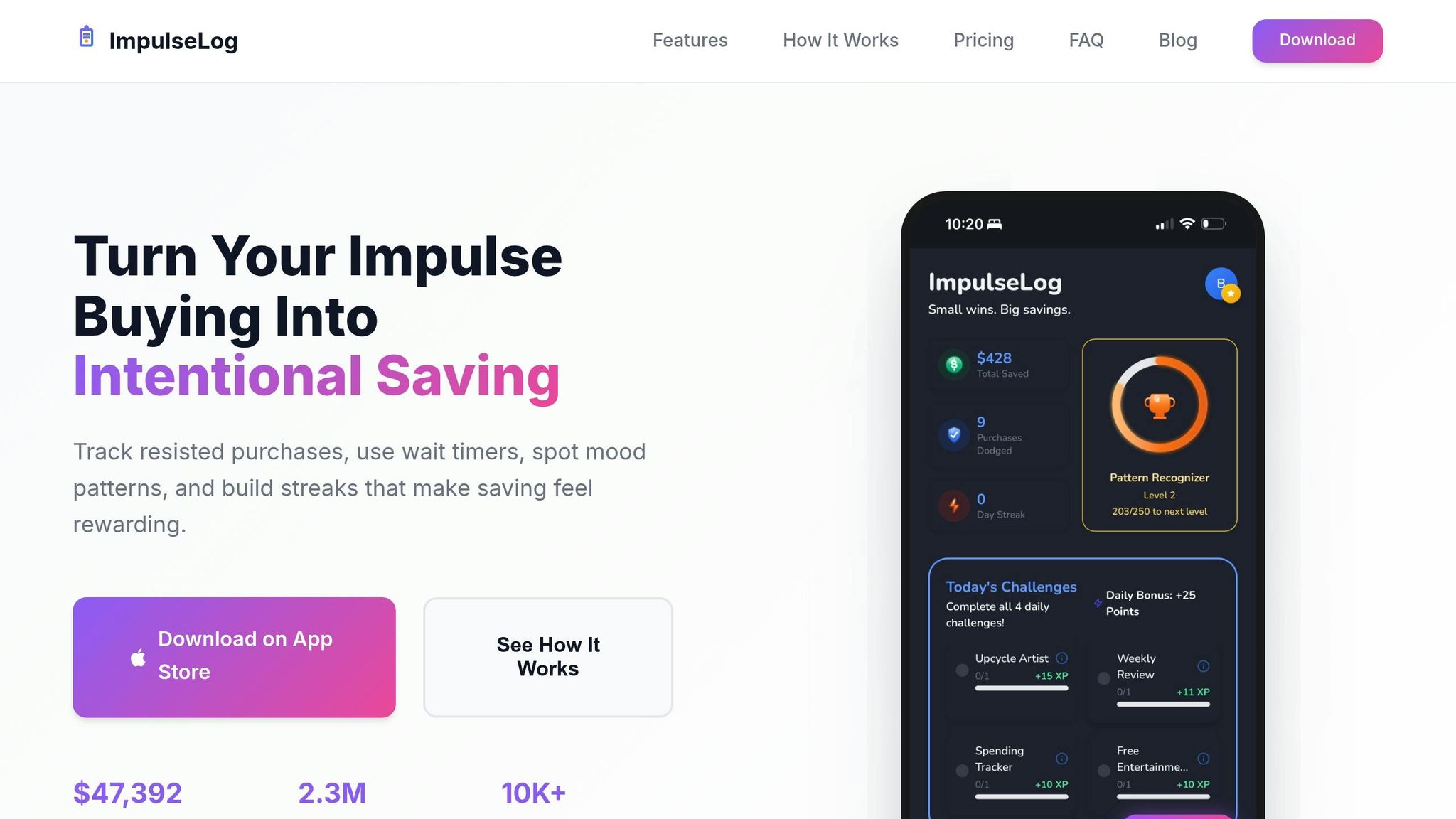
ImpulseLog takes the steps from the checklist and transforms them into actionable, user-friendly features, making it easier to manage mood-driven spending. Designed specifically for neurodivergent minds, the app focuses on creating dopamine-friendly actions, helping users tackle challenges like executive dysfunction. By making logging purchases more rewarding than impulsive buying, the app encourages better spending habits.
Each feature is tied directly to the checklist: wait timers help users pause (Step 1), Quick Logging creates a barrier to impulsive spending (Step 2), custom "Piggy Bank" goals align with monthly mood budgets (Step 3), gamified rewards replace shopping dopamine (Step 4), and Premium AI insights simplify weekly reviews (Step 5). With features like confetti celebrations, progress visuals, and charts, ImpulseLog prioritizes positive reinforcement over perfection, helping users build momentum.
Main Features of ImpulseLog
Here’s how ImpulseLog’s features align with the checklist and support better spending habits:
Quick Logging
When you feel the urge to buy, open the app and log the item, its price, and your mood in just a few seconds. This small action provides a dopamine boost - similar to making a purchase - without the financial hit. Resisted purchases are marked in green on your Impulse Ledger, showing money saved, while actual purchases appear in orange.
Wait Timers
This feature lets you set a delay before making a purchase. Choose a 24-hour pause or shorter timers (5–10 minutes) for smaller decisions. This pause creates space between the impulse and the action, giving your brain time to process.
AI-Powered Mood Analysis
Included in the Premium plan, this tool uses GPT-5-mini to analyze emotional patterns tied to your spending. It identifies triggers, like stress or boredom, and offers personalized advice, making weekly reviews more insightful.
Dopamine-Friendly Gamification
ImpulseLog turns saving money into a game. Earn XP for resisted purchases, unlock achievements, and celebrate milestones with confetti effects. The Streak Shield feature helps you stay on track by protecting your progress if you forget to log your mood for a day.
Daily Ritual & Savings Goals
The Daily Ritual is a quick, 20-second check-in to log your mood, review pending purchases, and maintain streaks. Savings Goals let you visualize what you’re working toward, reinforcing your long-term objectives.
| Feature | ADHD Benefit | Checklist Step Match |
|---|---|---|
| Wait Timers | Interrupts time blindness and urgency cues | Step 1: Wait Before You Buy |
| Quick Logging | Reduces friction; provides a micro-reward | Step 2: Create Purchase Barriers |
| Piggy Bank Goals | Makes long-term rewards tangible | Step 3: Set a Monthly Mood Budget |
| XP & Levels | Replaces shopping dopamine with rewards | Step 4: Track Streaks and Achievements |
| AI Summaries | Simplifies pattern recognition | Step 5: Review Your Spending Weekly |
ImpulseLog Plans and Pricing
ImpulseLog offers three plans to suit different needs and budgets. Each plan builds on the previous one, helping users develop lasting money habits:
-
Free Plan ($0 forever)
Includes core features like logging, the Impulse Ledger, savings goals, streaks, achievements, and the Daily Ritual. Perfect for trying the app without commitment. -
Essential Plan ($4.99/month)
Adds daily spending pattern analysis and weekly summaries for a deeper understanding of your habits. -
Premium Plan ($8.99/month)
Includes everything in the Essential plan, plus GPT-5-mini AI insights, trigger analysis, and personal growth coaching. A Premium Annual Plan is available for $29.99/year, offering a 50% discount compared to monthly pricing.
| Plan | Cost | Key Additions |
|---|---|---|
| Free | $0/forever | Core features: logging, goals, streaks, Daily Ritual |
| Essential | $4.99/month | Daily pattern analysis, weekly summaries |
| Premium | $8.99/month | GPT-5-mini AI insights, trigger analysis, coaching |
| Premium Annual | $29.99/year | All Premium features at 50% off monthly cost |
All plans are ad-free, prioritize privacy, and allow users to export or delete their data anytime. ImpulseLog is designed to work with your brain, making the process of managing emotional spending feel like progress - not a burden.
Building Long-Term Money Habits
Creating lasting financial habits often requires consistent external support, especially for neurodivergent individuals. These supports, like visual reminders and accountability systems, help maintain focus even when initial enthusiasm wanes.
Visual Reminders and Accountability Partners
A simple yet effective strategy is setting your phone's lock screen to display your savings goal. Every time you unlock your phone, you're reminded of what you're working toward [7][14].
Accountability partners add another layer of support by offering what Dr. Russell Barkley refers to as "borrowed executive function" [6]. Before making a purchase, reach out to your accountability partner. This brief pause can help curb impulsive decisions. Research shows that nearly 60% of impulse purchases are avoided when a 48-hour cooling-off period is applied, and having someone to check in with makes it easier to stick to that pause [11][14].
Maintaining Progress with Weekly Check-Ins
Set aside 10–20 minutes every Sunday for a quick review of your spending habits. This routine can help you spot patterns and reduce decision fatigue [15][16]. Visual tools, like color-coded transactions, make it easier to identify and adjust unhelpful spending behaviors [15][16].
"Every Sunday, I light a candle, log into my bank, and pretend I'm the CFO of my own chaos. That 45-minute window has kept me from financial collapse more times than I can count."
- Sasha, AuDHD [16]
Apps like ImpulseLog simplify these weekly reviews with built-in analytics. Its Premium plan uses AI to connect your spending habits to specific moods, such as work stress or late-night scrolling, and offers actionable tips without requiring detailed manual analysis [9][11]. Another helpful feature is tracking "almost purchases" - those items you considered but didn’t buy - so you can see how much money you saved by resisting temptation [17][5].
Conclusion: Manage Mood-Based Spending
Managing mood-driven spending doesn't rely on sheer willpower but instead on creating systems that work with your brain, not against it. The checklist approach offers a practical framework for bridging the gap between intention and action, especially for neurodivergent individuals who may struggle with impulsivity [8].
By focusing on structured delays - like pausing before purchases or conducting weekly spending reviews - the checklist provides external safeguards to counter impulsive tendencies. It's not about fighting your natural instincts; it's about supporting them with tools that make decision-making easier.
ImpulseLog takes this concept even further by turning the checklist into a dopamine-friendly experience. Features like XP points, streaks, and 23 achievements replace the thrill of impulsive buying with the satisfaction of "saving now." For premium users, AI-powered insights (using GPT-5-mini) analyze patterns between moods and spending triggers, helping identify risky moments such as late-night scrolling or stress from work [9]. This makes each step not only actionable but also rewarding, encouraging long-term progress.
Research backs this up - brief pauses have been shown to significantly reduce impulse purchases. As Eric Kaufmann puts it, "Impulse control isn't built through force. It's built through systems that support your brain" [6]. Even starting with a single checklist step can lead to meaningful change. With tools like ImpulseLog and a structured approach, you're letting the system handle the hard part, making it easier to create lasting habits.
FAQs
How do I find my spending triggers fast?
To get a handle on spending triggers, tools like ImpulseLog can be a game-changer. It allows you to log those moments of impulse and provides mood insights in seconds using AI. Pay attention to emotional cues - like stress, boredom, or even feeling overstimulated - and start spotting patterns in your behavior.
An 'Impulse List' can be a handy way to manage spending tied to hyperfocus or boredom. Plus, features like visual progress tracking and daily challenges can keep you motivated and aware, helping you cut back on unnecessary purchases.
What should I do instead of shopping for dopamine?
Instead of chasing that quick dopamine hit through shopping, try shifting your focus to activities that bring rewards without the need for impulsive spending. Start by building routines that support your long-term goals. Take time to identify what triggers your spending habits and create an environment that makes impulsive decisions less tempting. You can also set up external financial controls, like setting limits on your cards or using budgeting apps, to help curb the urge. Lastly, work on emotional regulation techniques - like mindfulness or journaling - to better manage the pull toward instant gratification. These steps can help you find fulfillment without the swipe of a credit card.
How can I start if tracking feels overwhelming?
If tracking feels like too much, break it down into smaller, quicker steps. Begin by jotting down impulses or actions in just a few seconds - keeping it simple and stress-free. Add a fun element by using visual tools like charts or graphs to monitor your progress. These can make the process more engaging and satisfying. Incorporating daily challenges or celebrating small wins can also boost your motivation. The idea is to make tracking feel easy, encouraging, and even enjoyable - not like another task on your to-do list.