5 Ways to Simplify Financial Tasks with ADHD
Managing money with ADHD can be overwhelming due to impulse spending, forgetfulness, and time blindness. These challenges often lead to late fees, missed savings, and financial stress. But the good news? You can tackle these issues with simple, brain-friendly systems that reduce mental strain and help you stay on track.
Here are five strategies to simplify financial management with ADHD:
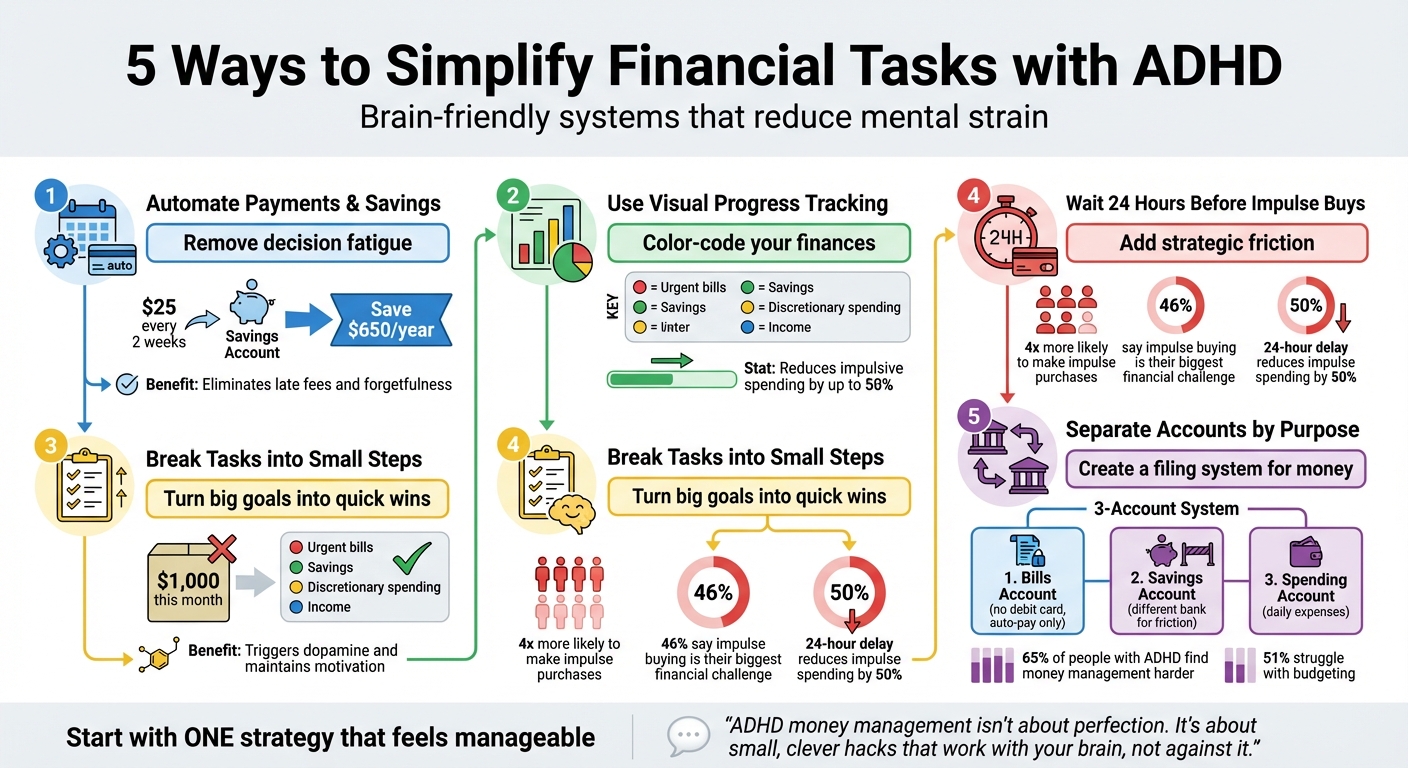
- Automate Payments and Savings: Set up automatic bill payments and savings transfers to reduce decision fatigue and avoid late fees.
- Use Visual Tools: Color-code expenses or track savings visually to make financial progress easier to understand and remember.
- Break Tasks into Small Steps: Divide big financial goals into smaller, manageable actions to stay motivated and avoid overwhelm.
- Wait 24 Hours Before Impulse Buys: Introduce a pause before non-essential purchases to curb impulsive spending.
- Separate Accounts by Purpose: Use different bank accounts for bills, savings, and daily spending to simplify budgeting and reduce spending temptations.
These strategies work with your brain, not against it, making financial tasks less daunting and more manageable.
5 ADHD-Friendly Strategies to Simplify Financial Management
ADHD Money Management Tips That ACTUALLY Work
Using an ADHD budget planner can help turn these tips into a sustainable routine.
sbb-itb-1fa9254
1. Automate Bill Payments and Savings Transfers
Simplifying financial tasks starts with working with your brain, not against it. For those managing money with ADHD, automating bill payments and savings transfers can be a game-changer. This approach removes the need for constant decision-making, tackling common challenges like forgetfulness, time blindness, and decision fatigue.
Lightens Mental Load
Every financial choice - whether it's paying a bill, deciding how much to save, or managing subscriptions - uses up mental energy. Automation eliminates these repetitive decisions, easing the strain on your executive function. As Garrett Johnson from No More Debts puts it:
"Automation is like having a personal assistant for your money. It takes the mental load off your brain, so you can focus on the rest of your life without added financial stress" [3].
By automating your payments, you can stop worrying about due dates or penalties, freeing up mental space for other priorities.
Builds Better Financial Habits
Start by setting up direct deposit for your paycheck. Then, automate at least the minimum payments for credit cards and utility bills. To "pay yourself first", schedule automatic savings transfers for the same day your paycheck arrives. Even small amounts - like a $25 transfer every two weeks - can add up to around $650 in a year [5]. These systems not only encourage saving but also create clear spending limits, helping you manage impulsive spending tendencies.
Reduces Impulse Spending
Automation sets firm boundaries for your spending. Once bills and savings are covered, the remaining balance in your checking account becomes your budget for discretionary expenses. This is where learning how to track spending with ADHD becomes essential to stay within those limits. Keeping your savings in a separate bank account can add a delay to transfers, making it harder to act on impulse. This setup also helps you avoid unnecessary costs, often referred to as the "ADHD tax", like late fees and interest charges. To stay on top of things, schedule an annual review of your automated payments and maintain a small buffer in your checking account to avoid overdraft fees.
2. Use Visual Progress Tracking Tools
For individuals with ADHD, traditional numeric spreadsheets can feel overwhelming and make it harder to focus on key details. Visual progress tracking tools, on the other hand, present financial data in a way that's easy to process and act on.
Reduces Cognitive Load
Color-coding is a simple yet powerful way to clarify financial priorities. For example, you can assign Red to urgent bills, Green to savings, Yellow to discretionary spending, and Blue to income. As Divergent Money explains:
"Colors are processed in a more direct and emotional way than just text. By assigning each financial category a hue, your brain instantly recognizes what it's looking at - and how to respond - before you even read the words" [9].
This approach helps your brain quickly identify what needs attention without overloading your mental energy or executive functions.
Encourages Consistent Habits
Reducing cognitive load is just the start - visual tracking also helps reinforce better financial habits. Physical tools, like charts or calendars, keep your goals visible and prevent them from being forgotten. For instance, a savings "thermometer" chart on your wall allows you to color in progress for every $50 saved. Each small win triggers a dopamine boost, making saving feel rewarding.
By seeing your progress daily, you're more likely to remember important dates like paydays, bill due dates, or savings milestones [9]. This constant visual reminder makes it easier to stay on track.
Supports ADHD-Friendly Engagement
Adding gamified features to your financial tracking can keep the process engaging. Apps like ImpulseLog use visual progress tracking combined with achievements and daily challenges to make managing money feel more like a game. This taps into the ADHD brain's need for immediate gratification, turning what might otherwise feel like a chore into something enjoyable.
Visual tools work hand-in-hand with automated systems, creating a balanced and engaging approach to money management that’s easier to maintain over time.
Minimizes Impulsive Financial Decisions
When you can physically see your progress toward a financial goal, it makes your future self feel more tangible. A visual savings tracker, for example, can provide a source of dopamine that competes with the urge to make impulse purchases. Studies show that adding strategic friction and visual tracking can stop impulse buying with ADHD and reduce impulsive spending by up to 50% [10].
Before making a purchase, simply glancing at your progress chart can give you a moment to pause and Understanding how mood affects your shopping can also help you pause and reconsider. This combination of visual cues, gamification, and automation creates a money management system tailored to the unique needs of an ADHD brain.
3. Break Tasks into Small, Gamified Steps
Managing finances can feel overwhelming, especially for individuals with ADHD. Breaking down large tasks into smaller, manageable steps can make the process more approachable. Instead of aiming to "get my finances in order" all at once, divide it into bite-sized actions. For example, treat "check balance" and "pay bill" as separate tasks. This strategy reduces the mental load and helps avoid the paralysis that often comes with tackling big, undefined goals [5].
Reduces Cognitive Load
Small, achievable steps create frequent "quick wins", which can keep motivation high. For instance, instead of aiming to save $1,000 in one go, set a more manageable goal like saving $20 this week [3][11]. Each time you hit one of these mini-goals, it triggers a dopamine release, which keeps your brain engaged and motivated.
Shorter budgeting cycles also help reduce the mental strain. Weekly budgeting, for example, involves fewer decisions than monthly planning, which can feel overwhelming. This simplified approach minimizes decision fatigue and lowers the chances of mistakes slipping through the cracks [8]. As Harold Robert Meyer, Founder of The A.D.D. Resource Center, explains:
"Traditional budgeting fails for ADHD because it demands sustained attention and detailed tracking [10]."
By breaking down tasks and timelines, managing money becomes less intimidating and more manageable.
Enhances Engagement for ADHD
Gamifying financial tasks can turn dull chores into something engaging and even fun. Think of your to-do list as a quest: paying a bill becomes "Defeat the Pile of Bills" [12]. Similarly, using the Snowball Method to tackle your smallest debts first creates visible progress quickly, building psychological momentum [11].
Apps like ImpulseLog take this idea further by adding achievements, daily challenges, and progress tracking. Completing tasks might earn you points or unlock badges, making financial management feel like a game while satisfying the brain's craving for immediate rewards [9][13].
Minimizes Impulsive Financial Decisions
Impulsive spending can be a significant challenge, but a simple 24-hour delay can cut these decisions by up to 50% [10]. The 24-hour rule involves waiting a full day before making any non-essential purchase. This pause gives your brain time to process the emotional urge and lets the initial dopamine-driven excitement fade. Often, you'll find the item isn't as necessary as it first seemed [3][10].
4. Wait 24 Hours Before Making Impulse Purchases
Managing finances with ADHD can be tricky, but the 24-hour rule is a simple yet effective way to curb impulsive spending. The idea is straightforward: when you feel the urge to make a non-essential purchase, give yourself a full day to think it over. This isn’t about relying solely on willpower - it’s about introducing a pause that disrupts the automatic cycle of "see it, buy it." For someone with ADHD, the gap between wanting something and acting on it can feel almost nonexistent. Harold Robert Meyer, Founder of The A.D.D. Resource Center, explains:
"The ADHD brain often experiences this gap [between wanting and acting] as compressed or nonexistent. 'That looks good' and clicking purchase can feel simultaneous." [16]
This waiting period gives your brain time to shift from an emotional reaction to a more rational decision. It’s a way to reduce the stress of making impulsive choices on the spot, helping you make clearer, more thoughtful decisions.
Minimizes Impulsive Financial Decisions
Research shows that adults with ADHD are about four times more likely to make frequent impulse purchases than those without ADHD [18]. By waiting 24 hours, you allow the initial dopamine rush - the one that makes the purchase feel so rewarding in the moment - to subside. Often, when you revisit the item a day later, you may realize you don’t actually want or need it. Leslie Hughes from Inflow highlights this dynamic:
"By postponing your purchase for at least 24 hours, you eliminate that quick hit of dopamine you'd get from buying it impulsively. You may not even want it anymore when you come back to buy it the next day." [19]
In a survey of 1,869 adults with ADHD, nearly half (46%) said their biggest financial challenge was resisting impulse buys [1]. This waiting period creates a buffer, helping you step back and evaluate whether the purchase is necessary or just a fleeting desire.
Reduces Cognitive Load
The 24-hour rule also eases the mental strain of constantly battling impulses. Instead of relying on sheer self-control, you’re leaning on a structured system that lightens the load on your executive functions [16][17]. This reduces the stress and mental exhaustion that can come with making snap decisions [14][15].
Adding small barriers, like removing saved payment information or taking a photo of the item instead of buying it right away, can also help reduce impulse spending [1]. After the waiting period, ask yourself, "Would I still buy this if I didn’t already have it?" This question can help you assess whether the item is truly worth it [7].
Makes It ADHD-Friendly
If waiting 24 hours feels overwhelming, start smaller. Try a 2-hour pause, using a timer to track the waiting period [18]. Another helpful trick is to think about the cost in terms of work hours. One ADDitude reader shared this perspective:
"Labor is a more real way to measure value vs. price. If I make $10 an hour, and I want something that costs $40, would I be willing to work four hours for that item?" [1]
Apps like ImpulseLog can also make this process more engaging. They let you track your impulse urges and turn the waiting period into a gamified challenge. By earning points and achievements, the delay feels less like a restriction and more like progress toward your financial goals. When paired with tools like automation and visual tracking, this strategy becomes a powerful way to manage spending habits tailored to an ADHD mindset.
5. Set Up Separate Accounts for Different Purposes
Managing all your money from a single account can quickly turn into a juggling act. It’s easy to mix up funds for rent, groceries, and fun when everything’s in one place. By setting up separate accounts for specific purposes, you create a simple system that keeps your finances organized - no mental gymnastics required. Think of it like a filing cabinet for your money, where each account has a clear role.
Reduces Cognitive Load
Trying to figure out if you can afford something while keeping track of other expenses is exhausting - especially if you have ADHD. Splitting your money into dedicated accounts, like one for bills, one for savings, and one for daily spending, takes the guesswork out of your decisions. Research shows that 65% of people with ADHD feel their condition makes managing money harder, and 51% struggle with budgeting [4]. By pre-assigning funds, you’ll never have to worry if that dinner out means you’ll come up short on rent. It’s like having a roadmap for your money, making everyday choices a whole lot easier.
Minimizes Impulsive Financial Decisions
Separate accounts also act as a safeguard against impulsive spending. Experts call this "strategic friction" - a built-in delay that makes it harder to access certain funds. Kate Dorman, Founder of Sound Financial Therapy LLC, suggests a simple yet effective tip:
"Move your emergency and long term savings accounts to a different bank than your checking account and impulse spending account, so you are not tempted to use them - out of sight, out of mind!" [4]
When your savings are tucked away at a different bank, it takes a few days to transfer the money. That delay gives you time to cool off and reconsider, reducing impulsive spending by up to 50% [10]. Meanwhile, setting up a "fun money" account with its own debit card lets you indulge in guilt-free purchases - within a limit you’ve already set.
Encourages Consistent Habits
A simple three-account system can make managing money feel almost automatic. Here’s how it works:
- A Bills Account for fixed expenses like rent and utilities. (Skip the debit card for this one - just automate payments.)
- A Savings Account at a different bank for long-term goals and emergencies.
- A Spending Account for daily expenses like groceries and entertainment.
Automate transfers to each account right after payday, so everything runs on autopilot.
| Account Type | Purpose | ADHD Benefit |
|---|---|---|
| Bills Account | Covers fixed monthly expenses (rent, utilities) | Reduces late fees and mental effort [10] |
| Savings Account | Emergency fund and long-term goals | Harder to access, discouraging overspending [4] |
| Spending Account | Daily expenses (groceries, fun money) | Sets clear limits without mental math [10] [2] |
This setup doesn’t just organize your money - it simplifies your life. Pair it with tools like ImpulseLog, which tracks your spending and turns progress into achievements, and you’ve got a system that’s both easy to use and motivating for an ADHD brain.
Conclusion
Managing money with ADHD doesn’t demand extraordinary willpower - it requires systems designed to align with how your brain works. Things like automating payments, using visual tools, gamifying tasks, delaying impulse purchases, and separating accounts aren’t about achieving perfection. Instead, they serve as practical guardrails to combat decision fatigue, address memory gaps, and avoid unnecessary costs like late fees or forgotten subscriptions.
When combined, these strategies create a reliable framework. Together, they tackle the specific challenges that make traditional budgeting methods fall short for those with ADHD. The key is to start small. Pick one strategy that feels approachable - maybe automating a single bill or setting up a savings account at a separate bank. As Sherry Andrew, ADHD Money Coach at Money Mindset Financial Coaching, says:
"ADHD money management isn't about perfection. It's about small, clever hacks that work with your brain, not against it" [6].
The best system is the one you’ll keep using - not just today but next week and beyond.
Give yourself room to experiment and adjust. Mistakes will happen, and that’s okay. Progress doesn’t have to be perfect, and you’re not alone in this journey. Tools like ImpulseLog can help by tracking impulse purchases and turning financial wins into motivating milestones. The ultimate goal isn’t a flawless budget - it’s creating habits that stick and lowering the stress of managing money in a way that works for your unique brain. These strategies not only simplify financial tasks but also empower you to face ADHD-related challenges head-on.
FAQs
What should I automate first if I’m behind on bills?
If you're struggling to keep up with bills, one of the easiest steps you can take is to automate your payments. By setting up automatic payments through your online banking, you remove the hassle of manual payments and reduce the risk of missing due dates. For added peace of mind, you can also set calendar reminders to keep track of when payments are scheduled. Automating your bills is a straightforward way to regain control and stay on top of your financial obligations.
How many bank accounts do I really need to make this work?
When it comes to the number of bank accounts you should have, there's no one-size-fits-all answer - it really depends on your personal habits and financial goals. However, a straightforward approach can make managing your money a lot easier. Many financial experts recommend sticking to three main accounts:
- A bills account: Use this exclusively for fixed expenses like rent, utilities, or loan payments.
- A daily spending account: This covers everyday purchases, such as groceries, dining out, or entertainment.
- A savings account: Reserved for building your emergency fund, big purchases, or future financial goals.
This setup keeps things simple and helps you stay organized without overcomplicating your finances. The trick is to choose a system that feels manageable and fits your lifestyle.
How can I stick to the 24-hour rule when I shop online?
Sticking to the 24-hour rule can be easier with a few simple strategies. For example, you can use browser extensions or even jot down reminders on sticky notes to prompt yourself to pause before hitting "Buy Now." Another effective trick? Remove saved payment details from your browser or device. This adds an extra step to the checkout process, making those impulsive purchases a little less tempting. These small changes give you the breathing room you need to rethink your choices and stay on track with your shopping plan.