ADHD and Micro-Saving: Common Challenges Answered
Managing money with ADHD can be tough, but small, automated steps can help. If you’ve struggled with saving, it’s not about lacking knowledge - it’s about how ADHD impacts decision-making and planning. Micro-saving offers a way to build financial habits without relying on willpower. Here’s how it works:
- Automate savings: Set up small, regular transfers (e.g., $5–$20) to a separate account.
- Focus on small wins: Celebrate every small deposit to stay motivated.
- Track spending habits: Use tools like apps to log avoided purchases and reduce impulse buys.
- Create a “Dopamine Menu”: Replace shopping with free, enjoyable activities for quick mood boosts.
These strategies work by breaking goals into manageable steps, minimizing stress, and providing quick rewards to keep you on track. Start small today - try automating one small transfer or logging one avoided impulse purchase - and build from there.
Money problems and ADHD? Here’s a financial therapist’s advice | Hyperfocus
sbb-itb-1fa9254
Why Standard Saving Methods Fail for ADHD
ADHD Financial Challenges: Key Statistics and Impact on Money Management
Executive Dysfunction and Money Planning
Traditional budgeting assumes you can plan ahead and follow through on those plans. But for people with ADHD, that's where things get tricky. As Ari Tuckman, Psy.D., explains:
"ADHD might as well be called Executive Function Deficit Disorder. It is fundamentally a disorder that impacts how we use the brain processes that help us perform day-to-day functions and work toward short- and long-term goals." [7]
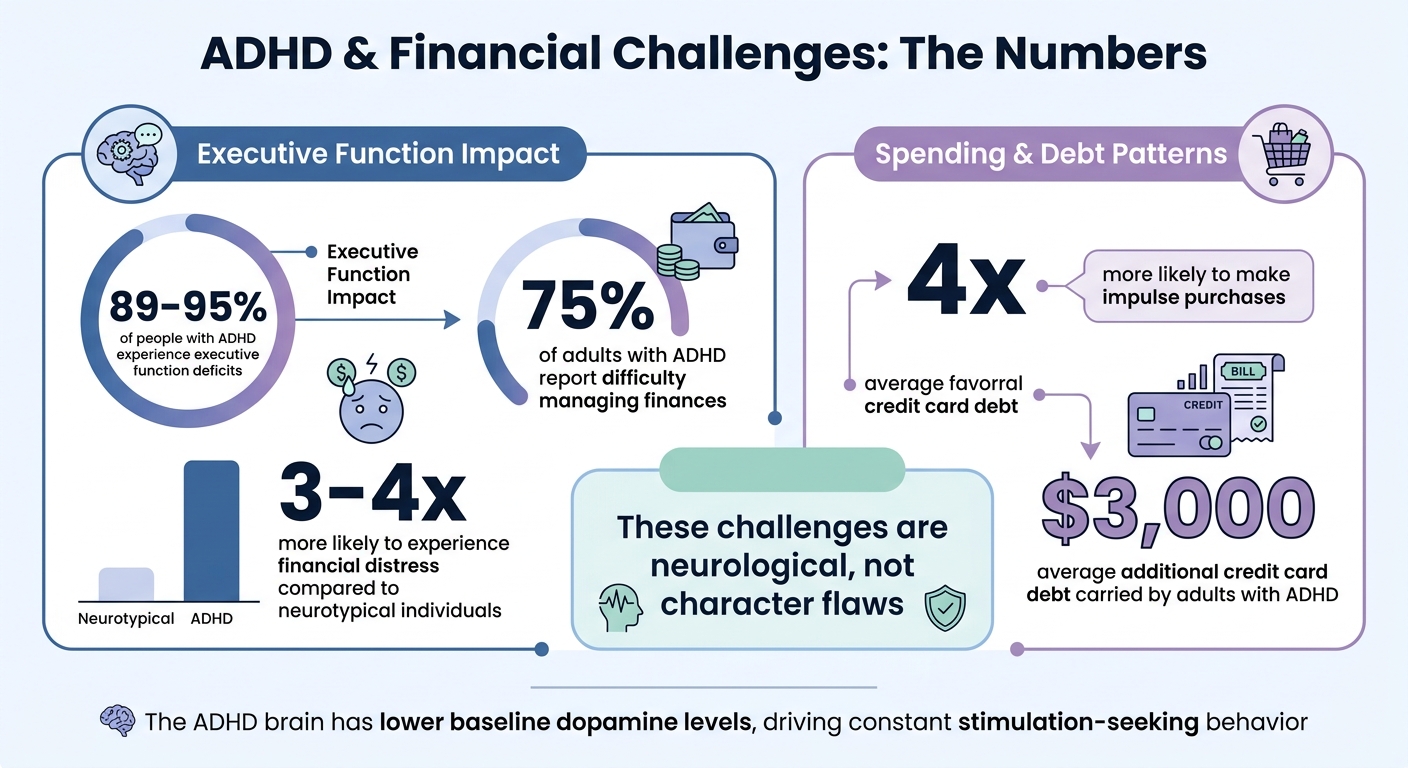
Here's the reality: Between 89% and 95% of people with ADHD also experience executive function deficits [6]. This can lead to challenges like forgetting about a small subscription fee or losing track of how much you've spent in a week. And then there's decision fatigue, which makes resisting the urge to stop impulse buying during late-night online shopping nearly impossible.
The numbers tell the story. About 75% of adults with ADHD report difficulty managing their finances [5], and financial distress is 3 to 4 times more common in this group compared to others [6]. It's not about lacking knowledge; the real struggle lies in execution.
And when you add the ADHD brain's dopamine dynamics into the mix, the challenges only grow.
How Dopamine Affects Spending and Saving
The ADHD brain, with its lower baseline dopamine levels, is constantly seeking stimulation [4] [8]. Shopping provides a quick dopamine boost - but that high fades fast, leaving the brain chasing the next hit.
Caren Magill, an ADHD coach, explains it perfectly:
"Impulsive spending isn't a result of poor math skills but a direct symptom of a brain craving stimulation." [3]
Saving money, on the other hand, is a long game. The reward might not show up for months or even years, which can feel completely disconnected for someone with ADHD. This is due to time blindness, where the future seems abstract and out of reach. Adults with ADHD are about 4 times more likely to make impulse purchases [4] and, on average, carry $3,000 more in credit card debt [4].
This isn't about willpower or poor decision-making - it's a neurological reality. The brain uses impulsive spending as a way to regulate dopamine, making the usual advice to "just stop spending" ineffective.
Recognizing these underlying mechanisms is the first step toward creating micro-saving strategies tailored to work with, rather than against, the ADHD brain.
How Micro-Saving Works for ADHD
What Micro-Saving Means
Micro-saving involves setting aside small amounts of money regularly - like $5 from your paycheck or the spare change from your morning coffee [9]. Instead of focusing on saving large sums all at once, this approach allows you to build your savings gradually. This method reduces financial stress and helps prevent the temptation to dip into savings for daily expenses [9]. For individuals with ADHD, traditional savings strategies that rely on big, infrequent deposits can feel daunting and unsustainable, unlike using an ADHD budget planner designed for consistency.
Automated micro-saving takes the pressure off by eliminating the need for constant decision-making, which can be a challenge for those dealing with executive dysfunction [9][2]. As neurotech and science writer Osheen Jain explains:
"The best system is the one you can still use when you're tired." [2]
In April 2025, Ally Bank showcased its "round ups" feature, which automatically saves the spare change from transactions. This tool helps users build emergency funds without the stress of tackling large financial goals [9]. For people with ADHD, these automated systems provide much-needed structure, making it easier to stick with saving habits. By focusing on smaller, manageable steps, this method also creates opportunities to celebrate every little financial success along the way.
Why Small Wins Matter
Micro-saving doesn’t just make saving easier - it turns it into a source of motivation. Each small deposit becomes a milestone, offering a quick dopamine boost that makes progress feel rewarding right away [1][4]. For individuals with ADHD, these small wins can be especially powerful, helping to counter feelings of inadequacy that often accompany their high expectations [10]. Every small step forward builds momentum, creating a sense of achievement that keeps the habit going.
Practical Micro-Saving Strategies for ADHD
Setting Up Automatic Savings
Saving money often boils down to one thing: remembering to do it. For many, automation solves this challenge by taking care of the hard part - actually putting the money aside. A straightforward approach is to adopt the "Pay Yourself First" method. For example, schedule an automatic $20 transfer to your savings account the day after payday. This way, the money is essentially "out of sight, out of mind" before you even think about spending it.
Harold Robert Meyer, Founder of The ADD Resource Center, explains it perfectly:
"The goal isn't perfection - it's protection from your future impulsive self while giving your current self permission to enjoy life." [11]
To make saving even easier, consider opening your savings account at a different bank from your checking account. This creates a little "strategic friction", as transfers between banks typically take 2–3 days. That delay can give you time to rethink impulsive spending decisions. If possible, choose a high-yield savings account to let your money grow over time. Another helpful approach is the "Three Buckets" system:
- Bills: Cover all your recurring payments automatically.
- Savings: Keep this separate to reduce the temptation to dip into it.
- Spending: This is your guilt-free money for daily use.
Start with one small automation this week - like a $10 transfer - then gradually build on it as you feel more comfortable.
Linking Savings to Daily Routines
Once you’ve automated your savings, tying it to your daily habits can make managing money feel more natural. A simple example is the "Payday Reset Ritual." Spend just five minutes on payday double-checking that your automations ran as planned. Reward yourself with something small afterward, like a favorite snack or a short break. This reframes payday as a moment of success rather than stress.
For non-essential purchases, try a 24-hour waiting rule. When mood affects your shopping and you feel the urge to buy something, add it to a wishlist or take a screenshot, then wait a full day before deciding. Often, the initial excitement fades, making it easier to skip unnecessary spending.
Another idea is to "body double" by scheduling a weekly video call with a friend to go over your finances together. And when you feel the itch to spend, have a prewritten "Dopamine Menu" ready. This could include quick, non-financial activities like taking a walk, playing a short game, or tidying up a small space. These alternatives can give you the same dopamine boost without touching your wallet.
Using Gamification and Visual Tracking
To keep your savings momentum going, try gamifying the process and using visual tools to track your progress. For instance, a simple wall chart or app that shows your growing savings can make your goals feel more real. As Harold Robert Meyer puts it:
"Visual progress tracking hijacks your dopamine system to make saving feel rewarding rather than restrictive." [11]
Turning abstract goals into something you can see and measure can transform saving from a chore into a satisfying achievement.
Controlling Impulse Spending While Saving
Building on the small wins of micro-saving, tackling impulse purchases head-on can take your financial management to the next level. Often, the gap between knowing you need to save and actually doing it comes down to challenges with self-regulation. For many people with ADHD, focusing on what you didn't buy can feel more empowering than just tracking your expenses. This way, every resisted purchase becomes a victory, not a missed opportunity.
Tracking Your Impulse Purchases
Apps like ImpulseLog make it easy to track avoided purchases, turning those moments of self-control into measurable savings. Each time you resist a purchase, you can log it and see your savings grow. For example, one user managed to save $5,000 in just one month using this method [12].
The app's free version offers basic features like logging, setting goals, and tracking streaks. If you opt for the Premium plan ($8.99/month), you get additional tools like AI-powered mood insights to help identify spending triggers.
Logging your mood alongside impulse decisions can reveal patterns - like spending more after a tough day or during late-night scrolling. A quick 20-second check-in each day can help you stay mindful and build momentum. Over time, this habit lays the groundwork for using rewards to reinforce your savings behavior.
Using Rewards to Reduce Impulse Buying
Once you've started tracking your avoided purchases, introducing rewards can help strengthen your new habits. Replacing the dopamine rush from spending with a sense of tangible progress can make a big difference. As David DeWitt, CFP®, explains:
"The goal is to give your brain rewards that are not arriving through checkout pages." [1]
ImpulseLog taps into this idea by gamifying self-control. Resisting an impulse earns you XP points, achievements, and levels, making saving feel like a game. The app's high ratings on the App Store suggest users find this approach both effective and motivating.
To take it a step further, create a "Dopamine Menu" - a list of free, enjoyable activities that can provide a similar boost without costing a dime. This could include a short walk, playing a quick game, or tidying up a small space. When you're tempted to spend, pick something from your menu instead and give your brain the stimulation it craves without touching your wallet. Start small by logging just one avoided purchase this week and see how quickly you can build momentum.
Conclusion
Managing money when you have ADHD isn’t about lacking discipline. As Dr. Russell Barkley puts it, "Financial struggles in ADHD are not typically caused by a lack of knowledge... it is a performance deficit. This means you know what to do, but your brain struggles to do it in the heat of the moment" [3]. The key is creating systems that align with how your brain naturally works, rather than trying to fight it.
This approach emphasizes small, manageable changes instead of overwhelming overhauls. Micro-saving strategies work because they break big financial goals into bite-sized, actionable steps that deliver quick, satisfying wins. Whether it’s automating a $50 transfer after payday, celebrating one avoided impulse buy, or using a simple visual cue to stay on track, these small actions build up over time.
The focus here is on consistency, not perfection. Start small - maybe delete just one shopping app this week or log your first avoided purchase in ImpulseLog. This app’s gamified features make saving feel rewarding, turning self-control into XP points and achievements. With tools like quick 20-second logging and AI-powered mood insights (available in the Premium plan for $8.99/month), you’ll get the structure you need without overwhelming your brain. Try one micro-saving strategy today and take the first step toward stronger financial habits.
FAQs
What’s a good micro-saving amount to start with?
Starting with a modest amount, like $5 to $10, can make a big difference. It allows you to ease into the habit without feeling overwhelmed while also addressing the impulsivity challenges that often come with ADHD. Taking this step gradually helps you stay consistent and gain confidence as you go.
How do I keep from transferring my savings back when I feel impulsive?
To keep from dipping into your savings impulsively, consider setting up some roadblocks. For instance, use accounts that are less accessible, like those without debit cards or immediate transfer options. Visual tools can also be a game-changer - track your savings progress with charts or apps that make your goals tangible. Building habits through streaks or earning small achievements can keep your motivation strong.
Another helpful trick? Give yourself a "cooling-off" period before transferring funds. This pause can help prevent emotional, spur-of-the-moment decisions. If you have ADHD or similar challenges, lean into systems that work with your natural tendencies. Automation, for example, can take the pressure off, while visual reminders can keep your goals front and center.
How can I spot the moods or situations that trigger my impulse spending?
You can figure out the emotions or situations driving your impulse spending by using tools that track patterns, like AI-powered mood insights or visual analysis. These tools can highlight recurring emotional triggers or specific contexts tied to impulsive buys, giving you a clearer path to manage them better.