
Top 7 Gamified Challenges for ADHD Money Goals
Managing money with ADHD can feel overwhelming due to impulse spending, difficulty sticking to budgets, and challenges with delayed gratification. Gamified tools like ImpulseLog break financial goals into small, rewarding tasks that align with ADHD brains' need for instant feedback and dopamine boosts. Here's a quick overview of seven gamified challenges that make saving money feel like a game:
- ImpulseLog Streak Quest: Earn XP and celebrate streaks for resisting impulse purchases.
- Savings Milestone Achievements: Break big goals into smaller steps with badges and progress bars.
- Mood Insight Dodgeball: Track emotional spending triggers and gain self-awareness.
- Predictive Analytics Treasure Hunt: Spot spending patterns and forecast financial outcomes.
- Category Conquest Battle: Focus on one spending category at a time to simplify budgeting.
- Visual Progress Reward Rally: Use trackers and digital trophies to visualize progress.
- Community Challenge Gauntlet: Add social accountability by working toward goals with others.
These challenges turn financial management into an engaging process, offering instant rewards and clear progress tracking to help you stay consistent. Start small, pick one challenge, and build momentum with small wins.
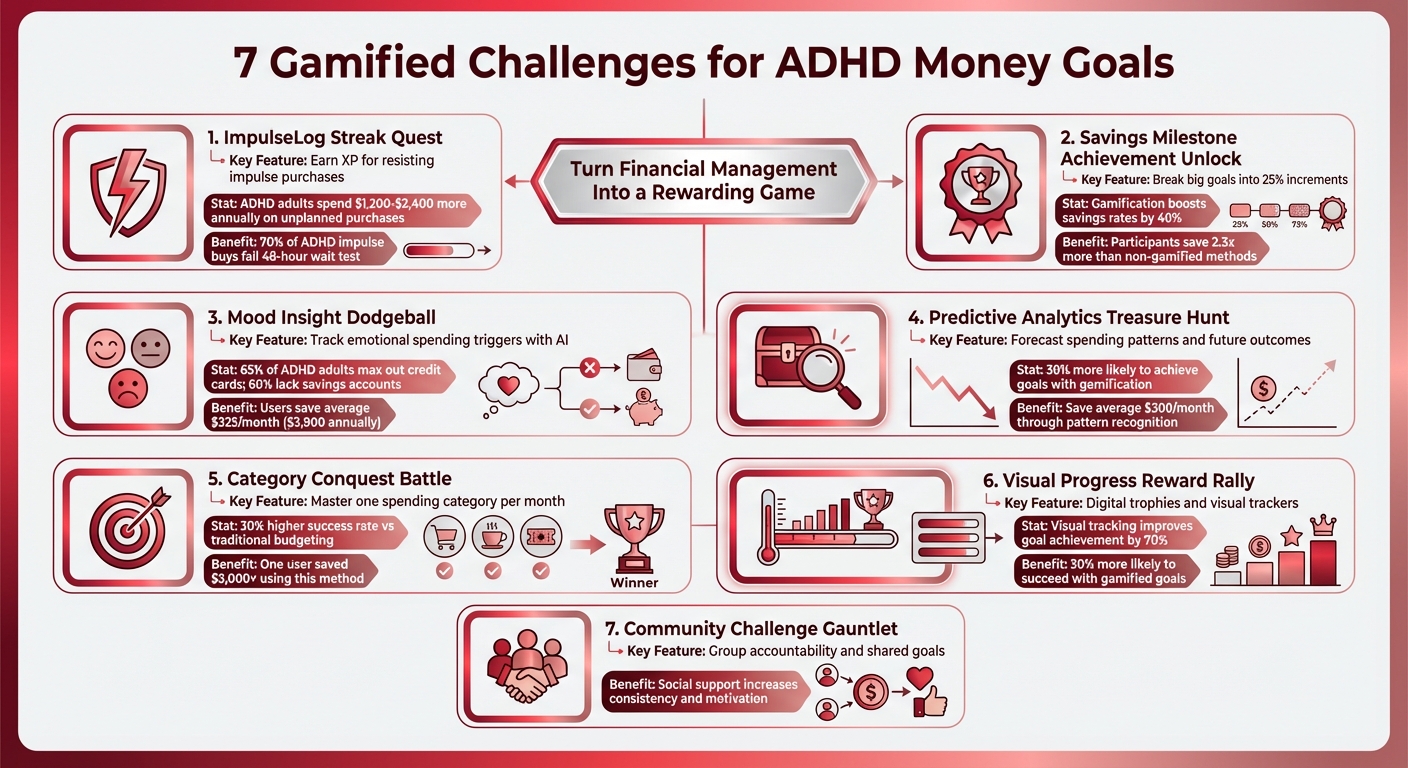
7 Gamified ADHD Money Management Challenges Overview
1. ImpulseLog Streak Quest
Engagement through gamification
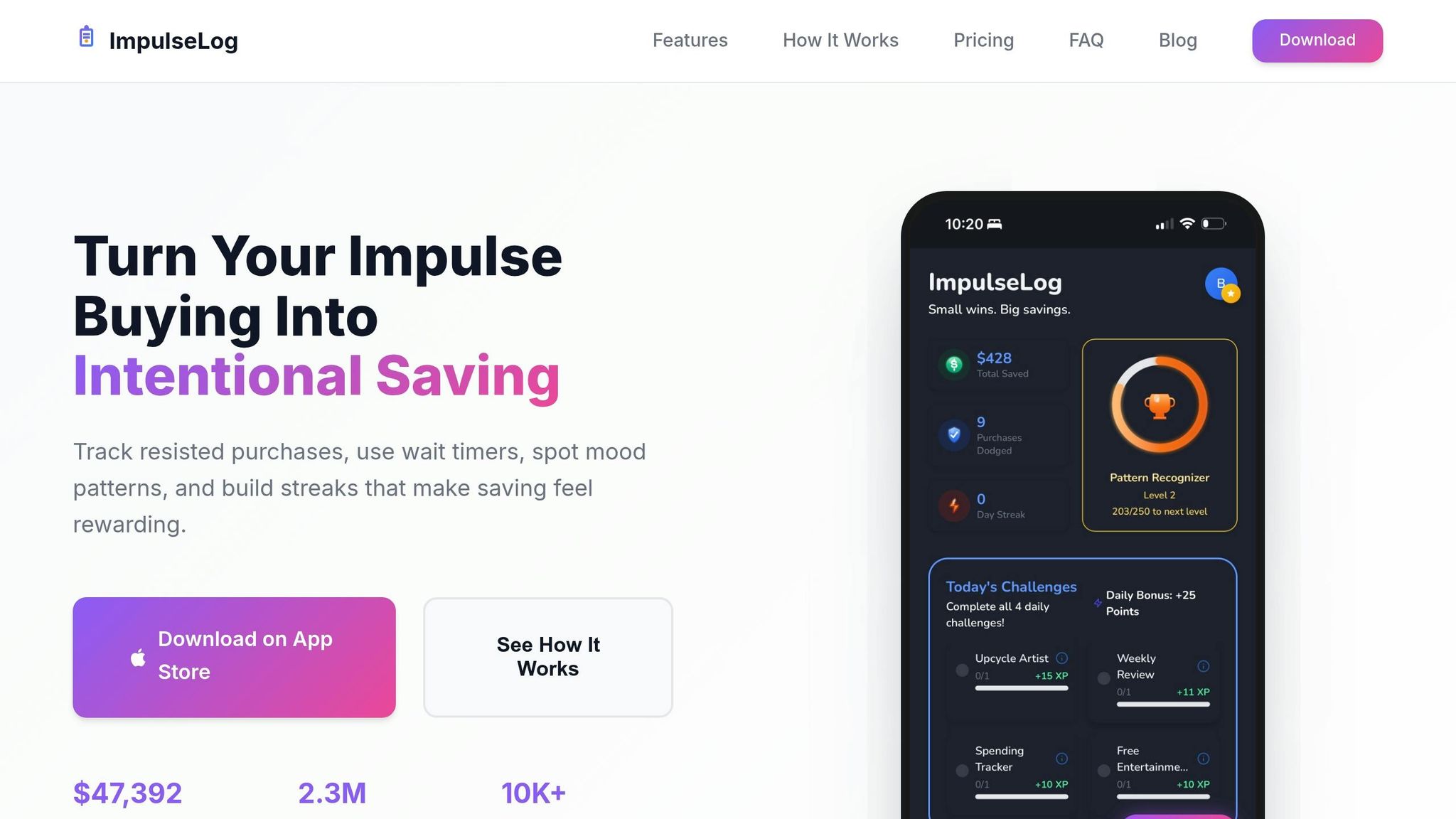
The Streak Quest turns daily impulse tracking into a fun, interactive game with 10 distinct levels, each featuring eye-catching metallic gradient colors ranging from red to rose. Every time you resist the urge to make an impulse purchase, you earn experience points (XP) that fill a progress ring with lively animations, giving you an instant feel-good moment. And when you log a victory or complete a challenge, celebratory confetti animations provide immediate positive reinforcement - something ADHD brains thrive on.
Custom icons, like a lightning bolt for streaks and a shield for avoided purchases, make your progress both visible and rewarding. Each time you record an "almost-buy" in the Impulse Ledger, you get instant feedback. This design makes saving money not only easier but also more engaging for users with ADHD.
Relevance for ADHD money management
On average, adults with ADHD spend $1,200–$2,400 more annually on unplanned purchases, late fees, and forgotten subscriptions compared to neurotypical adults[9]. The Streak Quest shifts the focus from the dopamine high of buying something new to the satisfaction of building a consistent record of smart financial choices.
Another helpful tool is the "Pause Button", which lets you set a 24-hour or custom wait timer before making a purchase. This delay creates a crucial barrier between the initial impulse and the final checkout - especially valuable since around 70% of ADHD-driven impulse buys fail a 48-hour "wait and see" test[9]. The daily check-in process takes less than 20 seconds, making it a quick and manageable habit to build.
Ease of tracking and progress monitoring
To make habit formation even simpler, the Daily Ritual guides users through an easy check-in process. Here, you can log your mood, review pending purchase decisions, and celebrate your current streaks. Visual tools like colorful charts, dynamic XP progress rings, and Piggy Bank goal trackers give you a clear view of your growing savings.
Incentives and rewards for consistency
One standout feature is the Streak Shield Indicator. This tool protects your streak on days when you complete an activity but might forget to log smaller details, like your mood. By prioritizing consistency over perfection, the design helps you stay motivated and avoid unnecessary frustration.
"ImpulseLog isn't about being perfect. It's about building momentum - one resisted impulse at a time." - ImpulseLog
These features make daily engagement rewarding, aligning perfectly with the financial goals of ADHD users.
Traditional Budgeting Impossible? The ADHD Money Method
2. Savings Milestone Achievement Unlock
The Savings Milestone Achievement Unlock builds on the success of impulse resistance challenges by turning long-term financial goals into a series of rewarding, smaller steps.
Engagement through gamification
Breaking down big savings goals - like setting aside $5,000 for an emergency fund - into smaller, manageable milestones (such as 25% increments) makes the process feel more achievable. Each milestone unlocks unique badges and animated progress bars, delivering instant gratification through visual and emotional rewards.
The app uses intuitive savings trackers to make abstract numbers feel real. Every time you hit a milestone, you’re rewarded with a new badge featuring its own design and color, making the act of saving feel like leveling up in a game. This approach transforms what could feel like a tedious task into a fun, rewarding experience.
Relevance for ADHD money management
For individuals with ADHD, saving money can be particularly challenging due to difficulties with delayed gratification. Traditional saving methods often feel unrewarding, but gamified savings apps can change that dynamic. Research shows that gamification can boost savings rates by up to 40% and that participants in gamified financial challenges save 2.3 times more than those who don’t engage in them[10].
"The problem with budgeting and saving money is that it doesn't match the rewards associated with spending money. The dopamine that gets released when you buy something new is way more than you get by putting money into your savings." - Rule Money[2]
ImpulseLog counters this challenge by offering micro-rewards for small wins, like staying consistent for a week, and major rewards for hitting bigger milestones. These regular dopamine boosts help maintain engagement and make saving feel as rewarding as spending.
Ease of tracking and progress monitoring
Visual tools can make a big difference when it comes to achieving financial goals. Studies show that visual progress tracking can improve goal achievement by 70%[10]. ImpulseLog simplifies this with real-time progress updates, showing exactly how close you are to your next milestone. This clear connection between small actions - like skipping a $30 impulse buy - and larger goals keeps motivation high.
Savings progress isn’t just measured in dollars. You can also track your achievements through badges earned and levels completed, giving you multiple ways to celebrate success. Plus, the app encourages non-monetary rewards for milestones, like treating yourself to a guilt-free afternoon with your favorite hobby or a movie night, ensuring your financial goals stay on track[11][12].
Incentives and rewards for consistency
ImpulseLog offers a mix of digital and experiential rewards to keep users engaged. Reaching milestones unlocks new features, custom categories, and special achievement badges, all designed to encourage consistent saving habits.
For those looking for additional features, the Essential plan ($4.99/month) grants access to all 23 achievements and unlimited streak tracking. Meanwhile, the Premium plan ($8.99/month) includes AI-powered mood insights and predictive analytics to help identify patterns in your saving behavior. These tools turn daily decisions into a game, where resisting an impulse purchase brings you closer to both short-term rewards and long-term financial stability.
This milestone-based approach lays a strong groundwork for tackling even bigger financial challenges in the future.
3. Mood Insight Dodgeball
Mood Insight Dodgeball transforms cooling-off periods into a game where you dodge emotional spending triggers before they turn into impulse buys. Instead of just tracking your spending, this challenge digs deeper, helping you figure out why you feel tempted to spend. It builds on earlier challenges by focusing on emotional triggers, boosting both self-awareness and financial discipline.
Engagement through Gamification
Every time you resist an impulse purchase, you log your emotional state. ImpulseLog's AI then analyzes how moods like stress, boredom, or excitement influence your spending habits. As you avoid impulses and reflect on your emotions, you earn XP and level up, turning self-awareness into a rewarding experience.
There’s also a Prediction Game: guess which mood will be your biggest spending trigger before reviewing your weekly AI summary. The excitement of uncovering your results keeps you motivated without relying solely on willpower. Like the previous challenges, this one breaks a tough process into fun, manageable steps.
Relevance for ADHD Money Management
For individuals with ADHD, impulsive spending often feels less like a choice and more like a brain seeking stimulation. Studies show that about 65% of adults with ADHD frequently max out their credit cards, and over 60% don’t have a savings account [14]. This challenge shifts the narrative from punishing spending habits to promoting emotional regulation and self-care.
"Impulsive spending has almost nothing to do with understanding math or money. Instead, it is a direct symptom of a brain that is starving for stimulation." - Dr. Russell Barkley, Clinical Psychologist [14]
By identifying patterns and triggers - like payday excitement or boredom - you can create intentional pauses between the urge to spend and the action itself. These insights, combined with practical tools, help you track and counteract high-risk moments. On average, users of impulse-control apps report saving about $325 per month, adding up to $3,900 annually [8].
Ease of Tracking and Progress Monitoring
Tracking your mood is quick and easy with tagging features and visual cooldown timers that reinforce your progress. Notifications prompt you to check in with your emotional state. For those on the Premium plan ($8.99/month), AI-powered insights and predictive analytics reveal spending patterns that might otherwise go unnoticed. Weekly summaries highlight which emotions are most tied to your spending urges, helping you stay ahead of them.
Incentives and Rewards for Consistency
This challenge focuses on rewarding thoughtful decisions over impulsive ones. Every mood log earns you XP and achievements, keeping you motivated. The Free plan includes basic mood tracking and 7-day streaks, while the Essential plan ($4.99/month) unlocks all 23 achievements and unlimited streak tracking. Colorful charts and celebratory animations provide immediate feedback, giving you the dopamine boost that traditional budgeting often lacks. ImpulseLog’s design works with your brain’s natural tendencies, making financial management feel less like a chore and more like a game.
4. Predictive Analytics Treasure Hunt
The Predictive Analytics Treasure Hunt is an exciting way to turn your financial data into a game, making savings goals feel more tangible and actionable. By uncovering hidden spending patterns and forecasting future outcomes, this tool transforms abstract financial planning into an engaging and interactive experience.
Engagement through Gamification
This treasure hunt identifies spending patterns like emotional triggers, payday habits, and holiday spending, turning them into trackable clues [13]. With ImpulseLog's Premium plan, you gain access to predictive analytics that show how an impulse purchase could grow if invested over 5–30 years, giving you a clear reward for resisting temptation [13]. You can also unlock Skill Trees to enhance your financial knowledge [11]. To keep you motivated, dynamic visuals - like a growing plant or a mountain climb - offer a dopamine boost that encourages long-term engagement [11] [13].
Relevance for ADHD Money Management
For individuals with ADHD, predictive tools help connect today’s choices with tomorrow’s outcomes. Features like Future Freedom Calculators transform vague savings goals into clear, measurable results, such as how many days of expenses you’ve covered or how many months of retirement you’ve secured [11]. This is especially impactful since studies show that people who gamify their financial goals are 30% more likely to achieve them compared to those who stick with traditional budgeting methods [11]. Additionally, AI-powered pattern detection addresses common ADHD challenges like forgetfulness and difficulty with multi-step planning, reducing the mental effort required to manage money [15] [7]. This foresight complements the immediate rewards offered by earlier challenges, creating a well-rounded approach to financial management.
Ease of Tracking and Progress Monitoring
ImpulseLog’s predictive tools automatically analyze your spending habits, removing the need for tedious manual tracking. The Premium plan provides insights into what triggers your spending and forecasts your future balance based on current behaviors. Visual dashboards and thermometer-style charts provide instant feedback - especially helpful for ADHD brains that respond well to visual cues [7]. You can even tag savings goals with emojis (like 🏖️ for a vacation), offering quick, relatable visual reminders. Just as earlier challenges bring daily decisions into focus, this tool helps bridge the gap between present actions and future results, addressing ADHD-related time blindness.
Incentives and Rewards for Consistency
Each discovered pattern and accurate prediction earns XP and unlocks achievements, making intentional spending feel rewarding. Behavioral finance apps like this have been shown to help users save an average of $300 per month by shifting spending habits [13]. Automatic savings rules can be set to activate whenever you resist an impulse buy, turning every "no" into a concrete financial win. This instant feedback satisfies the brain’s craving for stimulation while reinforcing positive financial behavior.
sbb-itb-1fa9254
5. Category Conquest Battle
Category Conquest Battle turns budgeting into a month-by-month challenge, where you tackle one spending category at a time. Instead of trying to monitor every expense all at once - which can feel overwhelming - you focus on mastering a single category, like dining out, groceries, or online shopping. This method works well because ADHD brains often respond better to short-term, focused projects rather than long-term, all-encompassing goals [4]. By narrowing your attention, this strategy reduces stress and helps you refine your financial habits step by step.
Engagement through Gamification
Adding a playful twist to your budget can make the process feel less like a chore and more like a game. For instance, renaming categories with fun titles like "Grocery Gauntlet" or "Subscription Sleuth" can make budgeting more engaging. You can also try the "Prediction Game" before reviewing your monthly spending - guess which category will be the biggest spender, then check the results. This approach transforms analyzing your spending into a fun puzzle rather than a source of guilt [4]. Tools like ImpulseLog enhance this experience with visual trackers that provide instant feedback and a dopamine boost [2][12]. This playful, gamified method helps explain why focusing on one category at a time is particularly effective for managing money with ADHD.
Relevance for ADHD Money Management
Category Conquest reshapes budgeting into an exciting and manageable project. This approach taps into curiosity about your spending habits, which helps lighten the mental load that budgeting often brings [2][4]. By turning financial management into an engaging activity, it becomes easier to stay motivated and consistent.
Ease of Tracking and Progress Monitoring
Breaking tasks into smaller, manageable steps makes budgeting less daunting. For example, a daily habit like quickly swiping through your transactions in ImpulseLog makes tracking easier to stick with [2]. By zeroing in on one category each month, you can avoid the all-or-nothing mindset that often derails budgeting efforts [4]. Real-time visual trackers and tiered rewards - like earning Bronze for small wins, Silver for monthly success, and Gold for major milestones - offer clear indicators of progress. These tools help eliminate the confusion of wondering, "Where did all my money go?" - a common challenge for individuals with ADHD [5].
Incentives and Rewards for Consistency
Category Conquest aligns perfectly with ImpulseLog's mission to turn financial discipline into a rewarding experience. Each category you master earns you XP and unlocks achievements, making your financial journey feel like a game. Research shows that people using gamified methods are 30% more likely to hit their financial goals compared to those relying on traditional approaches [11]. Adding micro-rewards - like playing a favorite song or enjoying a small treat after logging a transaction - can reinforce the habit loop [4]. One participant in a gamified budgeting challenge saved over $3,000 by sticking to the mechanics. And when the novelty wears off (often after two or three months), switching to a new "Challenge Mode" or focusing on a fresh category can keep the process exciting [4].
6. Visual Progress Reward Rally
Visual Progress Reward Rally turns managing your finances into an engaging and interactive experience. Instead of staring at static spreadsheets, you’ll see progress bars fill up, unlock digital trophies, and celebrate every positive step. This approach works particularly well for ADHD brains, which often struggle with delayed gratification - offering instant rewards to keep you motivated and consistent [11]. By building on earlier challenges, this visual method ensures your financial progress always stays front and center.
Engagement through Gamification
This rally uses gamified visuals to make money management feel concrete and engaging. Tools like savings thermometers, "Debt Smash" visuals, and ImpulseLog’s progress trackers help transform abstract financial goals into something you can see and interact with [11]. For instance, you could break a large debt into smaller, themed chunks - like “The Vacation Villain” or “The Credit Card Monster” - and color them in as you pay them off [17]. ImpulseLog takes it further by awarding digital trophies and achievement badges when you hit milestones [12].
Designed for ADHD Money Challenges
Visual trackers are especially helpful for ADHD-related struggles like time blindness [19] and object permanence issues [18]. When financial goals are buried in an app or only exist in your head, they can easily slip out of focus. A physical or digital tracker acts as a constant visual reminder, helping you connect today’s actions to the bigger picture. As Ellyce Fulmore puts it:
"The issue was never you. It was always the fact that the world itself was not designed with you in mind. And that includes the systems we've been taught to use with our money" [18].
With visual rallies, money management is tailored to work with your brain, not against it.
Simplified Tracking and Monitoring
Breaking big goals into smaller, manageable steps makes the process less overwhelming. For example, using a sticker chart where each sticker equals $25 turns a $5,000 goal into 200 mini-celebrations [18]. ImpulseLog’s automated tools, like progress bars and streak counters, make tracking effortless by updating as you log transactions - no manual math required [11]. Plus, it’s important to choose a system that welcomes you back even after a lapse [19].
Rewards That Keep You Motivated
Pairing visual milestones with rewards keeps the momentum going. Tiered rewards - like treating yourself to a favorite snack after a 7-day streak or planning a weekend getaway after 12 months - help reinforce your efforts [4]. Studies show that people who gamify financial goals are 30% more likely to achieve them compared to those using traditional methods [11]. You can also set up a “Fun Fund,” allocating 10% of your savings for guilt-free treats, ensuring you don’t feel deprived along the way [3]. By celebrating every small win, the visual rally makes staying consistent both enjoyable and rewarding.
7. Community Challenge Gauntlet
This challenge takes the idea of gamified tasks and adds a social twist to keep the momentum going. The Community Challenge Gauntlet transforms budgeting from a solitary effort into a team activity. Instead of tackling financial goals on your own, you collaborate with friends or family who face similar challenges. This added social layer creates the structure and accountability that ADHD brains often need to stay on track [11][6]. Whether it's a "Best Deal" competition in a group chat or a shared savings circle, the gauntlet turns budgeting into a shared adventure rather than a lonely grind.
Engagement through Gamification
daily challenges thrive by blending social interaction with financial goals. For example, you might join a WhatsApp group where everyone shares their best savings story of the month, and the group votes on a winner. This not only boosts morale but also spreads useful money-saving tips [3]. ImpulseLog’s free plan includes daily challenges that let you compete with others while tracking your progress. Some groups use leaderboards for friendly competition, while others adopt RPG-style "party systems", where completing tasks earns experience points and helps the team defeat virtual monsters [19]. This group dynamic complements individual efforts and reinforces better financial habits.
Joel from Budgets Are Sexy highlights the value of this approach:
"Sharing your success stories and celebrating other people's successes is soooo important in life. It boosts morale, motivates people, and rewards good progress" [3].
Why It Works for ADHD Money Management
For people with ADHD, external support can be a game-changer when it comes to staying consistent. daily challenges provide that support, offering immediate rewards like a dopamine hit from sharing a win in a group chat or seeing your name climb a leaderboard [12][4]. Explaining your success to others - known as the "teaching mode" effect - helps solidify new habits [4]. ImpulseLog’s built-in streak counters and visual trackers make team progress just as rewarding as individual achievements.
Money Mentor Online sums it up perfectly:
"The journey's more fun (and sustainable) when you're not going solo" [12].
Simplified Tracking and Monitoring
daily challenges make tracking progress a shared, enjoyable activity. Group spreadsheets filled with emojis, for example, can turn abstract goals into something tangible and fun [11][12]. You can start small with a "No-Spend Weekend" challenge alongside a partner, then work up to bigger group goals [11][6]. ImpulseLog’s community tools also integrate streak counters and achievement systems, allowing you to share progress without revealing specific dollar amounts - perfect for those who prefer financial privacy.
Motivation Through Rewards and Recognition
The gauntlet keeps you engaged with a mix of social recognition and rewards. Celebrate milestones with group acknowledgment rather than extra spending [11]. Some communities introduce surprise rewards or bonus envelopes to keep things exciting and prevent monotony [6]. Another option is a "fun fund", where a portion of the group’s savings is set aside for guilt-free treats, unlocked when collective milestones are achieved [16][1]. Virtual badges and occasional rewards add to the sense of accomplishment, while the combination of social accountability and instant feedback makes this challenge particularly effective for ADHD money management.
Why Gamified Challenges Work for ADHD Money Management
Managing money with ADHD isn't about not knowing what to do - it’s about struggling to follow through. Dr. Russell Barkley, a Clinical Psychologist, puts it this way:
"Financial struggles in ADHD are not typically caused by a lack of knowledge... it is a performance deficit. This means you know what to do, but your brain struggles to do it in the heat of the moment." [14]
The core issue lies in dopamine. ADHD brains naturally have lower dopamine levels and fewer receptors, which drives a constant need for stimulation [21]. Saving money doesn’t provide the same immediate reward as spending does. A purchase delivers a quick dopamine hit, while saving feels flat and unrewarding [2]. Gamification addresses this by turning positive financial habits into dopamine-boosting activities. Things like badges, streaks, and progress bars make saving feel more rewarding in the moment.
Time blindness, another hallmark of ADHD, adds to the challenge. Long-term goals, like saving for something six months away, often fail to create the sense of urgency needed to act [21]. Gamified challenges break these distant goals into smaller, daily or weekly tasks. Completing a streak or unlocking an achievement provides instant feedback, making progress tangible. For example, ImpulseLog’s visual trackers and daily challenges transform abstract savings into clear, engaging milestones that align with the ADHD brain's need for immediate rewards.
Studies show that many adults with ADHD face common financial hurdles, like exceeding credit limits or forgetting to pay bills [14]. Traditional budgeting tools often fall short because they’re built for people who are already confident with money [2][20]. ImpulseLog takes a different approach by using "save-to-win" mechanics instead of complex spreadsheets. Features like quick impulse logging, AI-driven mood insights, and achievement systems simplify financial management, breaking it into small, manageable actions that are easy to engage with [2][20].
External support also plays a critical role in overcoming ADHD-related challenges with planning and memory. ImpulseLog provides scalable features that offer the structure needed to stay consistent. By combining instant rewards with external accountability, it transforms financial management from an overwhelming task into something approachable and even enjoyable. These gamified strategies make managing money feel less like a chore and more like a game you can win.
Conclusion
Gamified challenges make managing money feel less like a chore and more like a rewarding game - perfect for an ADHD brain that craves engagement. Instead of struggling against the need for instant gratification, these strategies offer quick dopamine boosts for positive financial habits. Tools like visual trackers, streaks, and achievement unlocks take abstract goals and transform them into something tangible and immediately satisfying.
The key is finding a challenge that fits your specific needs. For example, no-spend weekends can help curb impulse buys, while automated systems are great for staying consistent without relying on memory. Interestingly, research shows that people who treat financial goals as games are 30% more likely to succeed than those who stick to traditional budgeting methods [11].
Starting small is essential to avoid burnout. Pick one challenge and commit to it for 30 days. Use tools like progress charts or phone reminders to stay focused. Remember, the goal isn’t to be perfect - it’s about creating momentum through small wins that add up over time.
ImpulseLog brings these gamified strategies together in one place, offering features tailored for ADHD brains. With quick logging, AI-driven mood insights, daily challenges, and visual progress tracking, it removes the hurdles of traditional budgeting. The Free plan includes impulse tracking, basic achievements, and daily challenges, making it easy to dive in without a big commitment.
FAQs
Which of the 7 challenges should I start with if I’m new to ImpulseLog?
ImpulseLog’s Daily Challenges are a fantastic way to ease into better spending habits. These challenges provide manageable, engaging tasks each day, designed to keep you motivated while helping you build streaks and earn rewards.
The beauty of this feature lies in its simplicity and consistency. By tackling small, daily tasks, you create a structured routine that feels more like a game than a chore. It's an ideal starting point for anyone looking to improve their financial habits without feeling overwhelmed.
How do I use the Pause Button to stop impulse buys in the moment?
To make the most of the Pause Button strategy, give yourself a cooling-off period - say, 24 to 48 hours - before committing to a purchase. If something catches your eye, snap a photo of it or save it to a wish list, then hit pause. This simple delay gives you time to think about whether the purchase truly fits your goals. It’s a practical way to tap into behavioral finance techniques, helping curb impulse buys and promote more thoughtful spending.
Do I need the Premium plan for mood insights and predictive analytics to help?
No, you don’t need a Premium plan to access mood insights or predictive analytics. Based on the available information, these features are not specifically tied to a premium subscription.