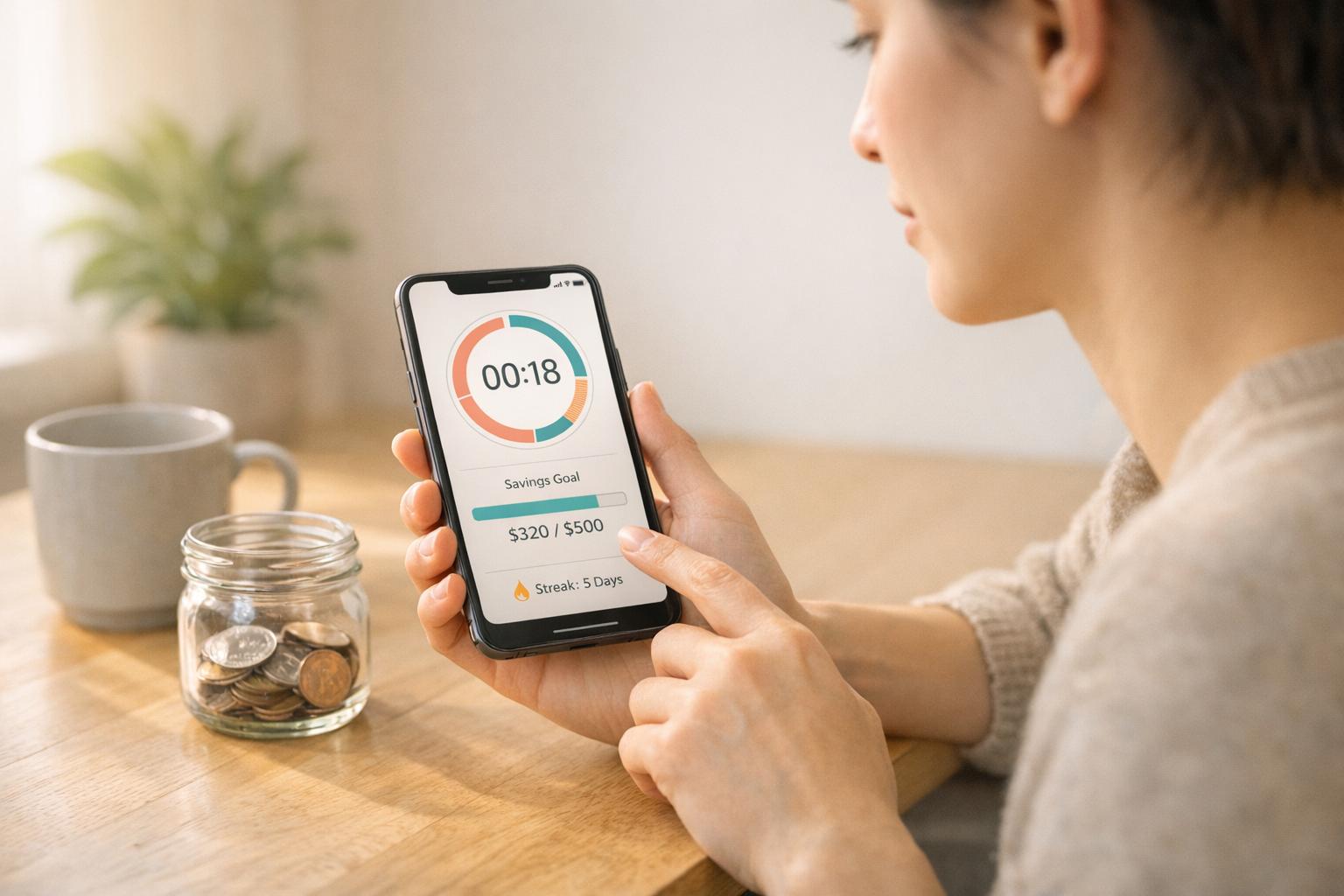
How Feedback Loops Boost ADHD Spending Control
If you often find yourself struggling with impulse spending due to ADHD, you're not alone. ADHD affects how the brain processes rewards and self-regulation, leading to challenges like overspending, maxed-out credit cards, and missed payments. But here's the good news: feedback loops can help you regain control.
Key Takeaways:
- ADHD brains seek dopamine, making impulsive purchases feel rewarding but financially harmful.
- Feedback loops provide immediate responses to actions, helping ADHD users pause and make better decisions.
- Apps like ImpulseLog use real-time tracking, visual rewards, and gamified features to turn saving into a dopamine-friendly experience.
- Users report saving thousands of dollars by resisting urges and tracking progress.
How It Works:
- Positive Feedback Loops: Reward good behavior, like resisting a purchase, with points or achievements.
- Negative Feedback Loops: Slow down impulsive decisions with tools like wait timers or alerts.
- Visual Tools: Progress bars and savings trackers provide instant, satisfying feedback.
- AI Insights: Identify emotional triggers like stress or boredom that lead to spending.
With tools like ImpulseLog, managing ADHD-related spending becomes easier, transforming impulsive habits into intentional savings. Want to make saving feel as rewarding as spending? Feedback loops might be the answer.
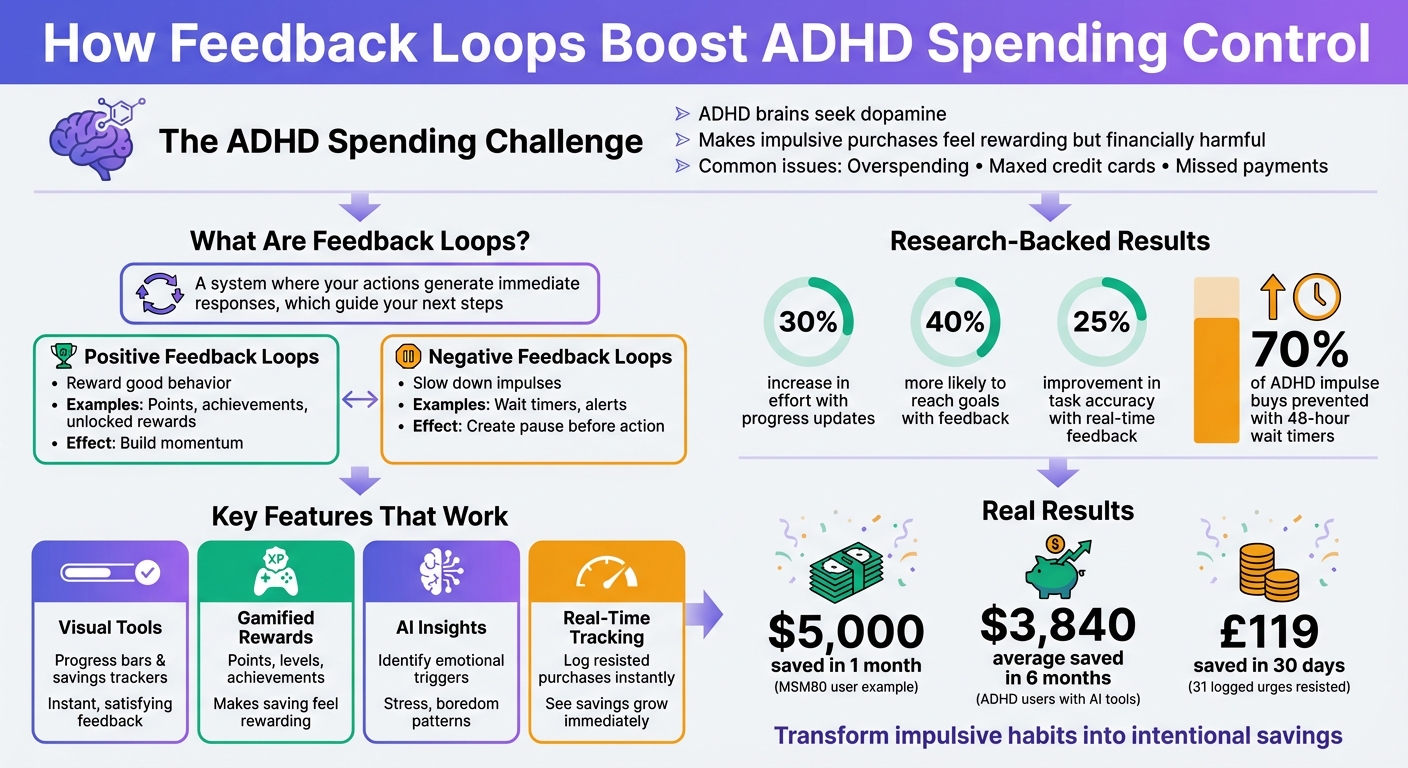
How Feedback Loops Help ADHD Brains Control Impulse Spending
MANAGING MONEY WITH ADHD PART 3 | the BEST way to budget (and STOP impulse spending) with ADHD
sbb-itb-1fa9254
What Feedback Loops Are and How They Help ADHD Brains
A feedback loop is essentially a system where your actions generate immediate responses, which then guide your next steps. In simple terms, you do something, the system reacts right away, and that reaction helps you decide what to do next. As Learning Loop explains:
"Feedback loops refer to the process where the outputs of a system are circled back and used as inputs, providing users with real-time information about their actions to reinforce or modify their behavior." – Learning Loop [7]
This instant exchange of information is particularly helpful for tackling impulsive spending, a common challenge for those with ADHD. Learning how to track spending effectively can make these feedback loops even more powerful.
Dr. Barkley highlights a key struggle for ADHD brains: you often know what to do, but executing it in the moment feels like a different battle. Feedback loops step in by offering real-time cues that counteract ADHD’s difficulties with self-regulation, especially when dopamine levels are low [4]. These cues come in two forms - positive and negative feedback loops - that work together to boost success and curb risky financial decisions.
- Positive feedback loops reward good behavior, like earning points or unlocking achievements when you resist an unnecessary purchase. These rewards build momentum and reinforce better habits.
- Negative feedback loops act as "speed bumps", slowing you down and encouraging a pause before making impulsive choices [7][1].
Research backs up the power of feedback. For instance, participants who received progress updates increased their effort by about 30% compared to those who didn’t. Plus, people with feedback are 40% more likely to reach their goals, and task accuracy improves by 25% when real-time feedback is in play [7]. For ADHD brains, this immediate feedback not only helps with decision-making but also provides a much-needed boost of dopamine - without the financial drawbacks.
Speed matters, too. The faster the feedback, the greater its impact. Visual tools like progress bars or color-coded alerts are especially effective because ADHD brains are wired to process visual information more easily than abstract data. For example, logging a resisted impulse and instantly seeing your savings increase provides a quick dopamine hit. This brief but satisfying reward helps meet the brain’s craving for stimulation while encouraging better financial habits [3].
This is where gamified financial tools shine. They transform saving money into an engaging experience by delivering quick, visually rewarding feedback. Tools like ImpulseLog use these strategies to make smart spending decisions feel both fun and rewarding in the moment, reinforcing positive habits right away.
How ImpulseLog Uses Feedback Loops to Reduce Impulse Spending
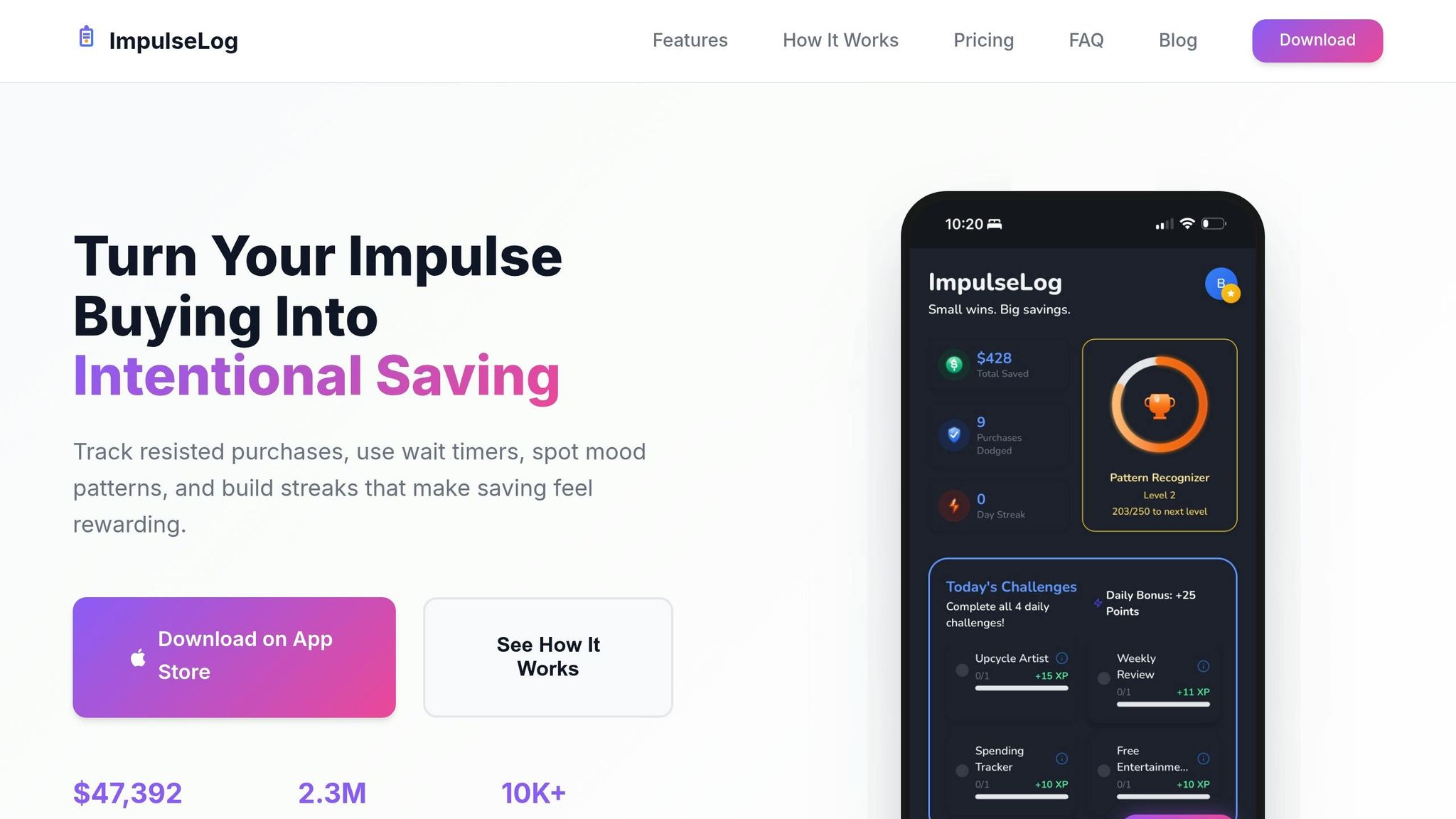
ImpulseLog takes the idea of feedback loops and transforms it into tools tailored for ADHD brains. By focusing on immediate feedback, the app helps users counteract impulse spending in real time. It doesn’t just track spending - it rewards users instantly for resisting those purchases. As developer Bradley Scott Munn explains:
"ImpulseLog helps in the moment you actually need it: when you're about to buy something." [8]
The app's features work together to make resisting impulsive buys feel natural and rewarding.
Quick Impulse Logging with Instant Savings Updates
ImpulseLog’s "Quick Add" feature allows users to log a resisted purchase in just seconds. When you log one, the app’s "Victory Modal" immediately updates your Total Saved counter, giving you a visual reward that feels like a dopamine boost - without spending a dime. One user, MSM80, shared their experience:
"From an impulsive spender this app has made me less impulsive. Seeing 5K$ I didn't spend last month because this app made it more impulsive to save." [8]
In addition to this, the app includes Wait Timers that enforce a 48-hour rule for purchases over $20. These timers create a pause between the initial urge and the action, preventing about 70% of ADHD-related impulse buys [3].
This quick-logging system feeds into a broader visual tracking system that highlights progress over time.
Visual Progress Tracking and Achievement Unlocks
ImpulseLog keeps users engaged with its 10-level XP trophy system. Each time you resist an impulse and log it, the XP ring fills with vibrant animations, making the experience feel rewarding [8].
The app also includes "Piggy Banks" to track up to 8 custom savings goals. These goals are paired with unique icons - like a shield for "Purchases Dodged" or a lightning bolt for "Day Streak" - that light up and update instantly. This visual representation makes future savings feel more concrete [8][4].
Daily Challenges and Gamified Rewards
The app’s 20-second "Daily Ritual" is a quick activity that combines a mood check with a review of pending decisions. It’s designed to build consistency without overloading your attention span [9]. Completing the ritual or logging a resisted impulse triggers celebratory confetti and haptic feedback, reinforcing positive habits.
ImpulseLog also offers daily challenges in four categories, with built-in timers for tasks like "Impulse Delay" (10 minutes) or "Pause Before Purchase" (5 minutes). To encourage consistency, the "Streak Shield" protects progress on days when you complete activities but forget to log specific data [8].
AI-Powered Insights and Personalized Feedback
In February 2026, ImpulseLog introduced the gpt-5-mini AI engine with version 2.014 [8][9]. This upgrade allows the app to analyze user mood and spending patterns. For $4.99 per month, premium users get daily personalized insights that link how mood affects shopping to spending habits [6][8].
The AI also provides "Support Cards", which offer ADHD-friendly financial advice based on recent behavior. Weekly summaries highlight patterns, such as "late-night scrolling" or "stress-shopping", helping users recognize and address triggers before they derail their budget. By treating spending impulses as data rather than personal failings, the app helps users avoid the shame often tied to ADHD-related spending [8][2].
With these features, ImpulseLog creates a system that encourages better financial habits while making the process feel rewarding and achievable.
How ImpulseLog's Features Drive Better Spending Habits
ImpulseLog turns impulsive spending into a satisfying habit of saving. Its features work together to make skipping a purchase feel more rewarding than giving in. Here's a look at how these tools create lasting changes in behavior.
Real-Time Progress Updates for Instant Gratification
Each time you resist a purchase and log it in ImpulseLog, the app's Victory Modal instantly updates your Total Saved counter with engaging visuals. This quick feedback provides a small dopamine boost, offering your brain a reward without spending money [3]. By turning the act of not spending into a visible accomplishment, the app builds momentum. Features like streak tracking and Piggy Bank goals further reinforce this sense of progress with real-time updates [6][8]. These immediate rewards set the stage for a stronger achievement system.
Achievement Systems That Encourage Consistency
ImpulseLog's achievement system bridges immediate rewards with long-term habit formation. Its 10-level progression system, complete with sleek metallic gradients and 3D glass effects, makes leveling up feel like a premium experience [8]. Features like "streaks with grace" and Streak Shields ensure that missing a day doesn't derail your progress - an approach designed to promote consistency over perfection, particularly helpful for users with ADHD [8][10]. The system offers dopamine-friendly rewards like XP, levels, and trophies, replacing the chemical satisfaction typically triggered by impulse purchases [5][6].
AI Insights for Smarter Spending Habits
ImpulseLog Premium leverages the gpt-5-mini AI engine (upgraded in February 2026) to analyze your mood, sub-mood, and spending patterns. This AI identifies links between emotional states and spending urges, offering personalized insights through Daily Support Cards and weekly summaries [8][10]. By treating impulses as data instead of flaws, the AI helps uncover root causes behind spending habits without judgment. Over time, it shifts impulsive tendencies into intentional decision-making by highlighting recurring triggers, often referred to as the "ADHD Tax" [3][8].
The results speak volumes: adults with ADHD using AI-driven tools and an ADHD budget planner like ImpulseLog have saved an average of $3,840 over six months, compared to $2,420 saved by non-ADHD users - showing how tailored tools can address higher baseline impulsivity [2].
Results: What ImpulseLog Users Achieve with Feedback Loops
User Data and Success Examples
ImpulseLog users have seen impressive outcomes, with data showing how feedback loops can lead to both significant savings and improved financial habits.
Take October 2025, for example: MSM80, a self-described impulsive spender, managed to save $5,000 in just one month by tracking and resisting spending urges[8]. MSM80 shared that seeing those savings accumulate gave them a new perspective, shifting their mindset from spending to saving.
Another example comes from March 2026, when Seaward, an app user and developer, ran a 30-day trial. By logging 31 spending urges instead of acting on them, they saved £119 (around $150). The data revealed some interesting patterns - 17 of those urges were tied to mid-afternoon cravings for takeout, while late-night urges stemmed from boredom. Once these triggers were identified, they became easier to manage[11].
"Patterns are way easier to interrupt than cravings. I didn't stop wanting these things. I just got better at catching myself in that gap between the urge and the tap of the card."
- Seaward, App Developer and User[11]
Research also shows that ADHD users benefit significantly from AI-driven tools like ImpulseLog. Over six months, they can block an average of $3,840 in impulsive purchases, compared to $2,420 saved by non-ADHD users. This highlights how the app helps bridge the impulsivity gap[2].
These examples emphasize how real-time feedback and actionable insights create a practical and engaging saving experience.
How Gamification Makes Saving Enjoyable
ImpulseLog takes the often-dull task of saving and turns it into something fun and rewarding. Instead of the fleeting dopamine rush of spending, the app offers users instant rewards like XP points, level-ups, and celebratory visuals. This gamified approach makes resisting impulses feel like a win[6][3].
The app focuses on positive reinforcement. Each logged impulse becomes a small victory, with progress tracked in real time. Features like the Streak Shield ensure that missing a day doesn’t erase previous efforts, which is especially helpful for ADHD users who may struggle with all-or-nothing thinking[8][10].
Users often share that watching their "Total Saved" counter grow is more rewarding than any single purchase. This shift in perspective is reflected in the app’s 5.0/5-star rating on the iOS App Store, showing how financial discipline can feel less like a chore and more like an achievement[8].
Conclusion: Why Feedback Loops Work for ADHD Spending Control
Feedback loops are effective for managing impulsive spending in ADHD because they shift the dopamine reward from buying to saving. Traditional budgeting methods often fall short for people with ADHD since they rely heavily on willpower and delayed gratification - two areas where ADHD brains typically struggle. Apps like ImpulseLog tackle this challenge by offering immediate and automatic tools that step in precisely when an impulse arises [2][3].
The magic lies in making future savings feel immediate and real. Features like visual progress charts, instant "Total Saved" updates, and gamified elements - such as earning XP or unlocking achievements - transform resisting an impulse into a rewarding experience. This is vital because adults with ADHD are statistically more likely to face higher debt and unplanned spending [2][3].
"ADHD brains need external structure to compensate for internal executive function deficits. Effective structure is immediate, automatic, and engaging."
- Dr. Russell Barkley, ADHD Expert [2]
By providing tangible, immediate rewards, feedback loops bridge the gap between impulsive behavior and financial control. Every avoided impulse becomes a visible step toward financial progress, creating a system that feels encouraging rather than restrictive.
ImpulseLog takes this concept further by turning impulses into actionable insights. The app allows you to log what you didn’t buy using an impulse spending calculator and uses AI to identify spending triggers - whether it’s late-night boredom or mid-afternoon stress. This approach empowers you to understand your habits without judgment. The free version of ImpulseLog includes essential features like impulse tracking, goal setting, and streaks, while the Premium plan ($8.99/month) adds advanced tools like AI-driven mood insights and predictive analytics.
If traditional budgeting apps haven’t worked for you, ImpulseLog offers a solution tailored to how neurodivergent minds function, making saving as dopamine-friendly as spending.
FAQs
What’s a feedback loop in budgeting?
A feedback loop in budgeting offers real-time insights into spending patterns, progress, and rewards. This system is especially helpful for individuals managing ADHD, as it supports developing better impulse control and encourages positive financial habits. Tools with gamified elements - like progress tracking and rewards - make the process more engaging, helping users stay motivated and gradually improve their spending behaviors.
How do wait timers stop impulse buys?
Wait timers are a simple yet effective tool to curb impulse buying. By introducing a deliberate pause - like a 24-hour delay - they create space for individuals to reconsider their purchases. This pause helps reduce the chances of acting on impulsive urges. For individuals with ADHD, this structured approach can be particularly helpful, encouraging more mindful and thoughtful spending habits.
Will logging urges actually change my habits?
Logging urges can play a powerful role in reshaping your habits by making you more aware of your spending patterns and the triggers behind them. This heightened awareness is a crucial first step toward changing behavior. Tools like ImpulseLog simplify the process by allowing you to quickly log impulses, identify triggers, and monitor your progress through visual data. Over time, this consistent tracking creates a feedback loop that helps you adjust your reactions to impulses, encouraging better self-control and more deliberate spending choices.