
Why ADHD Goals Need Realistic Timelines
Setting goals with ADHD requires more than motivation - it demands understanding how ADHD impacts time perception and task management. Unrealistic deadlines can lead to procrastination, rushed work, and burnout. Here's why realistic timelines matter and how to create them:
- Time Blindness: ADHD brains struggle with sensing time, making tasks feel either urgent or too far off. This can delay starting or cause last-minute stress.
- Working Memory Issues: Planning and organizing steps are harder, especially for multi-step tasks, leading to frequent distractions.
- ADHD Paralysis: Overwhelming timelines can freeze progress, creating a cycle of stress and avoidance.
- Longer Habit Formation: ADHD brains need 106–154 days (vs. 66 for others) to form habits, requiring patience and consistency.
Solutions for Success:
- Break Goals into Small Steps: Focus on tasks under 2 minutes to reduce overwhelm.
- Use Backward Planning: Start at the deadline and work backward, adding buffer time.
- Incorporate Rewards: Immediate rewards boost motivation, making progress feel engaging.
- Set Short-Term Goals: Stick to 90-day timelines to make objectives feel more tangible.
- Visual Tools: Timers and visible reminders help track progress and make time more concrete.
Realistic timelines align with ADHD needs, making goals achievable and reducing stress. By understanding how ADHD affects time and using tailored strategies, you can transform goals into actionable steps.
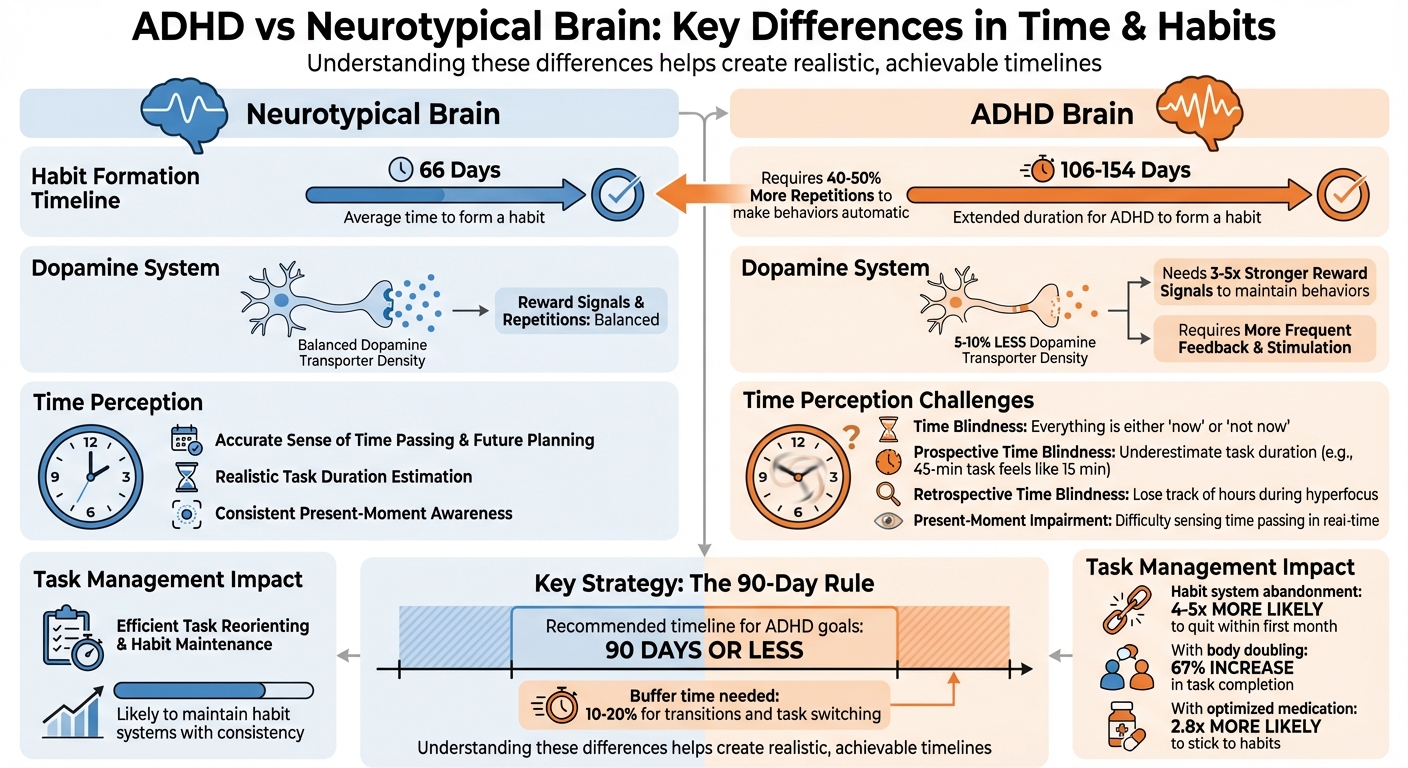
ADHD vs Neurotypical Brain: Time Perception and Habit Formation Differences
ADHD and Deadlines: 5 Tips That Actually Work! | Ep. 337
sbb-itb-1fa9254
How ADHD Affects Time Perception
For individuals with ADHD, time isn't just hard to manage - it feels fundamentally different. Experts suggest that ADHD brains often operate with an "unreliable internal clock", making it difficult to gauge the passage of time consistently. This neurological difference impacts everything from setting goals to planning tasks [5][12].
Dr. Geeta Grover offers an analogy to explain this:
"Imagine your brain is like an orchestra. This prefrontal part of your brain is the conductor of the orchestra... In ADHD brains... differences in their prefrontal cortex can hinder time management skills." [3]
ADHD disrupts time perception in several ways. Prospective time blindness leads to underestimating how long future tasks will take - for instance, assuming a 45-minute task will only take 15 minutes. Retrospective time blindness causes individuals to lose track of hours, especially during periods of hyperfocus. Meanwhile, present-moment impairment makes sensing the passage of time in real-time a struggle [5].
These challenges stem from differences in the basal ganglia and dopamine pathways, which are critical for regulating time perception. Stimulant medications can help normalize this process [11][13]. Psychologist Ari Tuckman describes the impact of time blindness vividly:
"Time blindness warps the internal ruler you use to measure duration." [1]
Time Blindness and Goal Setting
Time blindness creates a unique way of experiencing time in the ADHD brain: everything is either "now" or "not now" [5][12]. This binary perspective explains why distant deadlines often fail to spark motivation - the future can feel too abstract or disconnected to prompt action.
Research supports this idea. For example, children with ADHD perform worse on time-based prospective memory tasks compared to their peers, even when IQ is accounted for [11][3]. Similarly, adults with ADHD often change jobs more frequently, a pattern linked to ongoing struggles with managing time effectively.
While time blindness skews perceptions of deadlines, working memory deficits further complicate the ability to plan and execute tasks.
Working Memory Deficits and Task Planning
Planning realistic timelines becomes even more challenging when working memory - the brain's "mental workspace" - is less reliable. Working memory is where goals are stored and the steps to achieve them are organized. In ADHD, this workspace tends to be smaller and more fragmented, making it harder to maintain focus and follow through on plans [12][3].
This issue is often described as a "cascade effect." For example, while focusing on one task, a distraction might pull attention away, causing the original goal to slip out of focus—a common issue when mood affects your shopping or other task-oriented behaviors. Reorienting after such interruptions can take 15–20 minutes, draining mental energy and slowing overall progress [9].
The problem becomes even more pronounced with complex, multi-step projects. As the number of steps increases, so does the risk of "losing the plan", making it difficult to complete tasks efficiently. Frequent distractions and the need to constantly refocus create a cycle that hinders long-term productivity.
What Happens When ADHD Goals Have Unrealistic Timelines
When timelines don't align with reality, the ADHD brain can do more than just stumble - it can completely freeze. This phenomenon, often referred to as "ADHD paralysis," occurs when overwhelming stress causes the brain to shut down, making action feel impossible [9][6]. Dr. Andrew Le describes this experience vividly:
"Deadlines can feel like a mountain when you have ADHD. You want to start. You plan to finish. But somehow, time slips away, and the pressure builds until it's too late." [6]
The issue isn't limited to simply missing deadlines. Unrealistic expectations can spark "emotional avoidance," where tasks become so tied to feelings of fear and shame that the brain retreats entirely. This avoidance reinforces a cycle of stress and inaction, feeding back into the same "ADHD paralysis" that started it [6]. Research sheds light on how these patterns develop and the toll they take.
Research on Failure Rates and Burnout
The data paints a stark picture. In a study of 132 adults, researchers found that individuals with higher ADHD symptoms were more likely to procrastinate, which directly affected their physical health, psychological well-being, and relationships [15]. Even more telling: procrastination completely explained the link between ADHD symptoms and these negative outcomes [16].
For students, the stakes are particularly high. Those with significant executive function challenges - common in ADHD - report much higher levels of academic procrastination [6]. This constant state of falling behind doesn’t just hurt productivity; it also leads to anxiety, emotional exhaustion, and a higher risk of long-term burnout [9][2]. Instead of serving as helpful milestones, deadlines become "looming threats" that push individuals into a relentless cycle of crisis management [2].
These findings highlight how overly ambitious timelines can trap people in a harmful loop of delay, stress, and declining motivation.
The Procrastination Cycle
Unrealistic deadlines set off an "urgency cycle," where the ADHD brain, with lower sensitivity to dopamine, relies on bursts of stress to get started [14]. Far-off deadlines feel abstract until they become immediate, triggering a frantic, last-minute scramble [5].
This leads to a predictable chain of events: tasks are delayed due to overwhelm, followed by a panicked rush to complete them, resulting in lower-quality work. This cycle reinforces feelings of failure and shame, making it even harder to approach future tasks [6][2]. Dr. William Dodson explains the core struggle:
"ADHD is not a disorder of knowing what to do. It's a disorder of doing what you know, at the right time." [14]
Repeated failures to meet unrealistic deadlines erode self-confidence, often causing individuals to abandon goals altogether as a form of self-protection [14]. The emotional impact is profound - constant self-blame, guilt, and diminished self-worth, with these challenges frequently misunderstood as personal failings rather than neurological realities [6][2].
How to Set Realistic Timelines with ADHD
Breaking free from the cycle of feeling overwhelmed and missing deadlines requires an approach designed specifically for ADHD brains. Traditional goal-setting methods often assume neurotypical executive function, which is why they tend to fall short for people with ADHD [20]. The key isn't about working harder - it’s about adjusting the approach to fit how ADHD minds operate.
ADHD often impacts how time is perceived, making short-term goals more manageable. Dr. Russell Barkley describes this as "near-sightedness to time", where long-term goals can feel abstract and out of reach. On the other hand, short-term goals - like those set for 90 days - are easier to grasp and act on [10][19]. The strategies outlined here aim to close the gap between unrealistic expectations and ADHD-friendly planning.
One effective method is backward design planning. Instead of starting from today and counting forward, begin at the deadline and work backward. Build in a 10–20% buffer for transitions, preparation, and task switching [8][18]. For example, if a report is due Friday at 5:00 PM, schedule a review session earlier in the day to allow for last-minute adjustments.
Breaking tasks into tiny, manageable steps - each lasting under two minutes - can also help overcome the mental block of starting. For instance, instead of tackling "Write Report", begin with "Open Document." This approach reduces the 15–20 minutes often lost to reorienting yourself [9][20].
Modifying SMART Goals for ADHD
Standard goal-setting frameworks, like SMART (Specific, Measurable, Achievable, Relevant, Time-bound), can be adapted to better suit ADHD challenges. For example, keep goals time-bound to 90 days or less to make them feel more immediate and actionable [17]. Break "Specific" goals into smaller micro-tasks to avoid feeling overwhelmed [20]. Using a "70% Rule" can help you focus on making progress rather than achieving perfection, which keeps momentum going [6].
You can also tweak the "Relevant" component to mean "Resonant" or "Thrilling", focusing on goals that spark excitement or emotional engagement - something ADHD brains thrive on [21]. Tools like visual timers, such as the Time Timer, make time more tangible by showing it as a shrinking red disc [5]. Setting brief alarms every 20–25 minutes can also act as gentle nudges to stay on track. Keeping goals visible - whether on whiteboards, sticky notes, or index cards - helps ensure they remain top of mind. Additionally, simple "if-then" plans (e.g., "If I finish breakfast, then I'll log my spending") can improve follow-through [20].
Adding Dopamine-Friendly Rewards to Timelines
Because the ADHD brain thrives on immediate rewards rather than delayed gratification, incorporating dopamine-boosting strategies into your timelines can make tasks more engaging. As Dr. Megan Anna Neff explains:
"Initiating a task without the support of dopamine is like trying to start a car in the middle of winter and go from 0 to 100 at the getaway." [23]
Long-term goals often fail because they rely on delayed gratification, which doesn't provide the immediate dopamine boost needed to maintain motivation [22][24]. Instead, try using a tiered "Reward Ladder." Offer small rewards (like a snack or a quick break) after completing micro-tasks, medium rewards (like watching a favorite show) after hitting milestones, and a larger reward for completing the entire goal [20].
The PINCH framework - Passion, Interest, Novelty, Competition (or Challenge), and Hurry (Urgency) - can help you design tasks and rewards that naturally stimulate dopamine production [23]. Gamifying tasks by adding playful or competitive elements can also make them more enjoyable and help sustain focus [23][24]. Tools like ImpulseLog are great for ADHD-friendly goal-setting, featuring gamified achievements, visual progress tracking, daily challenges, and unlockable rewards. Since internal motivation can be unpredictable for ADHD brains, frequent external rewards are essential to keep goals grounded in the present, where they feel most achievable [5].
Building Habits and Achieving Long-Term Goals with ADHD
Creating realistic timelines is key to transforming short-term efforts into lasting habits, especially for those with ADHD. The challenge often lies in bridging the gap between starting a new behavior and making it automatic. This is where many ADHD-related goals tend to falter. By setting achievable timelines, the path to success becomes clearer and more manageable.
How Long It Takes to Form Habits
The idea that habits take 21 days to form is a myth - particularly for individuals with ADHD. Research shows that while neurotypical people may develop habits in around 66 days, those with ADHD typically need 106 to 154 days. For more complex habits, this timeline can stretch to 20–40 weeks[25][26]. These extended timelines underline the importance of setting realistic expectations to avoid frustration and burnout.
ADHD brains require 40–50% more repetitions to transition a behavior from conscious effort to automatic memory. This explains the "Forgetting Phase" (days 22–45), where the initial excitement fades, but the habit hasn’t yet solidified[27][28]. It’s during this phase that many people with ADHD abandon their efforts, as they’re 4–5 times more likely to give up on productivity systems within the first month[27]. Understanding and planning for these longer timelines can break this cycle of early enthusiasm followed by discouragement.
While realistic timelines are crucial, aligning habits with ADHD dopamine patterns is what ultimately sustains long-term behavior change.
Matching Goals with ADHD Dopamine Patterns
ADHD brains operate differently when it comes to motivation and reward. They have 5–10% less dopamine transporter density in areas responsible for these functions[25]. As Dr. William Dodson puts it:
"People with ADHD don't lack motivation - they lack the neurochemical infrastructure that makes consistent action possible for neurotypical brains." [25]
This means that individuals with ADHD often need 3–5 times stronger reward signals to maintain behaviors over time. Fluctuations in dopamine levels can make a goal feel achievable one day and overwhelming the next.
External supports can significantly improve habit formation. For example, adults on optimized ADHD medication are 2.8 times more likely to stick to habits compared to those relying solely on behavioral strategies[25][28]. Even without medication, techniques like body doubling - working alongside another person - can increase task completion rates by 67%[25][28].
Incorporating micro-rewards into daily routines also helps maintain motivation by boosting dopamine levels. ADHD brains naturally prioritize tasks based on interest, challenge, novelty, and urgency. Designing goals that align with these priorities increases the likelihood of long-term success.
Flexible tracking systems are another game-changer. Instead of rigid streak-based systems, tracking progress through completion rates (e.g., "I completed this task 5 out of 7 days") is three times more effective for maintaining habits over six months[27]. This approach acknowledges that consistency doesn’t have to mean perfection - and that’s perfectly okay for ADHD brains.
Conclusion: Realistic Timelines Lead to ADHD Goal Success
Creating realistic timelines isn’t about lowering your standards - it’s about working with your brain’s natural way of processing time. ADHD brains experience time differently because of dopamine regulation issues and differences in the prefrontal cortex. By using tools like the 1.5x rule, visual timers, and backward planning, you can build an external framework to counter time blindness effectively [3][5].
Studies suggest that practicing these methods consistently for 90 to 180 days can reshape how you approach time, helping to reduce missed deadlines and the exhaustion that comes from unrealistic expectations [4][7]. Accounting for transition costs - those 15–20 minutes your brain needs to switch between tasks [9] - and breaking goals into small, manageable steps with built-in buffers can make success more achievable and sustainable.
Whether you’re using an ADHD budget planner, tackling personal projects, or handling everyday responsibilities, realistic timelines help you avoid the chaos of last-minute, crisis-driven action [5]. This proactive approach replaces the stress of rushing with a steady, planned path toward your goals.
Dr. Geeta Grover’s advice sums it up perfectly:
"The first thing that I want all my patients to understand is: Be compassionate with yourself and understand that this is not willful, but part of their brain-based differences" [3]
Realistic timelines aren’t a sign of weakness - they’re a practical way to turn intentions into actions. By respecting your brain’s pace, you can bridge the gap between planning and doing, paving the way for consistent progress and meaningful achievements.
FAQs
How do I estimate task time with ADHD more accurately?
To better estimate task time when managing ADHD, it's important to acknowledge that your sense of time might not always align with reality, often causing you to underestimate how long things will take. To counter this, consider these strategies:
- Add buffer time: Build in extra time for tasks to avoid feeling rushed.
- Break tasks into smaller steps: Tackling projects in manageable chunks can make them feel less overwhelming and easier to track.
- Use external reminders: Tools like timers, alarms, or visual progress trackers can help you stay on schedule.
The goal is to set realistic expectations with flexible timeframes, leaving room for unexpected delays. These methods can make time management feel more achievable and reduce the stress of falling behind.
What should I do when I freeze and can’t start a task?
Freezing up often happens due to executive dysfunction or feeling overwhelmed, which is common with ADHD. Here are some practical ways to get moving again:
- Break tasks into tiny steps: Shrink the job into bite-sized actions that feel doable.
- Use timers or visual reminders: These can help you stay on track and add some structure to your time.
- Take one small action: Even something as simple as opening a document can help you build momentum.
- Be kind to yourself: This isn’t about laziness - it’s a neurological response, so give yourself some grace.
- Focus on calming your emotions: Reducing emotional tension can make it easier to think clearly and move forward.
How can I stay motivated when rewards are far away?
Staying motivated can be challenging for individuals with ADHD because the brain tends to seek immediate rewards. One strategy is to break big goals into smaller, manageable steps with short-term milestones. This creates a sense of progress and accomplishment. Celebrating these small wins can help increase dopamine levels, which plays a key role in maintaining motivation.
Using tools like gamified apps can also be helpful. These apps provide instant rewards, track visual progress, and highlight achievements, making it easier to stick to tasks while working toward bigger objectives.