
ADHD and Money: Breaking Psychological Barriers
Managing money with ADHD can feel overwhelming, but it’s not about laziness or irresponsibility - it’s about how ADHD affects your brain. Challenges like impulsive spending, avoiding financial tasks, and struggling to plan for the future are common. These issues often lead to late fees, missed payments, and higher debt, sometimes called the "ADHD Tax."
Here’s the good news: you can create systems that work with your brain instead of against it. For example:
- Automate your finances: Set up automatic bill payments and savings transfers to reduce reliance on memory or willpower.
- Use gamified tools: Apps like ImpulseLog turn financial tasks into engaging activities, offering small rewards for progress.
- Shift your mindset: Replace self-blame with problem-solving by recognizing that financial struggles stem from brain wiring, not personal failure.
- Simplify routines: Pair financial tasks with daily habits, like checking your bank balance during your morning coffee.
These strategies help you reduce stress, avoid shame, and build habits that align with how your brain works. Start small - automate one bill or track one impulse purchase using ADHD spending tricks - and celebrate each step forward.
Smart Money Habits for People with ADHD (with Otto Rivera, CFP, EA)
Rivera emphasizes that building these habits starts with learning how to track spending with ADHD to identify where impulse leaks occur.
sbb-itb-1fa9254
Psychological Barriers That Affect ADHD Money Management
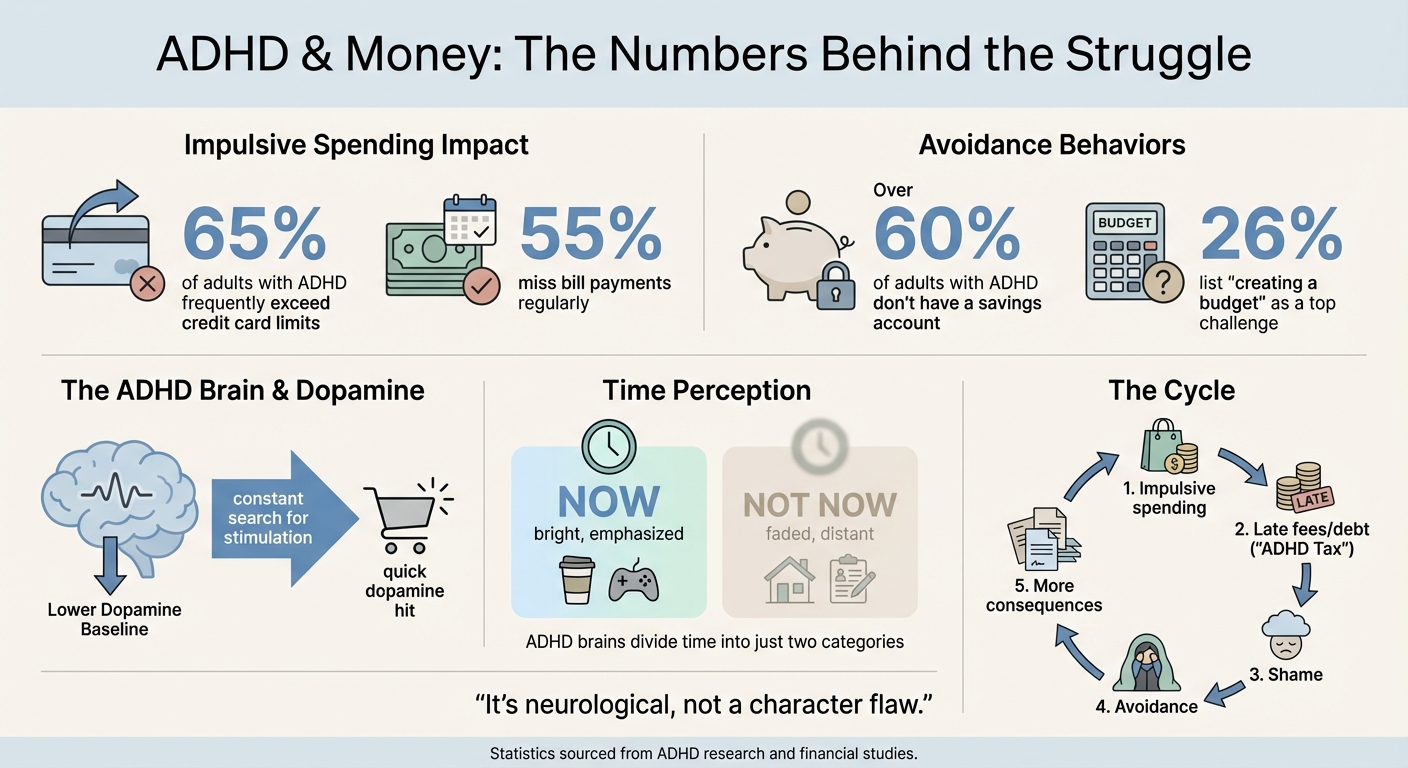
ADHD Financial Challenges Statistics and Impact Data
Managing money with ADHD can feel like an uphill battle, and it’s not because of laziness or irresponsibility. The real challenge lies in the neurological differences that create invisible obstacles. Let’s explore three major barriers that often trip people up.
Dopamine Seeking and Impulse Purchases
For those with ADHD, the brain operates with lower baseline dopamine levels and less efficient dopamine receptors. This constant search for stimulation can lead to impulsive spending. As ADHD Coach Caren Magill explains:
"Impulsive spending has almost nothing to do with understanding math or money. Instead, it is a direct symptom of a brain that is starving for stimulation." [6]
Shopping provides a quick dopamine hit - a temporary “high” that fades fast, leaving you chasing the next rush. Online shopping, with its instant gratification, can feel especially addictive, mirroring the mechanics of gambling [3].
The statistics paint a clear picture: 65% of adults with ADHD frequently exceed their credit card limits, and 55% miss bill payments regularly [6]. It’s not that you don’t know the importance of saving - it’s that your brain struggles to act on that knowledge when faced with an impulse. Clinical psychologist Dr. Russell Barkley calls this a "performance deficit", where knowing what to do doesn’t always translate into doing it [6].
ADHD Coach Roozbeh Khoshniyat highlights the neurological root of the problem:
"ADHD impulsive spending isn't a character flaw. It's neurological... Your brain doesn't produce or use dopamine the same way a neurotypical brain does." [1]
Spending often becomes a coping mechanism for stress, anxiety, or even boredom. The purchase isn’t about the product itself - it’s about soothing emotions in the moment [6][7][2]. This impulsivity not only disrupts financial stability but also feeds into the next challenge: money anxiety and avoidance.
Money Anxiety and Avoidance Behaviors
When financial tasks feel overwhelming, the ADHD brain doesn’t push through - it shuts down. This isn’t about being lazy. As Modern Era Counseling explains:
"Avoidance isn't laziness; it's a stress response. The brain sidesteps what feels threatening or overwhelming." [2]
This avoidance can lead to behaviors like avoiding bank accounts, ignoring bills, or forgetting about subscriptions. It’s a way to escape the emotional discomfort of facing financial realities [2][8]. For example, over 60% of adults with ADHD don’t have a savings account, and 26% list "creating a budget" as a top challenge [6][5].
Past financial mistakes - missed payments, overdraft fees, mounting debt - can create a sense of shame that makes addressing finances feel unbearable. One ADDitude reader summed it up:
"Admitting you have money issues can be harder than admitting you have ADHD." [5]
This shame fuels a vicious cycle. Avoidance leads to late fees or added debt (often called the "ADHD Tax"), which triggers even more shame and avoidance [6][7]. Budgeting feels emotionally charged rather than helpful, so it’s put off until the situation becomes critical [8][3]. By then, the consequences have already piled up.
As impulsivity and avoidance feed into each other, another barrier adds to the difficulty: time blindness.
Time Blindness and Difficulty Planning Ahead
Time blindness is one of the most misunderstood challenges of ADHD. Instead of seeing time as a linear progression, the ADHD brain divides it into two categories: “now” and “not now” [7][3].
For example, a credit card bill due in three weeks falls into the “not now” category, making it hard to prioritize over the immediate satisfaction of a purchase today. Harold Robert Meyer of The A.D.D. Resource Center explains:
"The credit card bill arriving next month exists in a hazy 'later' that doesn't compete with immediate gratification. By the time 'later' becomes 'now,' the damage is done." [7]
This is known as temporal discounting, where future rewards are undervalued compared to immediate gratification [3]. Saving $200 for retirement feels abstract and unimportant compared to spending $50 on something enjoyable today. The future self who has to deal with the consequences feels distant - almost like a stranger [1][7].
Adding to the challenge is a prospective memory deficit, which makes it hard to remember future tasks like paying bills or transferring money to savings [3]. ADHD Coach Roozbeh Khoshniyat explains:
"Time blindness means you can't really feel the future consequences of buying something right now. Your ADHD brain genuinely can't connect 'I buy this today' with 'I won't have rent money in two weeks.'" [1]
This isn’t about lacking willpower. Dr. Russell Barkley emphasizes the importance of external tools:
"ADHD involves 'time blindness' (focusing only on now and ignoring the future), you need physical, visual tools to stop impulse buying. You cannot rely on your internal willpower alone." [6]
Unfortunately, when “later” becomes “now,” the financial fallout often triggers shame and Rejection Sensitive Dysphoria (RSD) - a heightened emotional reaction to perceived failure [2][3]. This emotional spiral pushes you back into avoidance, perpetuating the cycle.
How to Overcome ADHD Financial Barriers
Understanding the financial challenges that come with ADHD is the first step toward overcoming them. The key isn’t more willpower - it’s creating systems that align with how your brain works. Here’s how to start building those systems.
Change Your Money Beliefs
Before tackling your finances, it’s essential to rethink how you view money. If you’ve been telling yourself things like, “I’m terrible with money” or “I’ll never figure this out,” it’s time to shift that narrative. Traditional financial advice often doesn’t fit the ADHD brain, so reframing your mindset is crucial. Neurodiversity Consultant and ADHD Coach Dana Dzamic emphasizes this:
"Structure without shame is sustainable. Shame without structure is paralysis." [4]
Financial struggles aren’t a reflection of your character - they stem from differences in how your brain handles attention, impulse control, and time management [4][1]. Therapist Valerie Moran adds:
"Financial literacy is a skill, not a personality trait." [8]
Instead of thinking, “I’m bad with money,” try saying, “My brain needs systems tailored to how I think.” This approach shifts the focus from blame to problem-solving [9][2]. By using external tools like automation and visual aids, you can escape the cycle of shame and start building effective habits [4][2].
One helpful tactic is the "Work Hour" Rule: calculate how many hours of work it would take to afford something using an impulse spending calculator [5]. For instance, a $60 impulse buy feels different when you realize it costs four hours of work. Another method is snapping a photo of an item you want or adding it to a digital wishlist instead of purchasing it right away - this gives your brain a dopamine boost without the actual spending [5][1].
Use Gamification to Track Spending
ADHD brains thrive on stimulation and immediate rewards. Gamification can make financial tasks more engaging, turning them into a game rather than a chore [1][10]. Garrett Johnson explains:
"Seeing your progress in engaging visuals can make budgeting feel less like a chore and more like a game." [10]
Apps like ImpulseLog are designed with neurodivergent minds in mind. They transform impulse tracking into an interactive experience with visual progress charts, daily challenges, and unlockable achievements. Each time you log an impulse instead of acting on it, you earn points and build streaks, giving your brain the dopamine hit it craves without spending money. The app also offers AI-powered mood insights to help identify spending triggers, like stress or boredom [10].
For example, you could set up a "No-Spend Challenge" where you avoid non-essential purchases for a specific time and track your progress in the app [5][10]. One ADDitude reader shared:
"I like to create no-shopping challenges for myself to help gamify avoiding impulse purchases... If I find things I would have otherwise bought on impulse, I'll save them to a wish list for later." [5]
Turning the act of resisting a purchase into a small victory keeps you motivated. Johnson adds:
"Small steps will turn a mountain into a series of small, climbable hills, with dopamine hits at the peak of each that keep you motivated and focused." [10]
ImpulseLog’s free plan includes features like impulse tracking, basic achievements, and savings goals. For more advanced tools like AI mood insights and predictive analytics, you can upgrade to the Premium plan for $8.99/month [10].
Automate Your Finances
While gamification helps with self-control, automation simplifies routine tasks so you don’t have to rely on willpower. Automation can handle up to 90% of repetitive financial tasks, such as paying bills or saving money, which are often stumbling blocks for ADHD brains [11]. As Divergent Money explains:
"Automation is not just a time-saver - it's a lifeline." [12]
A great starting point is the "Three Buckets" system: set up three separate accounts for Bills (fixed expenses like rent), Savings (future goals), and Spending (daily use) [11]. When your paycheck arrives, it’s automatically divided among these accounts, ensuring your money is allocated before you can spend it impulsively. Consider leaving the Bills account without a debit card to avoid accidental spending [11].
Align automatic payments with your payday. For example, schedule bills to be paid the day after your paycheck arrives to ensure funds are available and deadlines aren’t missed [11][12]. For savings, use an account at a different bank to create “strategic friction.” The delay in transferring money back can reduce impulsive withdrawals by up to 50% [11].
Don’t overlook subscription services. Apps like Rocket Money or Truebill can help identify recurring charges you may have forgotten about - what’s often referred to as the “ADHD tax” [11]. Finally, create a "Payday Reset Ritual": spend five minutes each payday verifying that your automations worked, then reward yourself with something small, like a favorite coffee or a quick episode of a show you enjoy [11]. This positive reinforcement makes financial tasks more pleasant and sustainable [10].
Pair these tasks with existing habits - a technique called habit stacking. For example, review your budget while having your morning coffee or check your account balances every Wednesday evening [8].
Building Lasting Financial Habits with ADHD
Setting up financial systems is one thing - keeping them running is a whole different challenge. To create habits that stick, especially with ADHD, focus on short cycles, visual rewards, and a no-shame attitude toward setbacks.
Link Money Tasks to Existing Routines
One way to make financial habits easier is by connecting them to routines you already have. This technique, known as habit stacking, involves pairing financial tasks with activities you’re already doing [14][8]. For instance, you could:
- Check your bank balance while your coffee brews on the 1st and 15th of each month.
- Review last week’s spending during Sunday meal prep.
- Look over upcoming bills during your midweek lunch break [14].
Financial coach Kimbree Redburn captures the essence of this approach:
"ADHD brains are wired for stimulation, not spreadsheets." [14]
Instead of tackling a daunting monthly budget, try a quick 15-minute reset each week. Pick a day to sit down and check balances, review transactions, reflect on what went well (or didn’t), and note any upcoming bills [13][14]. This shorter cycle gives you the immediate feedback your brain thrives on. Once you’ve tied these tasks to your daily routine, the next step is keeping track of your progress.
Track Progress Without Shame
Slip-ups with money aren’t moral failings - they’re just data points. If you overspend or miss a bill, it’s tempting to avoid your accounts altogether, but that only makes things worse [2]. Instead, view every financial action as neutral information that can guide better choices [13][4].
Using real-time visual tools can help keep you motivated. ADHD brains often struggle with rewards that feel distant, but tracking progress in real time can trigger the dopamine needed to stay engaged [14][2]. Whether it’s a savings thermometer, a color-coded chart, or a whiteboard, making your progress visible can be a game-changer. Apps like ImpulseLog even gamify the process - log an impulse you resisted, earn points, and unlock achievements along the way.
When setbacks happen, reframe your thinking. Instead of saying, "I’m terrible with money", try something like, "I had too much on my plate this week", or "I need extra support in this area" [4]. ADHD coach Dana Dzamic emphasizes this balance:
"Structure without shame is sustainable. Shame without structure is paralysis." [4]
Celebrate the small victories, too. Whether it’s sticking to your plan for a week or saving an extra $50, these wins matter. Modern Era Counseling reminds us:
"Consistency doesn't mean rigidity. Progress can be flexible, adaptive, and even creative." [2]
Your financial system should have your back, even on tough days - not just when you’re feeling motivated. By tying financial tasks to your routines and tracking your progress without judgment, you can counter the impulsivity and avoidance that often come with ADHD. With automation for routine tasks and tools like visual tracking and habit stacking, you can build habits that truly work for your brain.
Conclusion: Take Control of Your ADHD Finances
Managing finances with ADHD isn’t about fixing a flaw - it’s about understanding and working with how your brain operates. Challenges like dopamine-driven impulses, money-related anxiety, and time blindness aren’t personal failures. They’re simply part of how your brain functions, and they call for structure, not self-criticism.
The key lies in creating systems that reduce reliance on willpower. Automate your bills, set up “speed bumps” to slow impulsive spending, and use visual aids or gamified tools to make progress more tangible. Tie financial tasks to existing routines, and focus on tracking small victories without dwelling on occasional setbacks. These strategies don’t just address the challenges - they align with your brain’s natural tendencies.
Start with one small step this week. For instance, set up automatic transfers or try a tool like ImpulseLog to help pause before impulse purchases. ImpulseLog’s gamified achievements and tracking system provide the instant rewards your brain craves while encouraging healthier spending habits. Even logging a single resisted impulse is a step forward.
As Dana Dzamic wisely said, “A system paired with empathy fuels sustainable progress” [4]. Your financial system should be there to support you on the tough days, not just when you’re feeling motivated. Celebrate every small win, whether it’s saving $50 or simply checking your account balance without avoiding it.
With these strategies, you’re not starting from scratch - you’re building a framework that suits how your brain works. The challenges are real, but so are the solutions tailored just for you.
FAQs
What is the “ADHD tax”?
The "ADHD tax" describes the often-overlooked financial and emotional toll faced by individuals with ADHD. This concept stems from challenges like impulsivity, disorganization, and difficulty with time management. Common examples include spending on impulse purchases, incurring late fees, missing payments, or frequently replacing misplaced items. It underscores the added strain that managing everyday finances can impose on those living with ADHD.
How can I stop impulse spending in the moment?
To keep impulse spending in check, begin by pinpointing what sets it off - whether it's emotional slumps, certain settings, or even specific situations. Before making a purchase, take a moment to ask yourself: Do I genuinely need this, or am I just chasing a quick mood boost?
Apps like ImpulseLog can be a game-changer. They help track spending habits, provide insights into how your mood affects decisions, and even offer rewards for practicing self-discipline. For those who are neurodivergent, adopting strategies that address specific challenges can make it easier to manage spending urges in the moment. Building this kind of awareness is key to regaining control.
What’s the easiest way to automate my bills and savings?
The simplest way to manage bills and savings - especially for those with ADHD - is to use direct deposit and automatic transfers. With direct deposit, your paycheck goes straight into your account, cutting down the risk of missed payments. Pair this with scheduled transfers to a savings account, and you’ve got a hassle-free way to save regularly. These tools work together to create a low-stress system that helps curb impulsivity and builds healthy financial habits.